Facts
The deceased petitioner, Mahendra Sah, was appointed in 1980 and was serving as a Senior Accounts Clerk in the Road Construction Department, Magadh Road Circle, Gaya. A criminal case was instituted against him in connection with alleged irregular withdrawals, and he was taken into custody and suspended with effect from 13 July 1997. He was acquitted by the criminal court on 15 May 2002, and the State’s appeal was dismissed by the High Court on 16 January 2004.
Source reference: pp. 4–5A departmental proceeding initiated against him on 9 September 2000 culminated in an order dated 30 June 2006 passed by the Superintending Engineer, directing recovery of ₹4,49,724 from his salary and post-retiral dues. The petitioner superannuated on 30 April 2010. Subsequently, by order dated 25 August 2012, the authorities directed recovery of the outstanding amount with interest. Approximately ₹5,00,000 was ultimately recovered from his salary and retiral benefits.
Source reference: pp. 5–8The petitioner challenged the recovery and sought payment of several service and retiral benefits, including subsistence allowance, arrears of salary, transfer and travelling allowances, ACP benefits, salary for certain periods, refund of the recovered amount, and interest.
Source reference: pp. 2–4During the pendency of the writ petition, he died and his legal heirs were substituted.
Source reference: no citationThe petitioner contended that the enquiry officer had not conclusively found the charges proved; rather, the officer had recommended verification of the disputed signatures by a handwriting expert. It was also contended that no second show-cause notice was issued before the disciplinary authority imposed punishment.
Source reference: pp. 6–9Issues
Whether the disciplinary authority’s order dated 30 June 2006 directing recovery from the deceased petitioner was sustainable when it treated the enquiry officer’s report as a finding of guilt, although the report had recommended handwriting-expert verification before any final decision?
Source reference: pp. 11–12Whether the absence of a second show-cause notice before imposition of punishment vitiated the disciplinary proceedings?
Source reference: p. 11Whether the legal heirs were entitled to refund of the amount recovered pursuant to the invalid punishment order?
Source reference: pp. 12–13Whether the legal heirs were entitled to the other claimed service, salary, allowance, ACP and retiral benefits?
Source reference: pp. 12–13Law Applied
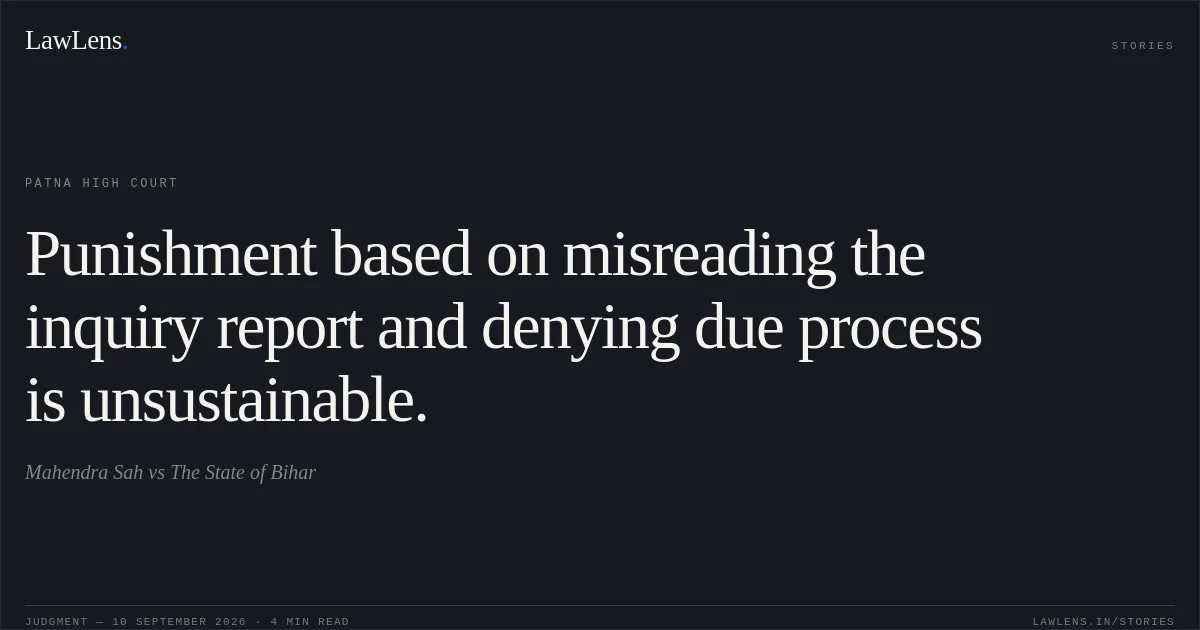
The Court applied the principles of procedural fairness in disciplinary proceedings, including the requirement that the disciplinary authority must correctly consider and deal with the enquiry officer’s report before imposing punishment.
Source reference: pp. 11–12A disciplinary authority cannot record a finding contrary to the actual contents of the enquiry report or treat a recommendation for further verification as a conclusive finding of guilt.
Source reference: pp. 11–12The Court also noted the importance of furnishing a second show-cause opportunity before imposing punishment, particularly where the disciplinary authority proposes to proceed against the employee on the basis of an adverse finding.
Source reference: p. 11No specific statutory provision or judicial precedent was cited in the judgment; the decision was based on the record of the enquiry, the disciplinary order, and principles of natural justice and fair disciplinary procedure.
Source reference: no citationReasoning
The Court compared the enquiry officer’s report with the disciplinary authority’s order. It found that the enquiry officer had recommended obtaining a handwriting-expert opinion regarding the signatures on the relevant bills and records before taking any final action against the petitioner and another employee.
Source reference: pp. 11–12The disciplinary authority, however, incorrectly recorded that the enquiry officer had found the charges proved and proceeded directly to impose recovery of ₹4,49,724.
Source reference: pp. 11–12This demonstrated non-application of mind and a material misreading of the enquiry report. The Court further noted that no second show-cause notice appeared to have been issued before punishment was imposed.
Source reference: p. 11Since the punishment order was procedurally and substantively defective, the consequential recovery could not be sustained. The Court therefore treated the recovery of ₹5,00,000 as unauthorised and directed its refund.
Source reference: pp. 12–13For the remaining claims, the Court relied on the State’s admissions or the absence of a valid reason for non-payment and issued directions for consideration or payment.
Source reference: pp. 12–13Holding
The writ petition was allowed.
The Court quashed the punishment order dated 30 June 2006 contained in Memo No. 688, holding that the disciplinary authority had misconstrued the enquiry officer’s report and had proceeded without proper procedural compliance.
Source reference: p. 12The legal heirs were directed to be refunded the entire amount of ₹5,00,000 recovered from the deceased petitioner’s salary and retiral dues.
Source reference: p. 12The authorities were also directed to pay transfer travelling allowance of ₹6,980; consider the travelling-allowance claim of ₹8,369 upon submission of the original bill; decide and grant ACP benefits from the date of entitlement with consequential benefits; and pay the amounts due for the periods claimed under prayers 1(g) and 1(h).
Source reference: pp. 12–13The claim for 15% interest was rejected. All directed benefits were to be granted within four months from receipt or production of the judgment.
Source reference: pp. 13–14Original Court PDF
Mahendra SahvsThe State of Bihar
Click to open original judgment
Original judgment, available to read, download and summarize on LawLens.in