Facts
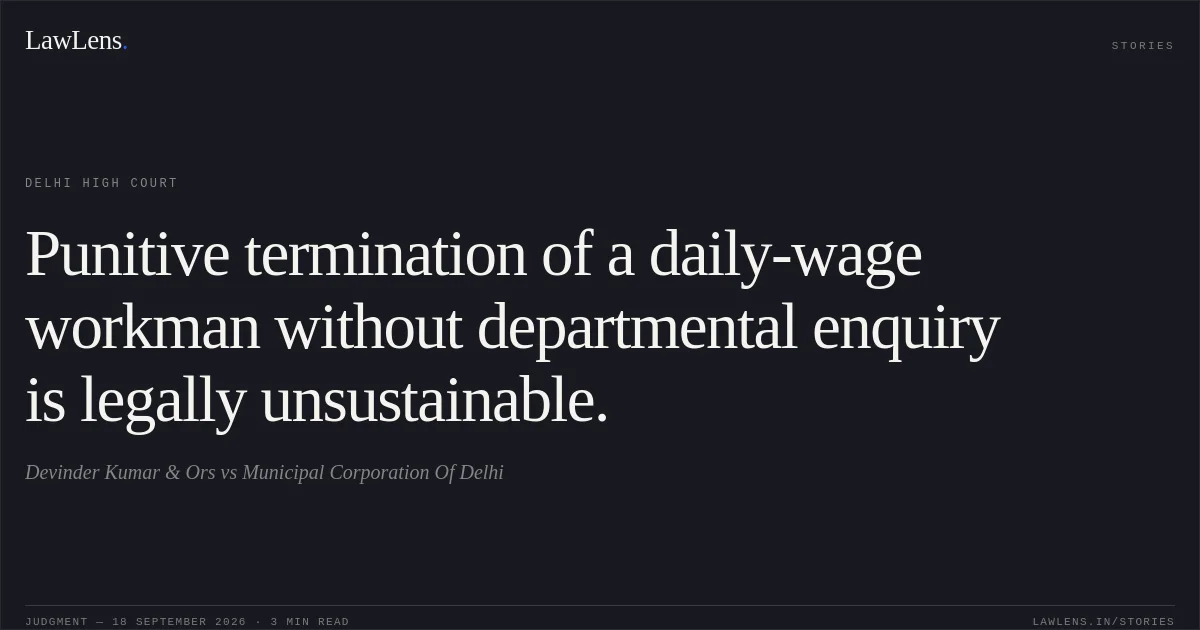
The petitioners were engaged by the Municipal Corporation of Delhi as daily-wage Beldars from 20 December 2000.
Source reference: p.1–2, paras. 1–2While deployed in the Sainik Farm area to monitor the movement of building material, they were served show-cause notices alleging that demolished properties had been reconstructed during their deployment. Although the petitioners denied involvement, their services were terminated on 25 October 2007 without a formal charge-sheet, departmental enquiry, or effective opportunity to defend themselves.
Source reference: p.1–2, paras. 1–2The Industrial Tribunal dismissed their claim, holding that the termination was disciplinary rather than retrenchment under Section 2(oo) of the Industrial Disputes Act, 1947, and that daily-wage workers were not entitled to a domestic enquiry.
Source reference: p.2, para. 3The petitioners challenged that award before the High Court.
Source reference: p.2, para. 3Issues
Whether termination of the petitioners’ services as a punitive or disciplinary measure, based on alleged misconduct, was legally sustainable in the absence of a departmental enquiry and an adequate opportunity of defence?
Source reference: p.2–3, paras. 4–6Whether the petitioners’ status as daily-wage workers excluded the application of principles of natural justice and the requirement of a departmental enquiry?
Source reference: p.2–3, paras. 3–6Whether the petitioners were entitled to reinstatement and back wages, or to any other appropriate relief, upon the finding that their termination was illegal?
Source reference: p.5, paras. 11–13Law Applied
The Court considered Section 2(oo) and Sections 25F, 25G and 25H of the Industrial Disputes Act, 1947, observing that a termination imposed as punishment for misconduct is not to be treated merely as retrenchment.
Source reference: p.2, para. 3It applied the settled principle that where termination is punitive or stigmatic, a regular departmental enquiry and reasonable opportunity to defend are ordinarily mandatory, irrespective of whether the employee is a daily wager or holds temporary status.
Source reference: p.2–3, paras. 5–6Relying on Municipal Corporation of Delhi v. Praveen Kumar Jain, (1998) 9 SCC 468, the Court held that a termination by way of penalty cannot stand without a departmental enquiry.
Source reference: p.2–3, para. 5The Court also considered Engineering Laghu Udyog Employees Union v. The Judge, Labour Court and Industrial Tribunal, 2003 (6) SCR 253, which recognises limited circumstances in which misconduct may be proved before the Labour Court, but does not dispense with the ordinary requirement of an enquiry where the employer relies on misconduct as the foundation of termination.
Source reference: p.3–4, paras. 7–8Finally, the Court applied the principle that reinstatement and back wages do not automatically follow from a finding of illegal termination.
Source reference: p.5, para. 11Reasoning
The Court held that the termination was founded on allegations of dereliction of duty and alleged involvement in unauthorised reconstruction, making it punitive and stigmatic.
Source reference: p.2–3, paras. 4–6The petitioners had merely been served show-cause notices; no charge-sheet was issued, no domestic enquiry was conducted, and they were not given an opportunity to lead evidence or properly defend themselves.
Source reference: p.2–3, paras. 4–6Their status as daily wagers did not remove the requirement of natural justice.
Source reference: p.2–3, paras. 5–6The respondent also failed to lead evidence before the Tribunal to independently establish misconduct, and the Tribunal’s reliance only on the petitioners’ deployment at entry points and the occurrence of reconstruction was insufficient.
Source reference: p.3–4, paras. 7–8The Court further found no direct or live link between the petitioners’ presence and the alleged unauthorised construction, nor any evidence of active involvement or connivance.
Source reference: p.4, para. 9Although the termination was therefore illegal, the Court declined to order reinstatement or back wages because the allegations related to events nearly two decades old, the termination had occurred in 2007, and prolonging the litigation would serve no useful purpose.
Source reference: p.5, paras. 11–13Holding
The High Court set aside the Industrial Tribunal’s finding that the petitioners’ termination was legal and justified.
It held that a punitive or stigmatic termination of daily-wage employees cannot be sustained without a proper departmental enquiry and an opportunity of defence.
Source reference: p.5, para. 10Instead of reinstatement or back wages, the Court awarded lump-sum compensation of ₹3,00,000 to each petitioner, directing the Municipal Corporation of Delhi to make payment within eight weeks.
Source reference: p.5, paras. 13–14The writ petition and pending applications were disposed of accordingly.
Source reference: p.5, paras. 13–14Acts & Sections Cited
4 provisions across 1 statute referred to in this judgment. Linked provisions open on LawLens.
Industrial Disputes Act, 19474
Original Court PDF
Devinder Kumar & OrsvsMunicipal Corporation Of Delhi
Click to open original judgment
Original judgment, available to read, download and summarize on LawLens.in