Facts
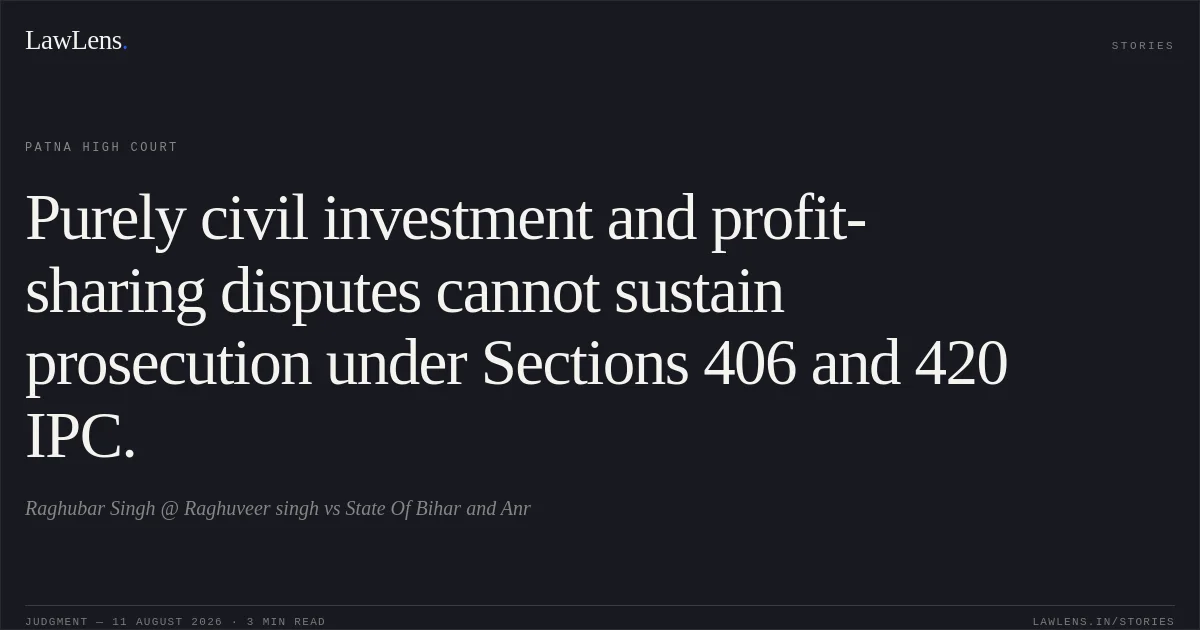
The petitioner sought quashing of the criminal proceedings in Complaint Case No. 2816(C)/2015, Trial No. 527/2015, including the order dated 7 November 2015 by which cognizance was taken under Sections 406 and 420 of the Indian Penal Code (“IPC”).
Source reference: p.1The complainant alleged that the petitioner had obtained a Public Works Central Department contract worth ₹52,76,314 for construction of residential buildings for the Director of the ICAR Research Complex.
Source reference: p.2The petitioner allegedly invited the complainant to invest in the project as a partner in return for a 50% share of the profits.
Source reference: p.2Pursuant to an agreement dated 4 June 2003 and a power of attorney, the complainant allegedly invested ₹13,16,000 and undertook construction-related activities on the petitioner’s behalf.
Source reference: p.2After completion of the project and settlement of accounts, the complainant claimed that ₹20,39,377, comprising his investment and share of profits, remained payable.
Source reference: p.2Although the petitioner allegedly promised on 15 June 2013 to repay the amount within three years, repayment was not made, resulting in the complaint.
Source reference: p.2The petitioner contended that the dispute was purely civil and concerned recovery or division of money, with no ingredients of criminal breach of trust or cheating.
Source reference: p.3Issues
Whether the allegations in the complaint prima facie disclosed the essential ingredients of offences under Sections 406 and 420 of the IPC against the petitioner?
Source reference: pp.3–5Whether the criminal proceedings could be quashed where the dispute essentially concerned recovery of money and division of profits arising from a contractual or business arrangement?
Source reference: pp.3–5Whether the cognizance order was liable to be set aside for want of adequate material and proper application of mind by the Magistrate?
Source reference: p.4Law Applied
The Court applied Sections 406 and 420 of the IPC: Section 406 requires the foundational elements of criminal breach of trust, including entrustment and dishonest misappropriation or conversion, while Section 420 requires cheating accompanied by dishonest or fraudulent inducement and delivery of property.
Source reference: p.4The Court relied on Rikhab Birani and Another v. State of Uttar Pradesh and Another, 2025 SCC OnLine SC 823, particularly paragraphs 19 and 20, for the principle that courts must exercise caution before initiating criminal proceedings where the dispute is essentially civil; criminal procedure cannot be used as pressure for recovery of money, and vexatious or camouflaged civil claims should be rejected at the threshold.
Source reference: p.4The precedent further requires the Magistrate to apply conscious scrutiny and issue process only where the complaint and supporting material disclose the essential ingredients of an offence; a summoning or cognizance order should not be passed mechanically.
Source reference: p.4Reasoning
The Court found that the complaint primarily disclosed an investment and profit-sharing arrangement between the parties, followed by an alleged failure to repay or divide the claimed amount.
Source reference: pp.2–3These allegations, even if accepted at the prima facie stage, indicated a dispute concerning accounts, repayment, and recovery of money rather than dishonest inducement at the inception of the transaction or entrustment followed by dishonest misappropriation.
Source reference: p.5Accordingly, the essential ingredients of Sections 406 and 420 IPC were not prima facie established.
Source reference: p.5Applying the principle in Rikhab Birani, the Court held that criminal proceedings could not be permitted to operate as a pressure mechanism in what was substantially a civil dispute, particularly when the cognizance order lacked sufficient material demonstrating the ingredients of the alleged offences.
Source reference: pp.4–5Holding
The Court answered the issues in favour of the petitioner.
It held that the allegations in the complaint did not prima facie constitute offences under Sections 406 or 420 IPC and that the dispute was essentially civil in nature.
Source reference: p.5The order of cognizance dated 7 November 2015 and all consequential criminal proceedings in Complaint Case No. 2816(C)/2015, Trial No. 527/2015, pending before the ACJM, Patna, were quashed and set aside insofar as they concerned the petitioner.
Source reference: p.5The application was accordingly allowed, and the trial court records were directed to be returned, if any.
Source reference: p.5Acts & Sections Cited
2 provisions across 1 statute referred to in this judgment. Each provision opens on LawLens.
Indian Penal Code, 18602
Original Court PDF
Raghubar Singh @ Raghuveer singhvsState Of Bihar and Anr
Click to open original judgment
Original judgment, available to read, download and summarize on LawLens.in