Facts
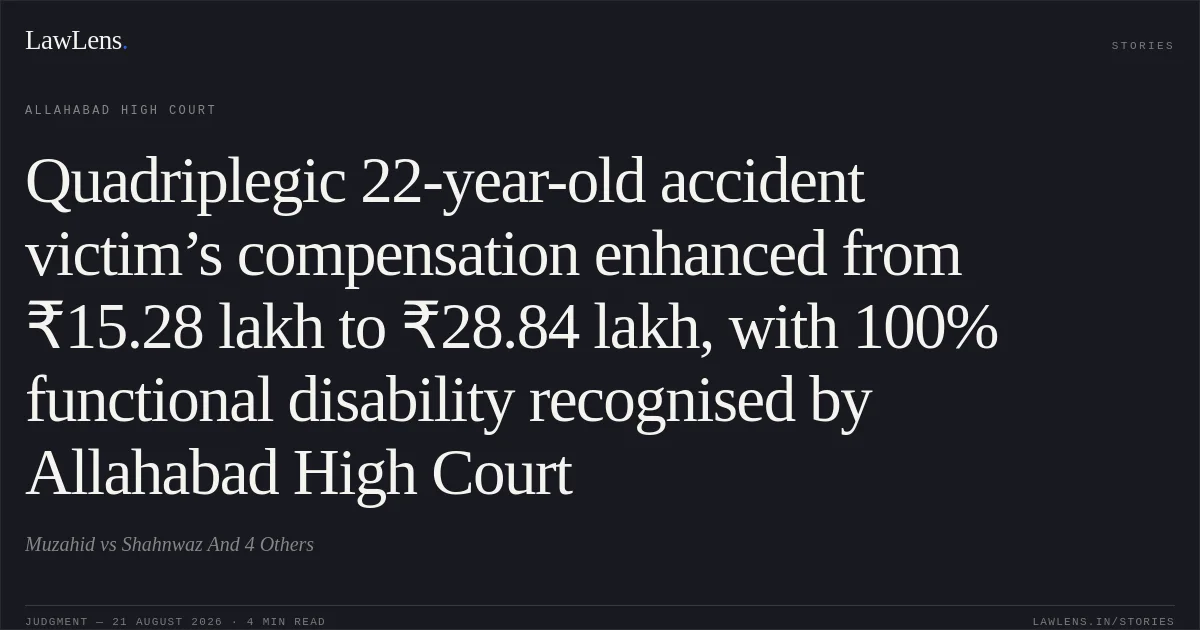
The appellant, aged approximately 22 years and employed as a conductor/cleaner, was travelling in vehicle no. UP 13 P 9762 on 2 November 2007 when it was hit by vehicle no. UP 13 J 9576 on GT Road, Muzaffarnagar.
Source reference: p. 1, paras. 3–6He sustained severe spinal injuries, including dislocation of the C4-C5 vertebrae, underwent spinal surgery with internal fixation, and thereafter suffered quadriplegia, complete immobility, urinary and faecal incontinence, and permanent dependence on others for daily activities.
Source reference: p. 1, paras. 3–6, 14He remained hospitalised for a total of 116 days across several hospitals and earned approximately Rs. 5,000 per month at the time of the accident.
Source reference: pp. 1, 4–5, paras. 5, 7, 14The Motor Accident Claims Tribunal held that the drivers of both vehicles were negligent and apportioned liability equally.
Source reference: pp. 2–3, paras. 4, 8–9It awarded Rs. 15,28,000 with 7% annual interest, fastening 50% liability on the owner of the appellant’s vehicle and 50% on the insurer of the other vehicle.
Source reference: pp. 2–3, paras. 4, 8–9The Tribunal assessed the appellant’s disability at 70%, awarded future loss of income on that basis, granted limited attendant charges, and declined past medical expenses for want of medical bills.
Source reference: p. 2, paras. 7–9Issues
Whether the appellant’s functional disability and consequent loss of earning capacity should be assessed at 100%, notwithstanding the 70% physical disability certificate relied upon by the Tribunal?
Source reference: pp. 5–8, paras. 15–21Whether the appellant was entitled to future prospects at 50% under Rule 220A of the Uttar Pradesh Motor Vehicle Rules, 1998?
Source reference: p. 10, paras. 22–23Whether the attendant charges awarded by the Tribunal were inadequate and required determination by applying the multiplier method?
Source reference: pp. 12–13, paras. 24–28Whether past medical expenses could be awarded despite the absence of supporting medical bills, on the basis of hospital records, prescriptions, and treatment evidence?
Source reference: pp. 13–14, paras. 29–30What amount of just compensation and apportionment of liability should be awarded?
Source reference: pp. 14–16, paras. 31–36Law Applied
Under Section 168 of the Motor Vehicles Act, 1988, compensation in a motor accident claim must be “just,” meaning fair, reasonable, and equitable, as explained in Helen C. Rebello v. Maharashtra SRTC, (1999) 1 SCC 90.
Source reference: p. 3, para. 12Jagdish v. Mohan, (2018) 4 SCC 571, requires compensation to provide realistic recompense for the loss of dignity, pain, and trauma caused by life-altering injuries.
Source reference: p. 3, para. 13Under Raj Kumar v. Ajay Kumar, (2011) 1 SCC 343, physical disability is not automatically equivalent to loss of earning capacity; the Tribunal must assess the impact of the disability on the claimant’s actual occupation and earning ability.
Source reference: pp. 5–8, para. 17However, where the claimant is permanently incapacitated and unable to earn any livelihood, functional disability may properly be assessed at 100%, as recognised in Parminder Singh v. New India Assurance Co. Ltd., (2019) 7 SCC 217, and Jithendran v. New India Assurance Co. Ltd., (2022) 15 SCC 620.
Source reference: pp. 8–10, paras. 18–20Rule 220A of the Uttar Pradesh Motor Vehicle Rules, 1998 permits future-prospect additions in permanent-disability cases, including 50% for an injured claimant below 40 years of age.
Source reference: p. 10, para. 22The multiplier method applies not only to loss of earnings but also to attendant charges, as held in Kajal v. Jagdish Chand, (2020) 4 SCC 413.
Source reference: pp. 11–13, para. 26Hospitalisation and treatment expenses may be awarded on a reasonable and conservative assessment even without bills where the medical records establish actual treatment and expenditure.
Source reference: pp. 13–14, paras. 29–30Reasoning
The Court held that the Tribunal had mechanically adopted the 70% physical-disability certificate without assessing the effect of the appellant’s condition on his earning capacity.
Source reference: pp. 5–10, paras. 17–21The appellant was a young conductor/cleaner, was completely bedridden, suffered quadriplegia and incontinence, and could not perform even basic daily functions without assistance.
Source reference: pp. 5–10, paras. 17–21Applying Raj Kumar, Parminder Singh, and Jithendran, the Court concluded that his loss of earning capacity was effectively 100%.
Source reference: pp. 5–10, paras. 17–21Since he was below 40 years of age, the Court added 50% future prospects under Rule 220A and calculated future loss of income as Rs. 7,500 per month × 12 × multiplier 18, totalling Rs. 16,20,000.
Source reference: p. 10, paras. 22–23Because the appellant required lifelong assistance, the Tribunal’s additional attendant award of only Rs. 1,00,000 was held inadequate.
Source reference: pp. 12–13, paras. 24–28Applying the multiplier method and adopting Rs. 4,000 per month, the Court awarded Rs. 8,64,000 for attendant charges.
Source reference: pp. 12–13, paras. 24–28The appellant’s repeated hospitalisations, surgery, prescriptions, discharge summaries, and medical reports established substantial treatment-related expenditure; accordingly, the Court conservatively awarded Rs. 2,50,000 for past medical expenses despite the absence of bills.
Source reference: pp. 13–14, paras. 29–30It retained the Tribunal’s other awards and additionally granted Rs. 1,00,000 for loss of marriage prospects, while avoiding duplication under loss of amenities because 100% loss of earning capacity had already been recognised.
Source reference: p. 14, para. 31Holding
The appeal was allowed and the Tribunal’s award was enhanced from Rs. 15,28,000 to Rs. 28,84,000.
The enhanced amount was directed to carry interest at 7% per annum from the date of filing of the claim petition until payment.
Source reference: p. 15, para. 33Liability remained apportioned equally between respondent no. 1 and respondent no. 5, each being responsible for 50% of the compensation and accrued interest.
Source reference: p. 16, para. 35The insurer was permitted to recover the amount from the vehicle owner if the owner failed to produce the vehicle documents and driving licence demanded by the insurer.
Source reference: p. 16, para. 35Payment was directed within one month, subject to adjustment of any amount already deposited or paid.
Source reference: p. 16, para. 36Acts & Sections Cited
3 provisions across 1 statute referred to in this judgment. Each provision opens on LawLens.
Motor Vehicles Act, 19883
Original Court PDF
MuzahidvsShahnwaz And 4 Others
Click to open original judgment
Original judgment, available to read, download and summarize on LawLens.in