Facts
The petitioner was the elected Sarpanch of Gram Panchayat Somni, Janpad Panchayat Rajnandgaon. Certain elected members initiated a no-confidence motion against her by application dated 11.03.2026 under Rule 3(1) of the Chhattisgarh Panchayat (Gram Panchayat Ke Sarpanch Tatha Up-Sarpanch, Janpad Panchayat Tatha Zila Panchayat Ke President Tatha Vice-President Ke Virudh Avishwas Prastava) Niyam, 1994.
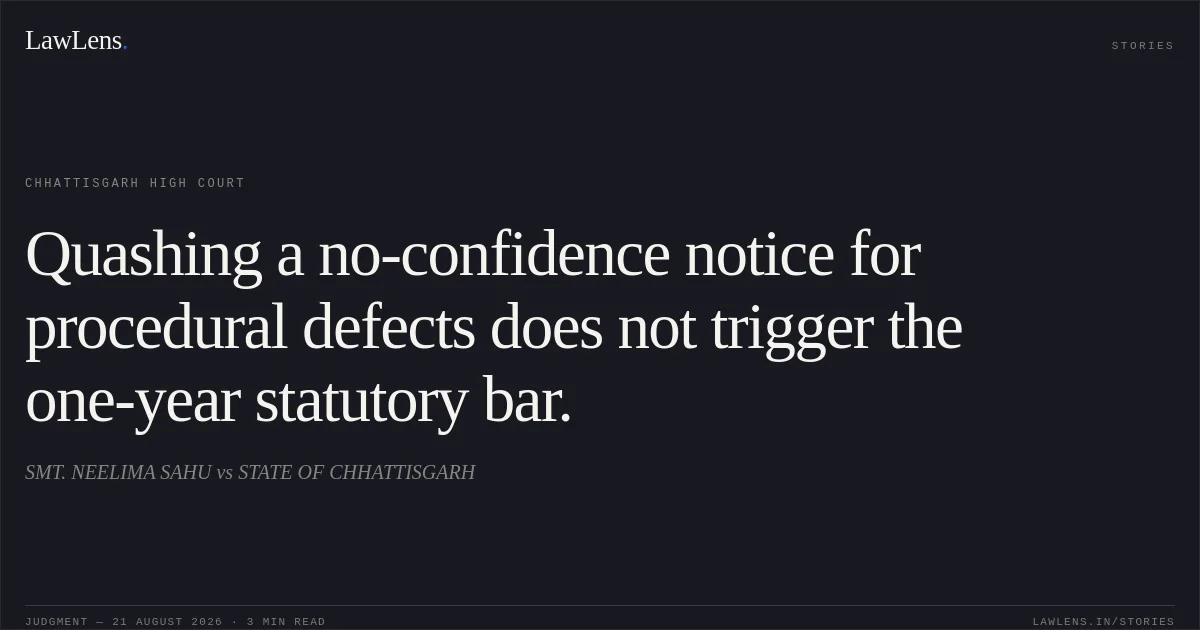
Source reference: para. 2Pursuant thereto, notice dated 18.03.2026 was issued, but the petitioner successfully challenged it in WPC No. 1308 of 2026. By order dated 25.03.2026, the High Court quashed the notice for non-compliance with the requirement of Rule 3(3), while reserving liberty to consider any future no-confidence motion initiated in accordance with law.
Source reference: para. 2A fresh proposal was thereafter submitted by one Up-Sarpanch and fifteen Panchs. The Sub-Divisional Officer sought verification from the Chief Executive Officer, Janpad Panchayat, who confirmed the signatures and proposal on 10.08.2026. The SDO then directed that the no-confidence meeting be convened on 20.08.2026.
Source reference: paras. 4, 6, 18The petitioner challenged the order dated 10.08.2026, contending that the fresh motion was barred by the one-year restriction under Section 21(3)(iii) of the Chhattisgarh Panchayat Raj Adhiniyam, 1993, and that the SDO had failed to record the requisite satisfaction under Rule 3(3) of the 1994 Rules.
Source reference: paras. 1–3Issues
Whether the fresh no-confidence motion was barred under Section 21(3)(iii) of the Chhattisgarh Panchayat Raj Adhiniyam, 1993, as being initiated within one year of the earlier proceeding?
Source reference: paras. 8–14Whether the SDO had complied with Rule 3(3) of the 1994 Rules by satisfying himself regarding the admissibility of the notice before directing that the meeting be convened?
Source reference: paras. 15–18Law Applied
Section 21(3)(iii) of the Chhattisgarh Panchayat Raj Adhiniyam, 1993 provides that a no-confidence motion shall not lie within one year from the date on which the previous no-confidence motion was rejected.
Source reference: para. 9Rule 3(1) of the 1994 Rules requires the notice to be signed by at least one-third of the total elected members, while Rule 3(3) requires the prescribed authority to satisfy himself regarding the admissibility of the notice with reference to Section 21(3), and thereafter fix the meeting within fifteen days, with seven days’ notice to members.
Source reference: para. 16The Court relied on Smt. Sunita Bai Chaudhary v. Omkar Singh, W.P. No. 22731 of 2017, and Kandhilal Patel v. State of M.P., 1999 (2) JLJ 109, for the principle that the one-year embargo applies only where the earlier motion was rejected, not where the proceedings or resolution were quashed or set aside for procedural defects.
Source reference: paras. 12–13It also relied on Smt. Janki Sahu v. State of Chhattisgarh, WPC No. 2757 of 2021, and Bhulin Dewangan v. State of M.P., 2000 (4) MPHT 69, for the principle that the prescribed authority’s satisfaction concerns the admissibility of the notice and that procedural non-compliance does not necessarily invalidate proceedings absent substantial prejudice or failure of justice.
Source reference: paras. 17–18Reasoning
The Court held that the earlier proceeding had not resulted in rejection of the no-confidence motion. The notice dated 18.03.2026 was quashed midway for violation of the seven-clear-days requirement under Rule 3(3); the motion was never considered or voted upon. Therefore, Section 21(3)(iii) was not attracted, since the statutory embargo operates only from the date on which a previous motion is rejected, and not where the proceeding is annulled for a technical or procedural defect.
Source reference: paras. 10–14On the second issue, the SDO obtained verification from the CEO, who confirmed that one Up-Sarpanch and fifteen Panchs had signed the proposal. The SDO acted upon that verification and directed the meeting to be convened within the prescribed framework. This demonstrated sufficient satisfaction regarding the admissibility of the notice under Rule 3(3); personal verification of each signature by the SDO was not a statutory requirement.
Source reference: para. 18Holding
The High Court answered both issues against the petitioner. It held that the fresh no-confidence motion was not barred by the one-year restriction under Section 21(3)(iii), because the earlier notice had been quashed for procedural non-compliance and had not been rejected on merits.
It further held that the SDO had duly satisfied himself regarding the admissibility of the fresh proposal before fixing the meeting. Accordingly, the challenge to the order dated 10.08.2026 and the proposed meeting dated 20.08.2026 was rejected, and the writ petition was dismissed as meritless.
Source reference: paras. 18–20Acts & Sections Cited
3 provisions across 1 statute referred to in this judgment. Linked provisions open on LawLens.
Chhattisgarh Panchayat Raj Adhiniyam, 19933
Original Court PDF
SMT. NEELIMA SAHUvsSTATE OF CHHATTISGARH
Click to open original judgment
Original judgment, available to read, download and summarize on LawLens.in