Facts
Opposite Party No. 2 alleged that, while constructing a pucca house, the petitioners obstructed her, abused and threatened her and her family, and threw bricks from a rooftop, causing a head injury requiring treatment at Bankura Sammilani Medical College & Hospital.
Source reference: para. 2After alleging police inaction, she filed an application under Section 156(3) of the Code of Criminal Procedure, 1973 (“CrPC”), before the Chief Judicial Magistrate, Bankura. The Magistrate directed registration of an FIR, resulting in Bankura P.S. Case No. 265 of 2023 dated 1 August 2023 under Sections 323/326/307/120B/420/506/34 of the Indian Penal Code, 1860 (“IPC”).
Source reference: paras. 3–4The complainant subsequently stated that the actual date of occurrence was 16 April 2023, rather than 4 April 2023, and supplied a corrected address of the accused.
Source reference: para. 5Following investigation, the police submitted charge-sheet No. 284 of 2023 under Sections 323/120B/420/506/34 IPC, omitting Sections 326 and 307 IPC for want of supporting material.
Source reference: para. 6The petitioners sought quashing of the resulting G.R. Case No. 1094 of 2023, alleging false implication, prior property disputes, delay, alibi, procedural irregularity in invoking Section 156(3) CrPC, and lack of application of mind by the Magistrate.
Source reference: paras. 7–9Issues
Whether the FIR, investigation, and charge-sheet disclosed a prima facie case warranting continuation of the criminal proceeding, or whether the proceeding amounted to an abuse of process requiring quashing.
Source reference: paras. 15–20Whether the alleged failure to exhaust the remedies under Sections 154(1) and 154(3) CrPC before invoking Section 156(3) CrPC vitiated the Magistrate’s direction to register the FIR.
Source reference: para. 19Whether the alleged alibi, delay in lodging the complaint, and discrepancy regarding the date of occurrence justified quashing at the revisional/inherent-jurisdiction stage.
Source reference: paras. 16–18Whether an accused petitioner was competent to affirm the affidavit supporting a criminal revision/application in view of Section 4(2) of the Oaths Act, 1969.
Source reference: paras. 21–25Law Applied
The Court applied the principle that criminal proceedings should not be quashed where the complaint, FIR, statements under Sections 161 and 164 CrPC, medical records, and charge-sheet disclose a prima facie case; disputed questions of fact and evidentiary defences cannot ordinarily be adjudicated in quashing proceedings.
Source reference: paras. 15–18Section 156(3) CrPC permits a Magistrate to direct police investigation where the allegations disclose cognizable offences, subject to the Magistrate’s application of mind.
Source reference: para. 19The Court considered Ranjit Singh Bath v. Union Territory, Chandigarh, Criminal Appeal No. 4313 of 2024, concerning the need to approach the police under Sections 154(1) and 154(3) CrPC before invoking Section 156(3), but held that the complainant’s assertion of police refusal sufficiently addressed that requirement in the present case.
Source reference: para. 19The Court further relied on Sushanta Kumar Pal v. State of West Bengal & Anr. and the Division Bench decision in Bonneswar Dutta & Ors., 1998 SCC OnLine Cal 13, to hold that Section 4(2) of the Oaths Act does not prevent an accused from affirming an affidavit for applications such as anticipatory bail, stay, transfer, or quashing, since such an affidavit is procedural and does not constitute compelled testimonial evidence.
Source reference: paras. 23–25Reasoning
The allegations, if accepted at face value, described obstruction, assault, threats, and brick-throwing causing injury, thereby disclosing cognizable offences.
Source reference: para. 15The investigation was not mechanical: the police recorded witness statements, collected medical documents, and consciously omitted Sections 326 and 307 IPC when those offences were not supported by the evidence.
Source reference: para. 15The petitioners’ alibi was a matter of defence requiring proof and assessment at trial; deciding it on untested documents would impermissibly convert the quashing proceeding into a mini-trial.
Source reference: para. 16The delay was explained by the complainant’s medical treatment and alleged police refusal to register the case, and therefore was an evidentiary matter rather than an independent ground for quashing.
Source reference: para. 17Similarly, the discrepancy in the date of occurrence had been reported to the police on the date of FIR registration, and its significance could be assessed during trial.
Source reference: para. 18The Court also found that the Magistrate had applied its mind to a complaint disclosing cognizable offences and that, in any event, the subsequent investigation and charge-sheet supplied independently gathered material supporting a prima facie case.
Source reference: paras. 19–20The objection to the accused’s affidavit was rejected because affirming an affidavit in support of a criminal revision was not equivalent to administering compelled testimony in a criminal trial.
Source reference: paras. 21–25Holding
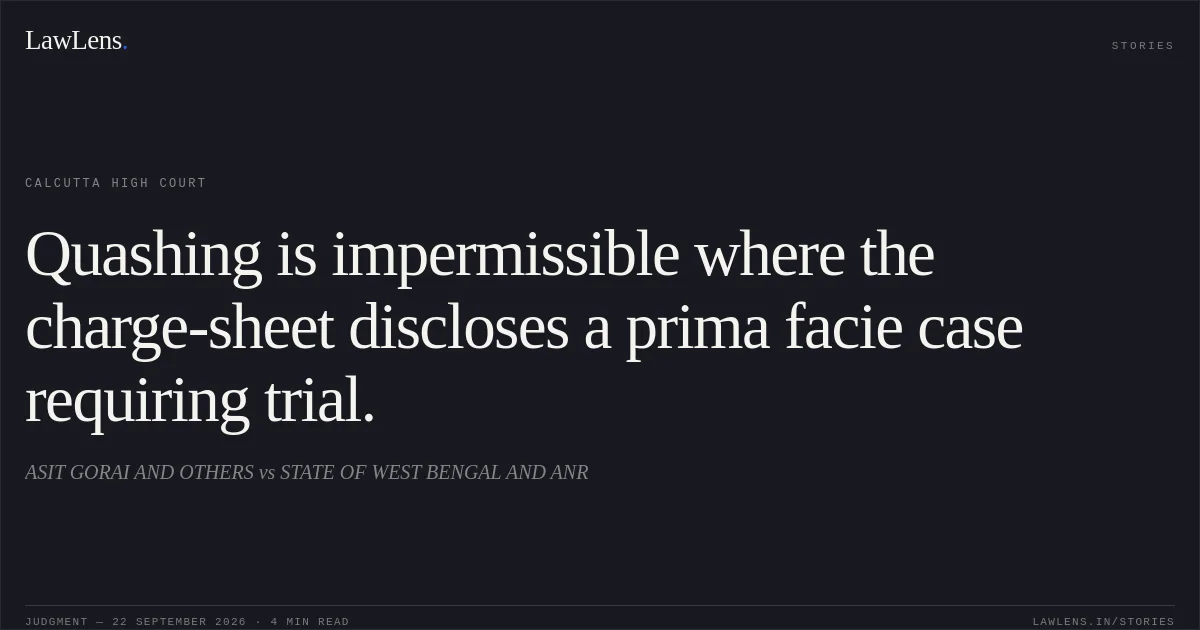
The Court held that the materials on record disclosed a prima facie case under Sections 323/120B/420/506/34 IPC and that the petitioners’ defences concerning alibi, delay, prior property disputes, and the date discrepancy could not be determined at the quashing stage.
The objection to Petitioner No. 1’s affirmation of the affidavit was also rejected.
Source reference: paras. 24–25Accordingly, C.R.R. No. 4830 of 2023 was dismissed, connected applications were disposed of, and the Trial Court was directed to proceed expeditiously and in accordance with law in G.R. Case No. 1094 of 2023.
Source reference: paras. 27–28Any interim order was vacated, and the case diary was directed to be returned to the State’s counsel.
Source reference: paras. 30–31Acts & Sections Cited
15 provisions across 3 statutes referred to in this judgment. Each provision opens on LawLens.
Indian Penal Code, 18606
Code of Criminal Procedure, 19738
Oaths Act, 19691
Original Court PDF
ASIT GORAI AND OTHERSvsSTATE OF WEST BENGAL AND ANR
Click to open original judgment
Original judgment, available to read, download and summarize on LawLens.in