Facts
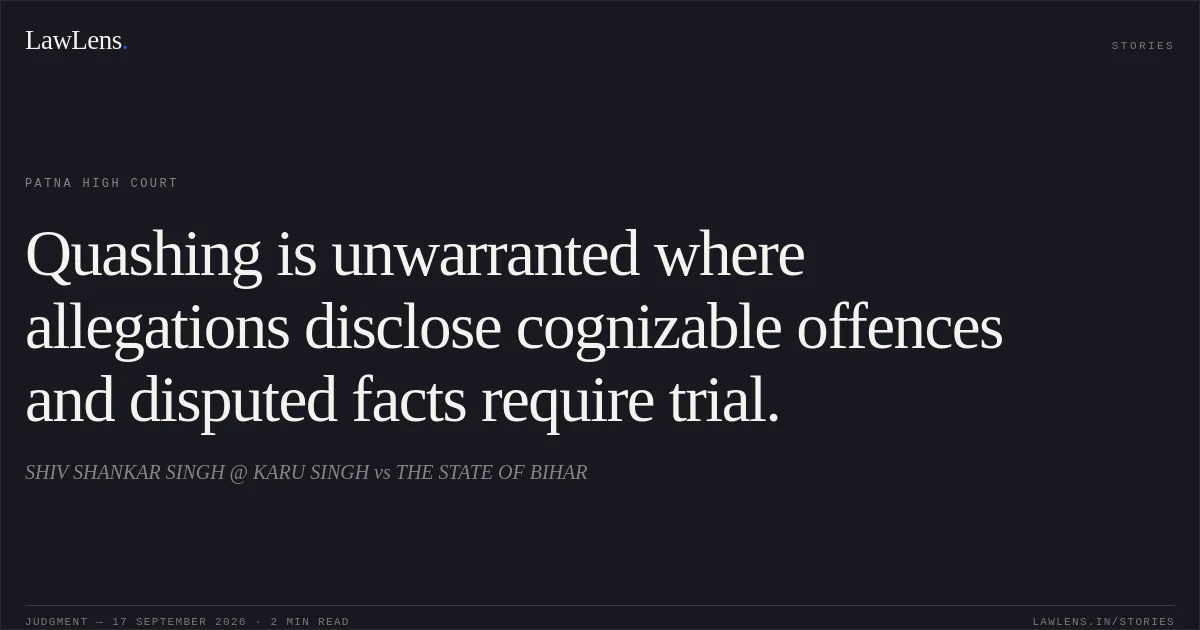
The petitioners challenged the order dated 12 July 2018 by which the Chief Judicial Magistrate, Nawada, took cognizance of offences under Sections 302, 201 and 34 of the Indian Penal Code (“IPC”).
Source reference: p.1; para. 2The prosecution alleged that Petitioner No. 1, allegedly in conspiracy with Petitioner No. 2 and other accused, had taken away the informant’s sister, Rukmini Devi, and that the accused subsequently murdered her by pressing her neck and cremated her body.
Source reference: p.1–2; para. 3On the basis of the written report, Mufassil P.S. Case No. 163 of 2016 was registered; after investigation, the police submitted a charge-sheet, leading to the impugned cognizance order.
Source reference: p.2; para. 4The petitioners contended that the deceased had died due to illness, that her last rites were performed in the presence of villagers, and that the case had been falsely instituted due to an ulterior motive arising from Petitioner No. 1’s second marriage.
Source reference: p.2–3; paras. 5–6The State opposed quashing, arguing that the FIR disclosed cognizable and heinous offences and that the petitioners’ factual defence could be tested only at trial.
Source reference: p.3; para. 7Issues
Whether the order taking cognizance under Sections 302, 201 and 34 IPC should be quashed when the FIR and materials collected during investigation disclose allegations of murder and concealment of evidence.
Source reference: p.1; paras. 2, 4Whether disputed factual questions—such as the cause of death, performance of the last rites, and the alleged motive for lodging the case—can be adjudicated in a quashing proceeding or must be determined at trial.
Source reference: p.3–4; paras. 5–8Law Applied
The Court applied Sections 302, 201 and 34 IPC, concerning murder, causing disappearance of evidence of an offence, and acts done in furtherance of common intention, respectively.
Source reference: p.1; para. 2At the stage of considering a quashing petition, the Court examines whether the allegations and available materials prima facie disclose cognizable offences; it does not undertake a detailed evaluation of disputed facts or determine the veracity of competing versions, which are matters for trial.
Source reference: p.3–4; paras. 7–8No specific judicial precedent was cited in the judgment.
Source reference: no citationReasoning
The FIR alleged that the petitioners, acting with the other accused, murdered Rukmini Devi and thereafter cremated her body, thereby prima facie attracting Sections 302, 201 and 34 IPC.
Source reference: p.1–2; para. 3Although the petitioners asserted that the deceased had died from illness and that the prosecution was motivated by personal hostility, those assertions directly disputed the prosecution’s factual case and required evidentiary assessment.
Source reference: p.2–3; paras. 5–6Since the FIR facially disclosed cognizable and serious offences, and the disputed facts could be tested through evidence during trial, the Court declined to interfere with the cognizance order.
Source reference: p.3–4; paras. 7–8Holding
The Court held that the petitioners’ contentions involved disputed questions of fact whose truth could be ascertained only at trial.
Accordingly, the quashing petition was dismissed as devoid of merit, and the order taking cognizance under Sections 302, 201 and 34 IPC was not set aside.
Source reference: p.4; para. 8The trial court record, if any, was directed to be returned along with a copy of the judgment.
Source reference: p.4; para. 9Acts & Sections Cited
3 provisions across 1 statute referred to in this judgment. Each provision opens on LawLens.
Indian Penal Code, 18603
Original Court PDF
SHIV SHANKAR SINGH @ KARU SINGHvsTHE STATE OF BIHAR
Click to open original judgment
Original judgment, available to read, download and summarize on LawLens.in