Facts
On 9 July 2015, Dhruv Narayan Prasad, husband of Opposite Party No. 2, went to a village temple with Petitioner No. 3. An alarm was subsequently raised that he had fallen into a well; his body was recovered and a post-mortem examination was conducted. The complainant later suspected that the petitioners had murdered him for property-related reasons.
Source reference: para. 3; p. 2A complaint case was instituted on 28 April 2017, and the learned ACJM XII, Bhagalpur took cognizance on 19 January 2018 of offences under Sections 302 and 120B of the Indian Penal Code against the petitioners.
Source reference: para. 2; p. 1The petitioners sought quashing of the cognizance order, relying on the earlier Unnatural Death proceeding, the post-mortem opinion indicating death by drowning, alleged delay, family and property disputes, LIC-related documents, and an alleged communication by Opposite Party No. 2 to the Superintendent of Police approximately 25 days after the death.
Source reference: paras. 4–11; pp. 2–6The State and the complainant opposed the petition, contending that the petitioners were asking the High Court to assess disputed evidence and conduct a mini-trial. They relied on the complainant’s solemn affirmation and the statements of four enquiry witnesses, which had been considered by the Magistrate before cognizance was taken.
Source reference: paras. 12–18; pp. 7–15Issues
1. Whether the cognizance order dated 19 January 2018, concerning offences under Sections 302 and 120B IPC, was liable to be quashed for want of prima-facie material or non-application of mind?
Source reference: paras. 19–20, 33–34; pp. 15–222. Whether the alleged delay in instituting the complaint, considered along with the earlier U.D. proceeding, medical material, LIC documents, and the alleged family or property dispute, demonstrated mala fides or abuse of the process of law warranting quashing?
Source reference: paras. 23–30, 39–43; pp. 17–273. Whether the High Court could, in quashing jurisdiction, determine the disputed factual question of whether the deceased died accidentally by drowning or was murdered pursuant to a criminal conspiracy?
Source reference: paras. 31–38; pp. 20–24Law Applied
The Court applied the principles governing the High Court’s extraordinary quashing jurisdiction under Section 482 of the Code of Criminal Procedure: interference is warranted sparingly where the allegations, taken at face value, disclose no offence, or where the proceeding is manifestly attended by mala fides or constitutes an abuse of process; however, the Court cannot conduct a mini-trial, assess witness credibility, or weigh competing evidence at the cognizance stage.
Source reference: paras. 19–22, 29, 38; pp. 15–24Sections 302 and 120B IPC were the substantive provisions invoked in the complaint.
Source reference: para. 2; p. 1Relying on Anita Maurya v. State of Uttar Pradesh, Kishan Singh v. Gurpal Singh, Nazibul Rahim Khan v. State of U.P., and Anukul Singh v. State of U.P., the Court recognised that unexplained and deliberate delay, particularly when forming part of a retaliatory or mala fide prosecution, may justify quashing.
Source reference: para. 9; pp. 5–6Conversely, Skoda Auto Volkswagen (India) Pvt. Ltd. v. State of Uttar Pradesh, Punit Beriwala v. State of NCT of Delhi, and State of Karnataka v. Prabhu Shankar establish that delay alone is not a ground for quashing and that disputed matters must ordinarily be examined at trial or, where appropriate, at the stage of discharge.
Source reference: paras. 14–16; pp. 7–11The Court also relied on the principles concerning the contextual assessment of delayed or procedurally suspect criminal proceedings discussed in Deo Prasad v. State of Uttar Pradesh.
Source reference: para. 17; pp. 11–13Reasoning
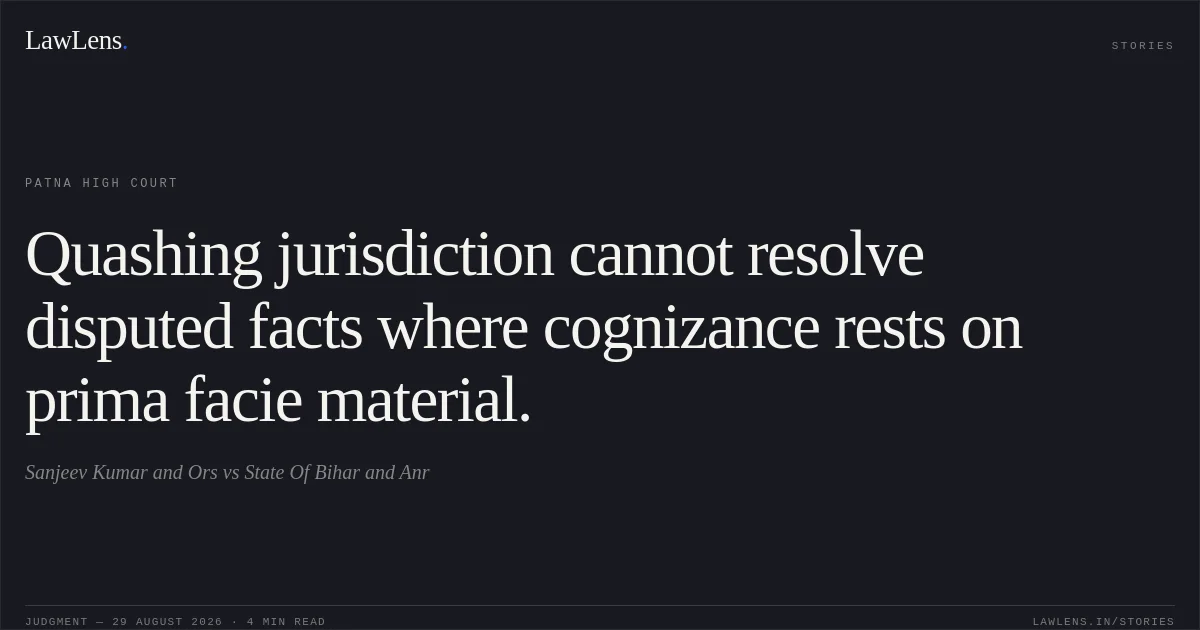
The Court held that the petitioners’ case depended upon accepting their version that the death was accidental and that the later complaint was fabricated because of a family or property dispute. Resolving that question would require comparison of the post-mortem report, the earlier U.D. proceeding, the alleged police communication, the LIC documents, the complainant’s allegations, and the enquiry witnesses’ statements—an evidentiary exercise impermissible in quashing jurisdiction.
Source reference: paras. 30–32, 35–38; pp. 20–24Although the alleged communication to the Superintendent of Police approximately 25 days after the death was relevant to the issue of delay, its authenticity and significance were disputed, while the complainant offered an explanation based on her alleged nervous shock and the purported misuse of her signature on a blank paper.
Source reference: paras. 27–29, 43; pp. 18–27The LIC documents were likewise disputed because one document was undated and the policy details allegedly did not correspond, making their evidentiary value a matter for factual adjudication.
Source reference: paras. 18, 41, 43; pp. 14–15, 25–27Since the Magistrate had considered the complainant’s solemn affirmation and the statements of four enquiry witnesses and had recorded prima-facie satisfaction regarding Sections 302 and 120B IPC, the cognizance order could not be characterised as mechanical or legally perverse.
Source reference: paras. 33–34, 46; pp. 21–28The seriousness of the offence did not alter the applicable threshold; the decisive question remained whether the proceeding was patently abusive, which the Court found it was not.
Source reference: para. 44; p. 27Holding
The Court held that the petitioners had failed to establish patent illegality, manifest mala fides, non-application of mind, or abuse of process warranting interference under the quashing jurisdiction.
The disputed issues concerning delay, the earlier U.D. proceeding, the medical opinion, the LIC documents, the family dispute, and the competing versions of the death were left open for consideration at the appropriate stage, including discharge or trial.
Source reference: para. 47; p. 28Accordingly, the petition was dismissed, the cognizance order dated 19 January 2018 was not interfered with, and the judgment was directed to be communicated to the trial court along with the trial court record, if any.
Source reference: paras. 48–50; p. 29Acts & Sections Cited
4 provisions across 3 statutes referred to in this judgment. Each provision opens on LawLens.
Indian Penal Code, 18601
Code of Criminal Procedure, 19732
Prevention of Corruption Act, 19881
Original Court PDF
Sanjeev Kumar and OrsvsState Of Bihar and Anr
Click to open original judgment
Original judgment, available to read, download and summarize on LawLens.in
![A police constable cannot be removed for unauthorized absence without a Rule 359-compliant inquiry.. Mohammad Sidiq Khan vs D/o Home Ut Of Jammu & Kashmir. CAT - ['Srinagar']. LawLens](/stories/thumbnails/a-police-constable-cannot-be-removed-for-unauthorized-absence-without-a-rule-359-compliant-7b43fc316bd94f22a62676153bbc9d54.webp)
![A Review DPC lacks authority to determine or alter inter se seniority.. SAURABH KUMAR vs REVENUE. CAT - ['Patna']. LawLens](/stories/thumbnails/a-review-dpc-lacks-authority-to-determine-or-alter-inter-se-seniority-4b21640f20af46fcabdfc8273d2ce959.webp)