Facts
The de facto complainant borrowed money (approx. Rs. 5.5—6 Lakhs) from the applicants in 2018 for his son’s travel and agricultural needs.
Source reference: p.2-3As security, the complainant executed two Agreements to Sell (Banakhat) for his ancestral lands.
Source reference: p.3-4Two years later, the complainant filed an FIR alleging that the applicants demanded exorbitant interest (up to Rs. 27.5 Lakhs), used threats of death, forcibly took onion crop proceeds, and occupied his land.
Source reference: p.4-6Meanwhile, Applicant No. 1 had filed a Civil Suit for specific performance, where a Civil Court granted an interim injunction against the complainant.
Source reference: p.8-9The applicants moved the High Court to quash the FIR/Charge-sheet, arguing the dispute was purely civil and a retaliatory measure.
Source reference: p.7Issues
1. Whether the controversy, rooted in executed Agreements to Sell and financial advances, is essentially of a civil nature, rendering criminal prosecution an abuse of process.
Source reference: p.132. Whether the ingredients of Section 384/386 (Extortion) and Section 506(2) (Criminal Intimidation) of the IPC are made out when property was delivered via voluntary contracts.
Source reference: p.13, 17-193. Whether the inordinate and unexplained delay of two years in filing the FIR vitiates the prosecution.
Source reference: p.13, 20Law Applied
The court primarily applied the criteria from State of Haryana v. Bhajan Lal, which permits quashing where allegations are absurd, inherently improbable, or maliciously instituted with an ulterior motive.
Source reference: p.11-12It relied on Paramjeet Batra v. State of Uttarakhand and G. Sagar Suri v. State of U.P., establishing that civil disputes should not be given a "criminal cloak" to exert pressure.
Source reference: p.14-15Regarding the IPC, the court interpreted Section 383/386 (Extortion), noting it requires "delivery of property" induced by fear—not just forcible taking.
Source reference: p.17-18It also applied the principle that mere words without an intention to cause alarm do not constitute "Criminal Intimidation" under Section 506(2).
Source reference: p.19Reasoning
The Court observed that the transaction began as a voluntary commercial agreement evidenced by registered Banakhats and bank cheques in 2018.
Source reference: p.14The allegations of extortion and intimidation surfaced only in 2020, coinciding with the breakdown of the contractual relationship.
Source reference: p.16, 21The Court reasoned that since the delivery of property (the agreements) was voluntary at the time of execution, the legal ingredients of "Extortion" under Section 383 were absent.
Source reference: p.18Furthermore, the existence of a parallel Civil Suit where an injunction was already operating against the complainant indicated that the FIR was a "retaliatory defense mechanism" to evade specific performance of the land contracts.
Source reference: p.16, 21The total lack of evidence regarding interest payments also undermined the charges under the Gujarat Money Lending Act.
Source reference: p.20Holding
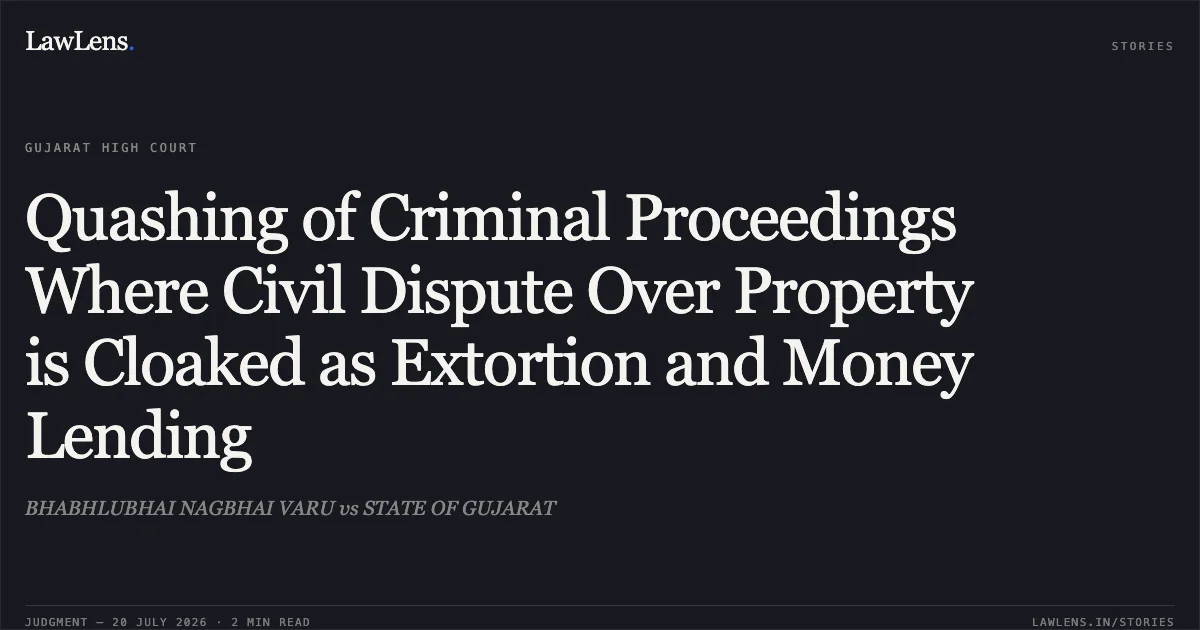
The Court held that the dispute was purely civil and the criminal machinery was used as a shortcut for a private grudge.
It concluded that continuing the prosecution would be a gross abuse of process, particularly as the matter was already sub-judice before a competent Civil Court which had protected the applicants' interests via an interim order.
Source reference: p.16, 21The High Court allowed the applications and quashed the FIR, Charge-sheet, and all consequential proceedings.
Source reference: p.22Acts & Sections Cited
10 provisions across 2 statutes referred to in this judgment. Each provision opens on LawLens.
Indian Penal Code, 18607
Code of Criminal Procedure, 19733
Original Court PDF
BHABHLUBHAI NAGBHAI VARUvsSTATE OF GUJARAT
Click to open original judgment
Original judgment, available to read, download and summarize on LawLens.in