Facts
The Petitioner No. 1 (husband) and Respondent No. 2 (wife) were married on January 23, 2025
Source reference: p. 2Following matrimonial disputes, the wife filed a complaint alleging dowry demands, physical assault, and mental cruelty, leading to the registration of FIR No. 56/2025 under Sections 85, 115(2), and 3(5) of the Bharatiya Nyaya Sanhita (BNS)
Source reference: p. 3During the pendency of the proceedings, and pursuant to a court-directed mediation on March 18, 2026, the parties reached a settlement agreement on April 16, 2026
Source reference: p. 3Under the agreement, the parties consented to a mutual divorce upon payment of ₹3,50,000 to the wife and the return of her personal effects
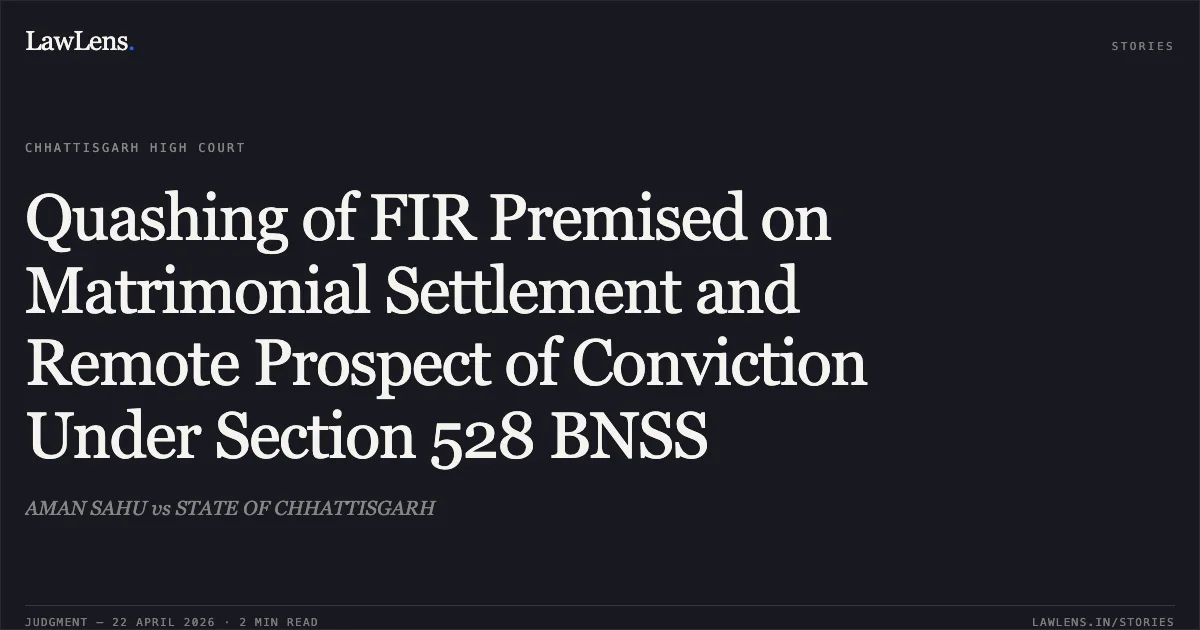
Source reference: p. 4-5Consequently, the petitioners moved the High Court to quash the FIR and subsequent proceedings based on this compromise
Source reference: p. 2Issues
1. Whether the High Court should exercise its inherent power under Section 528 of the Bharatiya Nagarik Suraksha Sanhita (BNSS) to quash criminal proceedings involving matrimonial disputes when the parties have reached a voluntary settlement
Source reference: p. 5, para. 7Law Applied
Section 528 of the Bharatiya Nagarik Suraksha Sanhita (BNSS), 2023
Source reference: p. 2Gian Singh v. State of Punjab & Anr. (2012) and Narinder Singh & Ors. v. State of Punjab & Anr. (2014), which established that the High Court has wide inherent powers to quash proceedings to secure the ends of justice, even for non-compoundable offences, particularly in matrimonial or civil-natured disputes where the possibility of conviction is remote due to settlement
Source reference: p. 5-7B.S. Joshi & Ors. v. State of Haryana (2003) regarding the quashing of matrimonial proceedings to encourage harmony
Source reference: p. 7Reasoning
The Court observed that the dispute between the parties was essentially matrimonial and private in nature, rather than a heinous crime affecting society at large
Source reference: para. 8Since the parties had entered into a comprehensive settlement agreement through mediation—which included specific terms for alimony and the return of dowry articles—the likelihood of the complainant supporting the prosecution was "minimal" and "bleak"
Source reference: para. 10-11The Court emphasized that continuing criminal proceedings despite a full settlement would amount to an abuse of the process of law and cause "extreme injustice" and "oppression" to the accused
Source reference: para. 8The Court integrated the timing of the settlement (post-charge sheet) as a valid factor for quashing under the Narinder Singh guidelines
Source reference: para. 9Holding
The Court answered the issue in the affirmative, holding that it is a fit case for quashing to secure the ends of justice
The petition was allowed, and FIR No. 56/2025, the filed charge sheet, and all consequential proceedings against the petitioners were quashed, subject to the fulfillment of the settlement terms dated April 16, 2026
Source reference: para. 12-13Acts & Sections Cited
6 provisions across 3 statutes referred to in this judgment. Each provision opens on LawLens.
Bharatiya Nagarik Suraksha Sanhita, 20231
Bharatiya Nyaya Sanhita, 20233
Code of Criminal Procedure, 19732
Original Court PDF
AMAN SAHUvsSTATE OF CHHATTISGARH
Click to open original judgment
Original judgment, available to read, download and summarize on LawLens.in