Facts
An FIR was registered in 2019 under Section 363 IPC following a report by the mother (Respondent No. 3) that her daughter (Respondent No. 2) was missing.
Source reference: para. 1, 3After recovery, the daughter stated under Section 164 Cr.P.C. that she had voluntarily accompanied and married the Petitioner, and was pregnant.
Source reference: para. 4Despite this, as she was a minor at the time of elopement, a charge-sheet was filed adding Sections 366/376 IPC and Section 6 of the POCSO Act.
Source reference: para. 1, 5During the trial, both the victim and her mother turned hostile, providing no incriminating evidence.
Source reference: para. 7, 9The parties, who have lived together for over six years and have three children, sought quashing of the FIR based on a compromise to secure their family’s peace.
Source reference: para. 2, 8, 10Issues
Whether the High Court should exercise its inherent power to quash criminal proceedings involving non-compoundable, heinous offences like Section 376 IPC and POCSO Act based on a settlement when the parties have married and established a family.
Source reference: para. 11, 12Whether the continuation of trial serves any meaningful purpose when the key witnesses have turned hostile and the chance of conviction is remote.
Source reference: para. 11, 16Law Applied
The Court primarily exercised its inherent powers under Section 528 of the Bharatiya Nagarik Suraksha Sanhita (BNSS), corresponding to Section 482 of the Cr.P.C.
Source reference: para. 11, 17It relied on *Narinder Singh & Ors. v. State of Punjab & Anr.* (2014), which allows quashing non-compoundable cases if the prospect of conviction is remote and quashing serves the ends of justice.
Source reference: para. 11It further cited *Madhukar & Anr. v. State of Maharashtra* (2025), noting that while Section 376 IPC is heinous, the Court’s power is not constrained by rigid formulas and must be exercised based on specific facts.
Source reference: para. 12References were also made to *XXX v. State of Kerala* (2026) and *Afsar Ali v. State of Uttarakhand* (2026) regarding the quashing of POCSO proceedings to maintain matrimonial harmony.
Source reference: para. 13Reasoning
The Court observed that while sexual offences are grave, the "justice delivery system cannot turn a blind eye" to the reality of the parties' current lives.
Source reference: para. 14The Court interacted with the respondents in chambers, confirming that the Petitioner and Respondent No. 2 are happily married with three children and that the mother regards the Petitioner as a son.
Source reference: para. 10Given that the prosecutrix and her mother have already testified and turned hostile, the Court reasoned that the "quest for truth" in this trial would likely result in acquittal.
Source reference: para. 15, 16The Court emphasized that "triumph of justice" in this specific context meant preventing the "inexorable apprehension and trauma" caused by pending litigation, rather than uprooting a settled family for a trial with a bleak outcome.
Source reference: para. 10, 14, 15Holding
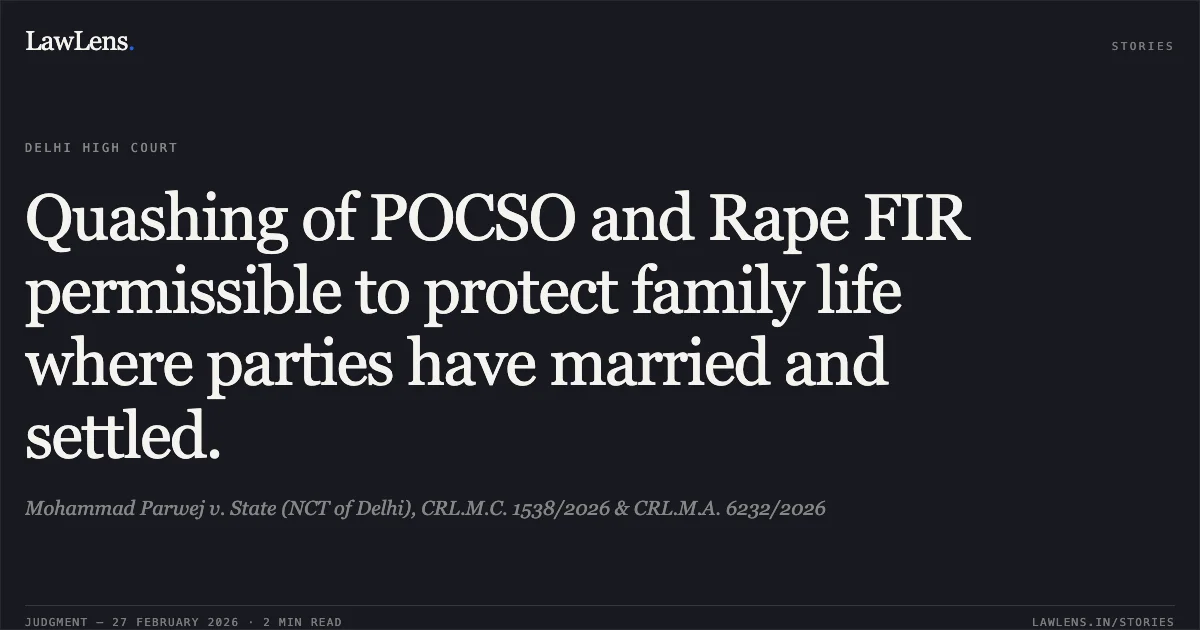
The Court answered the issues in the affirmative, holding that continuing the proceedings would be an exercise in futility and detrimental to the stable family life of the victims.
Consequently, the Court exercised its power under Section 528 BNSS to quash FIR No. 0235/2019, P.S. Karawal Nagar, and all consequential proceedings arising therefrom to "secure the ends of justice".
Source reference: para. 17, 18The petition and pending applications were disposed of accordingly.
Source reference: para. 19, 20Acts & Sections Cited
5 provisions across 3 statutes referred to in this judgment. Each provision opens on LawLens.
Indian Penal Code, 18603
Bharatiya Nagarik Suraksha Sanhita, 20231
Protection of Children from Sexual Offences Act, 20121
Original Court PDF
Mohammad Parwej v. State (NCT of Delhi), CRL.M.C. 1538/2026 & CRL.M.A. 6232/2026
Click to open original judgment
Original judgment, available to read, download and summarize on LawLens.in