Facts
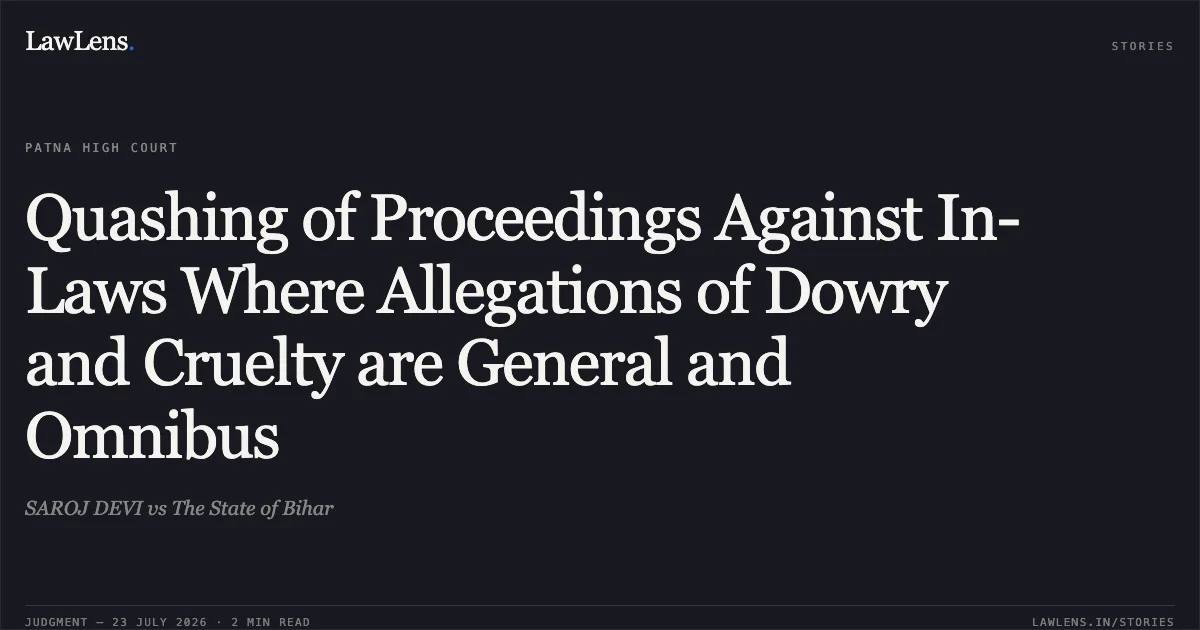
The petitioners (mother-in-law, father-in-law, and sister-in-law of the informant) sought quashing of a cognizance order dated 28.07.2022.
Source reference: p. 1-2The informant (Opposite Party No. 2) filed an FIR alleging that the petitioners and her husband demanded ₹50,000 and a Bolero vehicle as dowry, subjected her to cruelty, and attempted to burn her on 21.02.2021.
Source reference: p. 2It was further alleged that the husband subsequently performed a second marriage.
Source reference: p. 2The petitioners contended that the allegations were general and omnibus, arising from a matrimonial discord primarily between husband and wife, and that the offence of bigamy applies only to the husband.
Source reference: p. 2-3Issues
1. Whether the allegations against the in-laws (petitioners) in the FIR were specific enough to sustain criminal proceedings under Section 498A IPC and the Dowry Prohibition Act.
Source reference: p. 3-42. Whether the continuance of criminal proceedings against the relatives of the husband, in the absence of specific overt acts, constitutes an abuse of the process of law.
Source reference: p. 4-5Law Applied
The Court applied Section 498A (Cruelty by husband or relatives), Section 494 (Bigamy), and Sections 341, 323, 504, 506/34 of the Indian Penal Code, alongside Sections 3/4 of the Dowry Prohibition Act.
Source reference: p. 1-2It strictly followed the principles laid down by the Hon’ble Supreme Court in Kahkashan Kausar alias Sonam v. State of Bihar (2022), which cautioned against the "growing tendency" of roping in all family members with general and omnibus allegations in matrimonial disputes.
Source reference: p. 4-5The Court also referenced Dara Laxmi Narayana v. State of Telangana (2025) regarding the need for extreme caution when family relationships are brought into criminal cases.
Source reference: p. 5Reasoning
The Court observed that the thrust of the allegations regarding cruelty and the subsequent second marriage was primarily directed at the husband.
Source reference: p. 4-5Regarding the petitioners, the Court found that they had been "roped with general and omnibus allegations" without any specific overt acts attributed to them.
Source reference: p. 4The Court noted that the impugned cognizance order failed to identify specific material against the petitioners, merely stating that a prima facie case existed.
Source reference: p. 4Following the precedent in Kahkashan Kausar, the Court reasoned that allowing the trial to proceed against the in-laws in the absence of specific allegations would lead to unnecessary harassment and "scars of prosecution" despite a likely acquittal.
Source reference: p. 4-5Holding
The Court held that no useful purpose would be served by proceeding against the petitioners and that it was in the interest of justice to quash the proceedings against them.
The application was allowed, and the cognizance order dated 28.07.2022 passed by the Judicial Magistrate 1st Class, West Champaran, was quashed solely with respect to the three petitioners.
Source reference: p. 5-6Acts & Sections Cited
8 provisions across 2 statutes referred to in this judgment. Each provision opens on LawLens.
Indian Penal Code, 18606
Original Court PDF
SAROJ DEVIvsThe State of Bihar
Click to open original judgment
Original judgment, available to read, download and summarize on LawLens.in