Facts
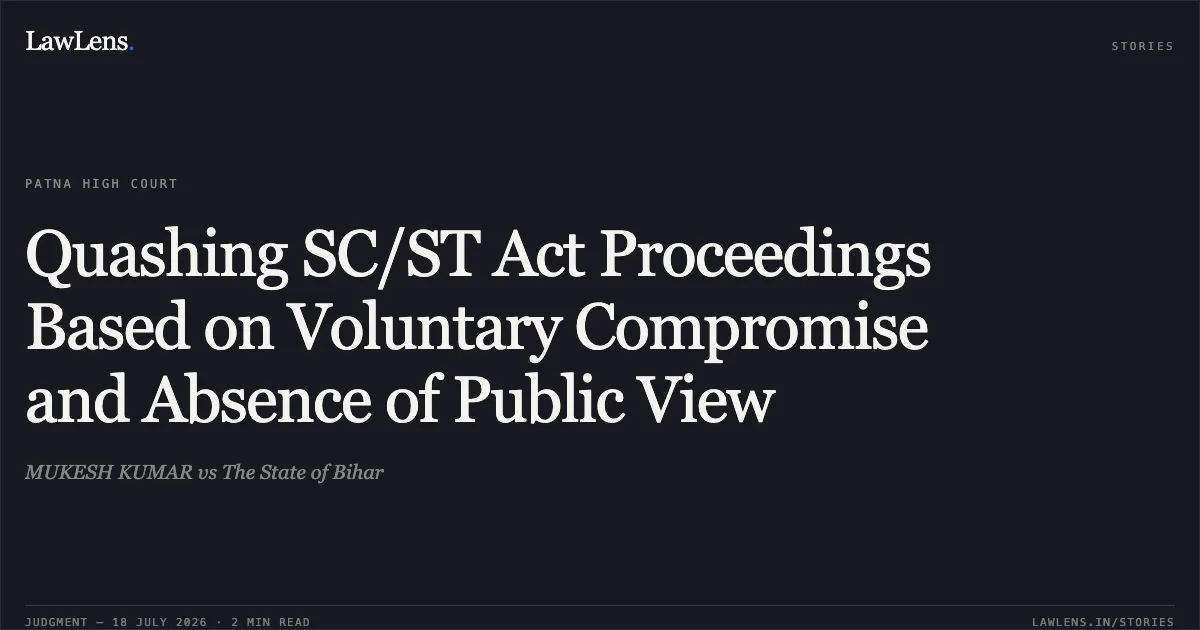
The petitioners sought quashing of FIR No. 39/2022 registered under Sections 385, 387, 341, 323, 354, 467, 468, 471, 504, 506, and 34 of the IPC and various sections of the SC/ST (Prevention of Atrocities) Act.
Source reference: p. 1-2The informant (Opposite Party No. 2), an Anganbari Sevika, alleged that Petitioner No. 1 (husband of Petitioner No. 2, a Sahayika) forcibly snatched an attendance register, demanded money, and hurled caste-based abuses.
Source reference: para. 3The petitioners contended the FIR was retaliatory following their complaint against the informant's irregularities.
Source reference: para. 4During the pendency of the application, the parties filed a joint interlocutory application (I.A. No. 01/2026) stating they had amicably resolved their private dispute and did not wish to pursue legal remedies.
Source reference: para. 6, 8Issues
1. Whether criminal proceedings involving offences under the SC/ST Act can be quashed on the basis of a compromise between parties.
Source reference: para. 72. Whether the allegations in the FIR satisfied the requirement of "public view" and intent to humiliate based on caste as required under the SC/ST Act.
Source reference: para. 9, 12, 14Law Applied
Section 482 of the CrPC regarding the inherent powers of the High Court to quash proceedings to prevent abuse of process or secure the ends of justice.
Source reference: para. 17-18Principles established in Ramawatar v. State of Madhya Pradesh (2022) and Ramgopal v. State of M.P. (2022), that non-heinous, private disputes under the SC/ST Act can be quashed on compromise even at post-conviction stages.
Source reference: para. 7, 15-16The "public view" doctrine from Swaran Singh & Ors. v. State (2008) and Karuppudayar v. State (2025).
Source reference: para. 10-13Principle from Hitesh Verma v. State of Uttarakhand (2020) that an offence is not established under the SC/ST Act unless the intimidation is specifically intended to humiliate the victim due to their caste status.
Source reference: para. 10-13Reasoning
The Court observed that the dispute was predominantly private in nature, arising from administrative friction at the Anganbari Centre, rather than caste-based animosity.
Source reference: para. 9, 14Per Karuppudayar, the Court found that the incident took place within the "four corners of the wall" and not in "public view," thereby failing to meet the statutory threshold for sections 3(1)(r) and 3(1)(s) of the SC/ST Act.
Source reference: para. 11-12Regarding the compromise, the Court verified the physical presence of the parties and the joint affidavit, concluding the settlement was voluntary and devoid of coercion.
Source reference: para. 8, 17The Court reasoned that since the offences were non-heinous and private, continuing the prosecution would be an abuse of the court's machinery, and quashing was necessary to do complete justice.
Source reference: para. 17-18Holding
The Court answered that proceedings under the SC/ST Act can be quashed when the dispute is private and a bonafide settlement is reached and held that the allegations did not constitute an offence under the SC/ST Act as the incident occurred outside public view and lacked caste-based intent.
Consequently, the High Court allowed the application and quashed FIR No. 39/2022 and all consequential proceedings.
Source reference: para. 18-19Acts & Sections Cited
9 provisions across 3 statutes referred to in this judgment. Each provision opens on LawLens.
Indian Penal Code, 18607
Scheduled Castes and the Scheduled Tribes (Prevention of Atrocities) Act, 19891
Code of Criminal Procedure, 19731
Original Court PDF
MUKESH KUMARvsThe State of Bihar
Click to open original judgment
Original judgment, available to read, download and summarize on LawLens.in