Facts
The Petitioner was appointed as a Treasury Account Clerk on a compassionate basis in 2012
Source reference: p. 1Following a show-cause notice in 2021 and a subsequent charge-sheet in 2022 regarding allegations of financial irregularities (embezzlement), a departmental inquiry was conducted
Source reference: p. 1-2The Petitioner submitted a detailed reply to the inquiry report on April 22, 2025
Source reference: p. 2On September 30, 2025, the Collector, Bhind, acting as the Disciplinary Authority, issued an order removing the Petitioner from service
Source reference: Annexure P-1The Petitioner’s subsequent appeal to the Commissioner, Chambal Division, was rejected on May 27, 2026
Source reference: p. 2The Petitioner challenged these orders under Article 226 of the Constitution, contending they were non-speaking and unreasoned
Source reference: p. 2Issues
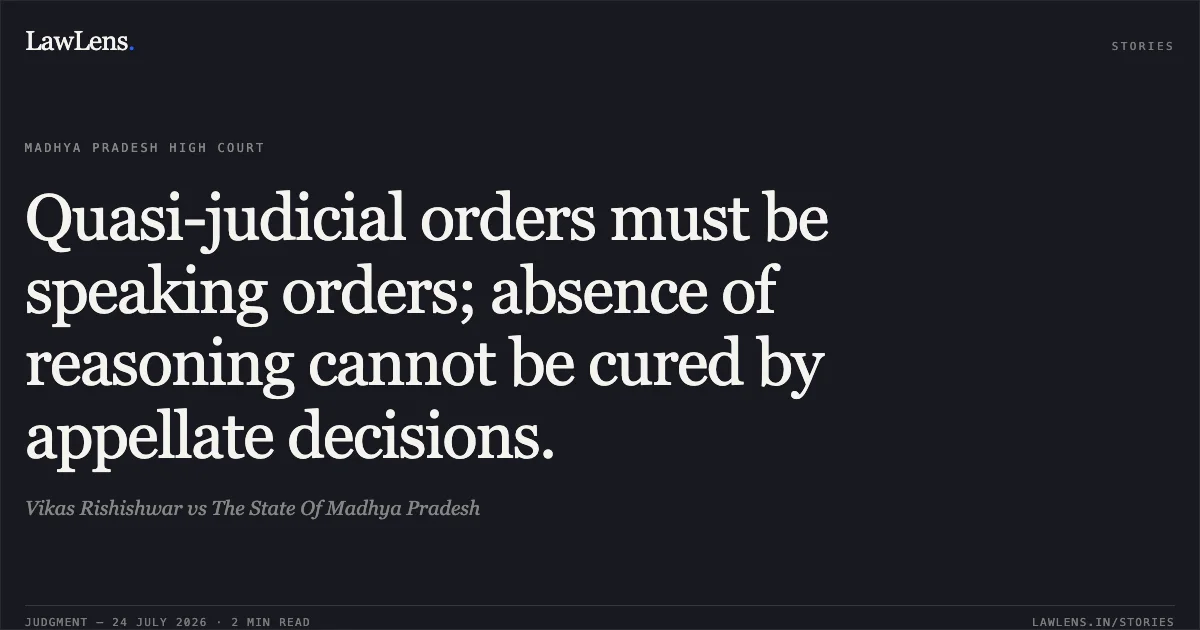
1. Whether the Disciplinary Authority’s order of removal was a "speaking order" as required under the principles of quasi-judicial adjudication
Source reference: p. 3 / para. 6-72. Whether the lack of reasoning in an original disciplinary order can be cured or compensated by the presence of reasons in an appellate order
Source reference: p. 6 / para. 12Law Applied
The Court applied the principle that a Disciplinary Authority exercises quasi-judicial power and must pass a speaking order supported by valid reasons
Source reference: p. 3It relied on State of Punjab v. Bandip Singh (2016) 1 SCC 724, which mandates that administrative decisions must be self-sustaining and impregnated with reasons to avoid arbitrariness
Source reference: p. 4It further cited Kranti Associates Pvt. Ltd. v. Masood Ahmed Khan (2010) 9 SCC 496, establishing that reasons are the "lifeblood" of judicial decision-making and a component of natural justice
Source reference: p. 5Finally, it applied Oryx Fisheries Pvt. Ltd. v. Union of India (2010) 13 SCC 427 and ICAI v. L.K. Ratna (1986) 4 SCC 537 to hold that the absence of reasons in an original order cannot be compensated by an appellate order
Source reference: p. 6-7Reasoning
The Court scrutinized the impugned order dated September 30, 2025, and observed that it merely stated the conclusion of guilt and the resulting punishment without addressing the specific facts, grounds, or explanations provided in the Petitioner’s detailed reply
Source reference: p. 2-3The Court reasoned that since the Disciplinary Authority was exercising a quasi-judicial function, it had a legal obligation to demonstrate an objective consideration of the relevant factors
Source reference: p. 3, 5Applying the Oryx Fisheries precedent, the Court noted that a "rubber-stamp" reason or a complete absence of reasoning in the initial decision constitutes a breach of fundamental procedure that cannot be rectified by the Appellate Authority’s reasoning
Source reference: p. 6-7Consequently, the failure of the Disciplinary Authority to pass a reasoned order rendered the entire process arbitrary and unsustainable in law
Source reference: p. 4, 8Holding
The Court allowed the petition in part, holding that the impugned punishment order and the appellate order were non-speaking and legally flawed
It quashed the orders dated September 30, 2025 (Annexure P-1) and May 27, 2026 (Annexure P-2). The Court directed the Collector, Bhind, to pass a fresh, reasoned, and speaking order after considering all grounds raised in the Petitioner's explanation dated April 22, 2025, and providing a personal hearing, within three months
Source reference: p. 8Original Court PDF
Vikas RishishwarvsThe State Of Madhya Pradesh
Click to open original judgment
Original judgment, available to read, download and summarize on LawLens.in