Facts
The petitioner, an Assistant Manager, challenged two orders: a disciplinary order dated 28.12.2023 [Annexure P-2] and an appellate order dated 27.10.2025 [Annexure P-1].
Source reference: para. 2, 4The Disciplinary Authority had imposed a punishment of withholding one annual increment with cumulative effect (later described in the order as two increments for one year without cumulative effect) following a show-cause notice and electricity theft proceedings.
Source reference: para. 2, 4The petitioner contended that both the disciplinary and appellate orders were non-speaking, unreasoned, and failed to consider his specific explanations or the grounds raised in his appeal.
Source reference: para. 2Issues
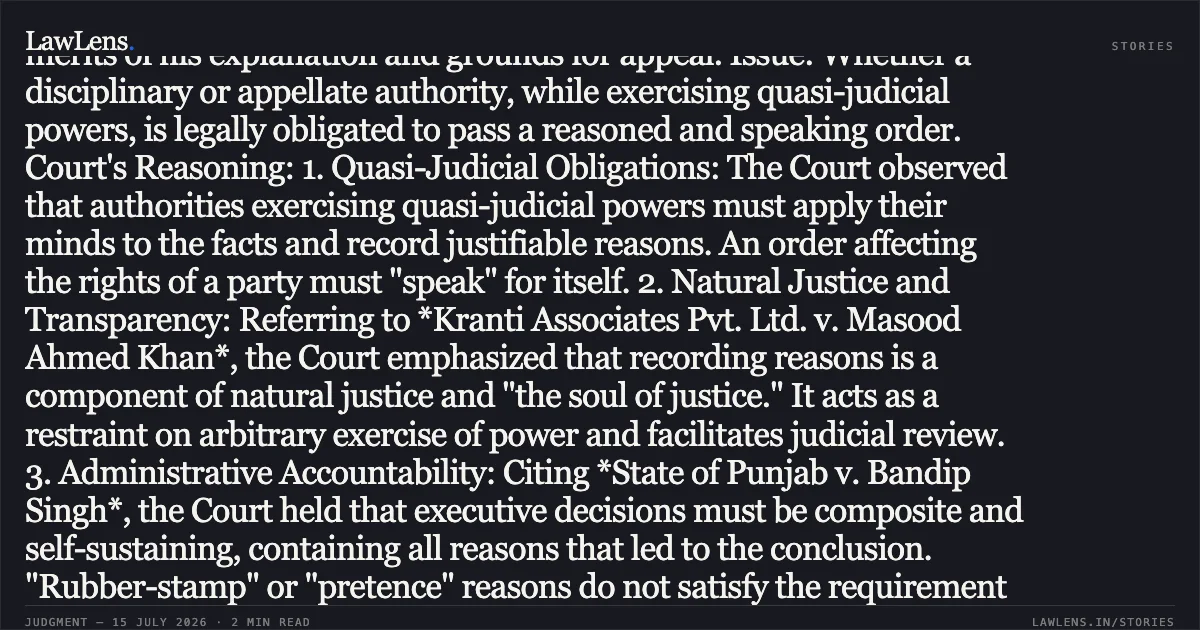
1. Whether the Disciplinary and Appellate Authorities, while exercising quasi-judicial powers, are mandated to pass reasoned and speaking orders.
Source reference: para. 5, 72. Whether the impugned orders dated 28.12.2023 and 27.10.2025 are legally sustainable if they fail to reflect the application of mind to the facts and defenses raised by the petitioner.
Source reference: para. 5, 8Law Applied
Disciplinary and Appellate Authorities exercise quasi-judicial powers and must pass "speaking orders" that reflect an application of mind to relevant facts and circumstances.
Source reference: para. 5, 7Administrative decisions must be self-sustaining and not arbitrary, as established in State of Punjab v. Bandip Singh (2016) 1 SCC 724.
Source reference: para. 9, 10Reasons are the "lifeblood of judicial decision-making" and a component of natural justice and human rights, as per Kranti Associates Private Limited v. Masood Ahmed Khan (2010) 9 SCC 496.
Source reference: para. 11Reasoning
The Court perused the text of the impugned orders and found them deficient in reasoning, observing that the Disciplinary Authority merely reiterated the proposed punishment without addressing the petitioner's point-wise reply or explaining why his explanation was unsatisfactory.
Source reference: para. 4, 5The Appellate Authority rejected the appeal by simply affirming the lower order without discussing the specific grounds of appeal.
Source reference: para. 6, 7Since these orders affect the rights of the party, the "face of the order" must speak so the affected party knows how their defense was considered.
Source reference: para. 8The absence of cogent, clear, and succinct reasons rendered the orders "rubber-stamp" decisions, violating the principles of transparency and accountability required under the rule of law.
Source reference: para. 11Holding
The Court held that non-speaking quasi-judicial orders are unsustainable and quashed the impugned orders dated 28.12.2023 and 27.10.2025.
The matter was remanded to the Disciplinary Authority with a direction to pass a fresh, reasoned, and speaking order within three months, explicitly considering the petitioner’s explanation dated 09.10.2023 and providing him a personal hearing.
Source reference: para. 13, 14Original Court PDF
Piyush AtulkervsMadhya Pradesh Madhya Kshetra Vidyut Vitran Co. Ltd.
Click to open original judgment
Original judgment, available to read, download and summarize on LawLens.in