Facts
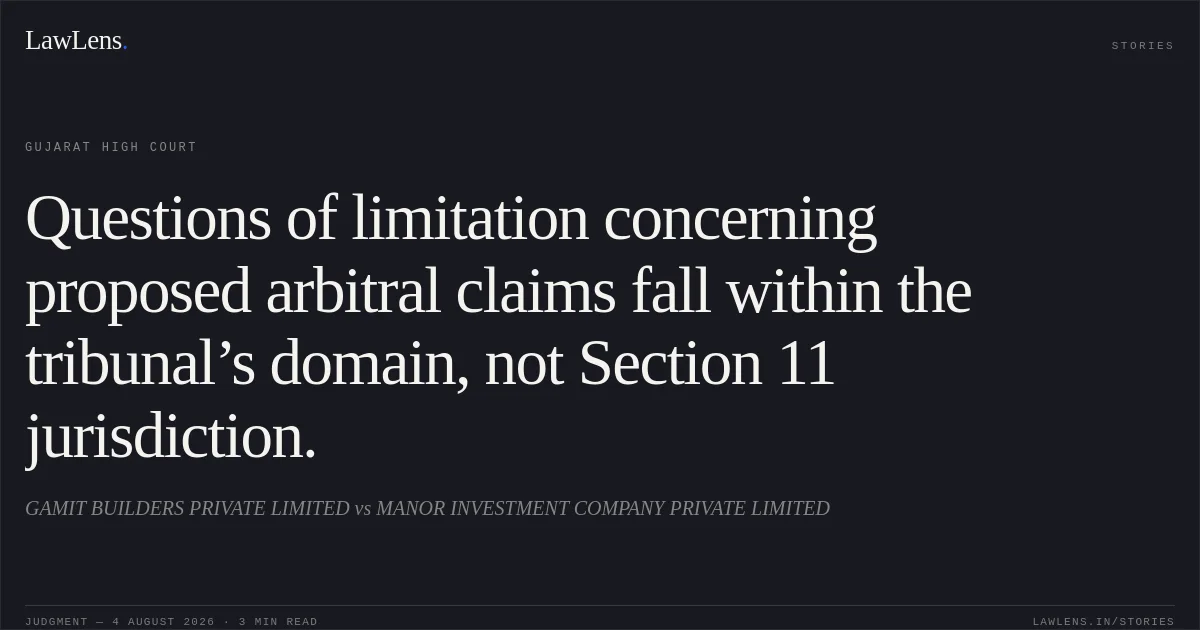
Gamit Builders Private Limited (“GAMIT”) filed a petition under Section 11 of the Arbitration and Conciliation Act, 1996, seeking appointment of a sole arbitrator for disputes arising from an MoU dated 25 October 2010, a registered Agreement to Sell dated 8 April 2011, and a Supplementary Agreement dated 14 June 2011.
Source reference: paras. 2–4; pp. 1–6Under these instruments, GAMIT agreed to purchase land from Manor Investment Company Private Limited (“MICPL”), made payments aggregating to approximately Rs. 5.45 crores, and claimed possession of 85 parcels of land.
Source reference: paras. 3.3–3.4; pp. 3–5In 2023, GAMIT sought cancellation of certain mortgage-related documents. MICPL, in its reply, purported to cancel the transaction documents, invoked the arbitration clause, and proposed an arbitrator.
Source reference: para. 3.5; pp. 4–5GAMIT declined the proposed arbitrator and suggested appointment of a retired High Court Judge; MICPL did not respond.
Source reference: para. 3.6; pp. 5–6MICPL opposed the Section 11 petition on the grounds that the claims were ex facie barred by limitation and that there had been no valid invocation under Section 21.
Source reference: paras. 6–6.3; pp. 9–11Issues
1. Whether the arbitration clause contained in the contractual documents survived and constituted a subsisting arbitration agreement between the parties.
Source reference: para. 7; pp. 11–122. Whether the petitioner’s proposed claims were so stale and ex facie barred by limitation that the Section 11 petition should be rejected at the threshold.
Source reference: para. 7; pp. 11–123. Whether objections concerning limitation and the validity or sufficiency of the invocation under Section 21 were matters for determination by the referral court or by the arbitral tribunal.
Source reference: paras. 5.1, 6.1–6.2, 10–11; pp. 7–11, 20–21Law Applied
The Court applied Sections 7, 11 and 16 of the Arbitration and Conciliation Act, 1996.
Source reference: para. 9; pp. 13–20Under Section 11(6A), the referral court’s examination is confined to the existence of an arbitration agreement, with formal validity generally assessed on a prima facie basis; substantive jurisdictional objections and evidentiary disputes are ordinarily for the arbitral tribunal under Section 16.
Source reference: para. 9; pp. 13–20The Court relied on Ajay Madhusudan Patel v. Jyotindra S. Patel, (2025) 2 SCC 147, and the principles in Vidya Drolia v. Durga Trading Corporation, (2021) 2 SCC 1, that courts should refer parties where jurisdictional facts are debatable and should not conduct a mini-trial at the referral stage.
Source reference: para. 9; pp. 13–14, 19It also relied on In Re: Interplay Between Arbitration Agreements under the Arbitration and Conciliation Act, 1996 and the Stamp Act, 1899, (2024) 6 SCC 1, which confined Section 11 scrutiny principally to the existence of an arbitration agreement under Section 7 and left substantive objections to the tribunal.
Source reference: para. 9; pp. 14–16SBI General Insurance Co. Ltd. v. Krish Spinning, 2024 SCC OnLine SC 1754, was relied upon for the proposition that detailed adjudication of preliminary objections at the Section 11 stage may improperly deprive a claimant of a forum and undermine expeditious referral.
Source reference: para. 9; pp. 16–18The doctrine of separability and the principle of kompetenz-kompetenz were also applied: the arbitration clause may survive termination or alleged invalidity of the underlying contract, and the tribunal may rule on its own jurisdiction.
Source reference: para. 8; pp. 12–13Reasoning
The Court found, prima facie, that Clause 8 of the registered Agreement to Sell contained a valid arbitration agreement.
Source reference: para. 10; p. 20The fact that MICPL itself had invoked the clause and proposed an arbitrator further supported the existence of a subsisting arbitration agreement.
Source reference: para. 10; p. 20Although MICPL contended that the claims accrued between 2011 and 2015 and were therefore time-barred, determining limitation required interpretation of the Agreement to Sell, the Supplementary Agreement, and subsequent correspondence between the parties.
Source reference: paras. 6–6.1, 10–11; pp. 9–11, 20–21That exercise involved disputed and potentially evidentiary questions and therefore could not be conclusively undertaken in the limited jurisdiction under Section 11.
Source reference: no citationApplying the principles of separability, kompetenz-kompetenz, and restricted judicial scrutiny, the Court held that limitation and related jurisdictional objections should be determined, if raised, by the arbitral tribunal.
Source reference: paras. 8, 11; pp. 12–13, 20–21The Court consequently did not reject the petition on the basis of limitation or the respondent’s objections regarding invocation.
Source reference: no citationHolding
The petition under Section 11 was allowed.
The Court appointed Hon’ble Mr. Justice Ashutosh J. Shastri, former Judge of the Gujarat High Court, as the sole arbitrator to adjudicate the disputes between the parties in accordance with the Arbitration Centre (Domestic and International), High Court of Gujarat Rules, 2021.
Source reference: Order ii; pp. 21–22The Registry was directed to communicate the order to the arbitrator forthwith, and pending applications, if any, were consigned to the records.
Source reference: Order iii–iv; p. 22Acts & Sections Cited
7 provisions across 2 statutes referred to in this judgment. Each provision opens on LawLens.
Arbitration and Conciliation Act, 19966
Limitation Act, 19631
Original Court PDF
GAMIT BUILDERS PRIVATE LIMITEDvsMANOR INVESTMENT COMPANY PRIVATE LIMITED
Click to open original judgment
Original judgment, available to read, download and summarize on LawLens.in