Facts
The petitioner, a retired Supervisor of the Kerala Tourism Development Corporation (KTDC), filed a writ of quo warranto against the 6th and 7th respondents.
Source reference: para 1, 5The respondents were appointed as Executive Trainees in 1991 and eventually promoted to Managerial grades.
Source reference: para 6-8The petitioner alleged that at the time of their initial recruitment, the respondents lacked the requisite qualifications (Pre-degree and a Diploma in Hotel Management) and that their appointments were obtained through misrepresentation.
Source reference: para 9, 13A 2024 Finance Inspection Department report supported the allegation of irregularity.
Source reference: para 11The respondents contended that they had disclosed their "results awaited" status during the interview, had served for 33 years with unblemished records, and had been cleared by multiple prior vigilance and departmental enquiries.
Source reference: para 22-26Issues
1. Whether the posts of Executive Trainee and Manager in the KTDC constitute a "public office" amenable to a writ of quo warranto?
Source reference: para 47, 592. Whether the appointment of the 6th and 7th respondents was in violation of statutory rules sufficient to warrant judicial ouster?
Source reference: para 43, 60Law Applied
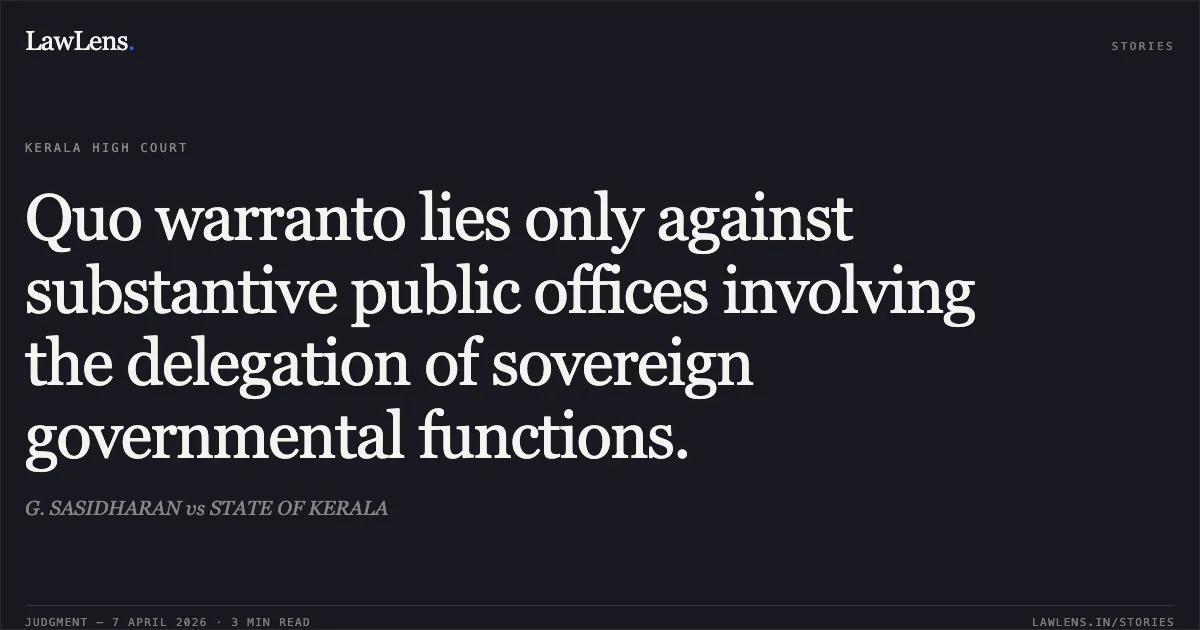
The court applied the established principle that a writ of quo warranto is a limited remedy used to oust a usurper from a "public office," provided the office is of a substantive nature, created by statute or Constitution, and involves the delegation of sovereign functions.
Source reference: para 43, 55Relying on University of Mysore v. C.D. Govinda Rao, the court noted that the petitioner must satisfy the court that the office is a "public office" held without legal authority.
Source reference: para 48Per B. Srinivasa Reddy v. Karnataka Urban Water Supply, the office must involve a portion of the sovereign power of the Government.
Source reference: para 31, 53Following Ashok Kumar Pandey v. State of W.B., the court reiterated that Public Interest Litigation (PIL) is generally not maintainable in service matters except for quo warranto.
Source reference: para 56Reasoning
The Court examined the nature of the KTDC and the specific posts held by the respondents.
Source reference: para 41It noted that KTDC was incorporated as a company limited by shares under the Companies Act to promote tourism and handicrafts, which are commercial activities.
Source reference: para 41Applying the "sovereign function test," the court reasoned that while KTDC might be an "instrumentality of the State" for Article 12 purposes, not every employee holds a "public office".
Source reference: para 43, 59The court found that the positions of Executive Trainee and Manager are contractual and regulated by internal service rules rather than direct statutory provisions.
Source reference: para 59Since the respondents do not exercise sovereign executive, legislative, or judicial powers on behalf of the State, their posts do not qualify as "public offices".
Source reference: para 58, 61Consequently, the fundamental prerequisite for issuing a writ of quo warranto—the existence of a public office—was absent.
Source reference: para 61Holding
The High Court dismissed the writ petition, holding that a writ of quo warranto cannot be issued because the respondents do not occupy a "public office" as defined by law.
The court held that the posts were contractual and commercial in nature, lacking the necessary delegation of sovereign power.
Source reference: para 61However, the court noted that this judgment does not fetter the rights of the KTDC Board or the State Government to proceed with internal appeals or administrative actions regarding the respondents' qualifications.
Source reference: para 64-65No order as to costs was made.
Source reference: para 66Acts & Sections Cited
1 provisions across 1 statute referred to in this judgment. Linked provisions open on LawLens.
Companies Act, 19561
Original Court PDF
G. SASIDHARANvsSTATE OF KERALA
Click to open original judgment
Original judgment, available to read, download and summarize on LawLens.in