Facts
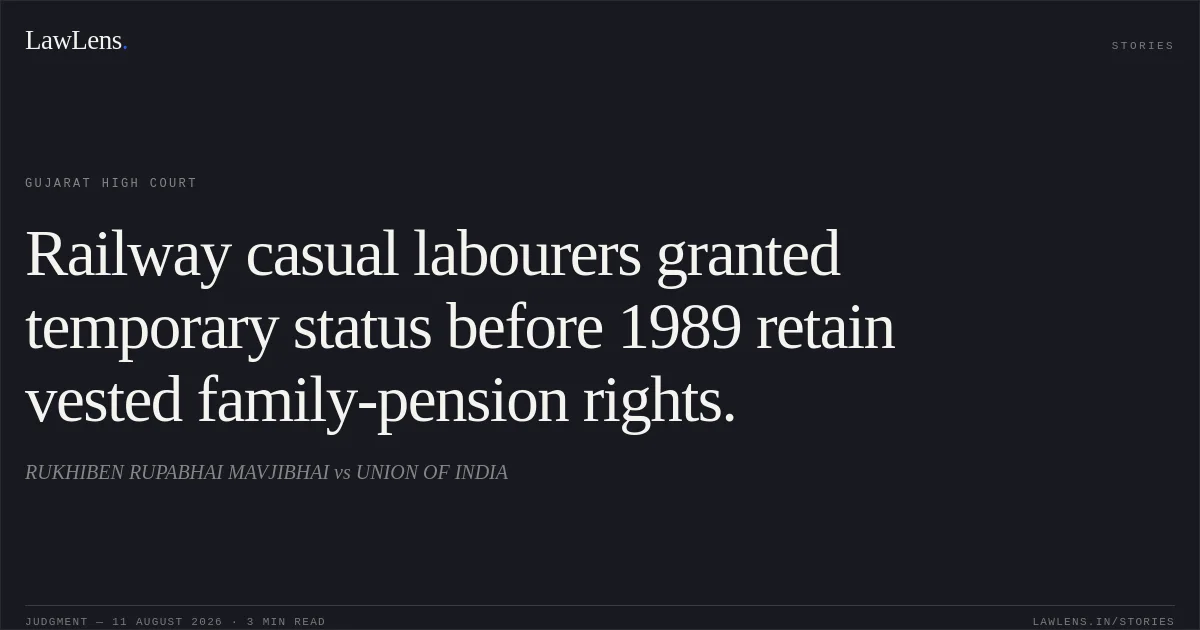
The petitioners were widows of railway employees who were initially engaged as casual labourers and were subsequently granted the status of “casual labour with temporary status” between 1981 and 1984/1986. Their spouses died while in service after completing more than one year of continuous service following the grant of temporary status.
Source reference: paras. 1–3, 8The petitioners’ claims for family pension were rejected by the Railway authorities and the Central Administrative Tribunal (“CAT”).
Source reference: paras. 9–22In connected proceedings, Ramilaben’s claim had initially succeeded before the Labour Court and the High Court, but the Supreme Court set aside those orders in view of General Manager, North West Railway v. Chanda Devi, while granting liberty to challenge the validity of Para 1501 of the revised IREM.
Source reference: paras. 9–17The petitioners thereafter approached the CAT pursuant to the liberty granted by the Supreme Court; their claims were rejected, leading to the present petitions.
Source reference: paras. 18–22Issues
1. Whether railway employees who acquired “casual labour with temporary status” before the 1989 revision of the IREM were to be treated as “temporary railway servants” under the then-prevailing Para 2301.
Source reference: paras. 23–292. Whether the subsequent 1986 circular and revised Para 1501 of the IREM, which excluded “casual labour with temporary status” from the definition of a temporary railway servant, could retrospectively divest the employees of rights already acquired.
Source reference: paras. 14–15, 24–29, 343. Whether the petitioners were entitled to family pension under Para 101(2) of the Manual of Railway Pension Rules, 1950, upon their spouses’ death in service after completion of one year’s continuous qualifying service.
Source reference: paras. 6–8, 25–29Law Applied
The court applied Para 2301 of the then-prevailing IREM, under which a “temporary railway servant” excluded “casual labour” but not “casual labour with temporary status”.
Source reference: paras. 4–5It also applied Para 101(2) of the Manual of Railway Pension Rules, 1950, which entitled the family of a temporary railway servant who died in service to family pension if the employee had completed one year’s continuous qualifying service.
Source reference: paras. 6–7The court relied on Inder Pal Yadav v. Union of India, (1985) 2 SCC 648, which approved the Railway scheme granting temporary status to eligible casual labourers.
Source reference: para. 3It distinguished General Manager, North West Railway v. Chanda Devi, 2007 (0) GLHEL-SC 40226, because that case concerned the post-1989 framework and the Railways Services (Pension) Rules, 1993, which were not applicable to the petitioners’ spouses.
Source reference: paras. 30–31The court further held that the revised Para 1501 of the IREM, introduced in 1989, could operate prospectively and could not retrospectively extinguish vested rights acquired under Para 2301 and the 1950 Pension Rules.
Source reference: paras. 24–29, 33–34Reasoning
The employees acquired “casual labour with temporary status” before the 1989 revision of the IREM. On the date of such acquisition, Para 2301 treated them as temporary railway servants because only ordinary casual labour was excluded from that definition.
Source reference: paras. 23–25Their status consequently carried the benefits available to temporary railway servants under the law then in force. Since Para 101(2) of the 1950 Pension Rules expressly granted family pension where a temporary railway servant died in service after completing one year’s continuous qualifying service, and the petitioners’ spouses satisfied that condition, a pensionary right accrued to them.
Source reference: paras. 6–8, 25–27The later 1986 circular and revised Para 1501 could not retrospectively nullify that vested entitlement.
Source reference: paras. 24–29, 33–34The court therefore found the petitioners’ cases materially distinguishable from Chanda Devi, Union of India v. Rabia Bikaner, and the Allahabad High Court decision relied upon by the Railways, as those authorities did not address the effect of the 1950 Pension Rules on employees who had already acquired temporary railway servant status under Para 2301.
Source reference: paras. 30–36Holding
The court held that the petitioners’ spouses were temporary railway servants under Para 2301 of the IREM when they acquired casual labour with temporary status before 1989.
Their vested entitlement to family pension under Para 101(2) of the Manual of Railway Pension Rules, 1950 was not affected by the subsequent 1986 circular or revised Para 1501 of the IREM.
Source reference: paras. 24–29, 33–34The Railways were directed to compute and pay the family pension benefits to the petitioners or their respective legal heirs within three months from receipt of the judgment.
Source reference: paras. 37–38Both special civil applications were disposed of, and the pending civil application was consigned to the record.
Source reference: para. 39Acts & Sections Cited
1 provisions across 1 statute referred to in this judgment. Linked provisions open on LawLens.
Industrial Disputes Act, 19471
Original Court PDF
RUKHIBEN RUPABHAI MAVJIBHAIvsUNION OF INDIA
Click to open original judgment
Original judgment, available to read, download and summarize on LawLens.in