Facts
On 3 March 2023, the accused-appellants, Pahad Singh and Dungar Singh, allegedly went to the house of Indira Kanwar in connection with a proposed Aata-Sata marriage arrangement and assaulted her with axes. When Hari Singh intervened, the accused allegedly inflicted fatal axe blows upon him. They thereafter attacked or chased other persons, including Jaswant Singh, Rinku Kanwar, Narendra Singh, Hadmat Singh and ASI Surendra Singh. Indira Kanwar and Hari Singh died from their injuries, while several others sustained injuries
Source reference: paras. 3–4Following investigation, the accused were charged under Sections 341, 323, 324, 325, 307 and 302 read with Section 34 IPC. The Trial Court convicted both accused and awarded death sentences under Section 302/34 IPC, besides sentences for the remaining offences. The accused preferred a criminal appeal, and the Trial Court’s death sentence was referred to the High Court for confirmation under Section 366 CrPC
Source reference: paras. 2, 5–9Issues
Whether the prosecution proved beyond reasonable doubt that the accused, acting in furtherance of their common intention, committed the murders of Indira Kanwar and Hari Singh and the other charged offences under Sections 341, 323, 324, 325, 307 and 302/34 IPC
Source reference: paras. 23–34, 53–64Whether the accused were entitled to the benefit of Exception 1 to Section 300 IPC on the ground of grave and sudden provocation or sudden quarrel
Source reference: paras. 60–63Whether the death sentence imposed for the offence under Section 302/34 IPC satisfied the “rarest of rare” standard, or was required to be commuted to imprisonment for life
Source reference: paras. 65–79Law Applied
The Court applied Sections 341, 323, 324, 325, 307, 302 and 34 IPC, concerning wrongful restraint, voluntarily causing hurt and grievous hurt, attempt to murder, murder and common intention, respectively.
Source reference: paras. 4–6, 64It relied on the settled principle that credible testimony of related or injured eyewitnesses cannot be discarded merely because of their relationship with the victims, particularly where it is consistent and corroborated by medical and forensic evidence.
Source reference: paras. 24–34The Court also applied Section 27 of the Indian Evidence Act to the recoveries of the blood-stained axes pursuant to the accused’s disclosure statements.
Source reference: paras. 50–52For sentencing, it applied the principles in Bachan Singh v. State of Punjab, Machhi Singh v. State of Punjab and Lehna v. State of Haryana: death is an exceptional punishment, permissible only where the case falls within the “rarest of rare” category and life imprisonment is unquestionably inadequate.
Source reference: paras. 68–69The Court further considered the accused’s mitigating circumstances in accordance with the mitigation principles recognised in Manoj v. State of Madhya Pradesh.
Source reference: para. 73Reasoning
The Court found the evidence of the complainant, injured eyewitnesses, child witness, natural eyewitness and police officer to be consistent, credible and corroborated by the prompt FIR, medical evidence, post-mortem reports, seizure proceedings and recovery of two human-blood-stained axes.
Source reference: paras. 24–34, 35–45, 50–58The injuries to the deceased—multiple deep chop wounds to the head and neck—established homicidal death caused by heavy sharp-edged weapons.
Source reference: paras. 36–44The Court rejected the defence plea of false implication and held that the alleged land and matrimonial disputes did not undermine the prosecution evidence.
Source reference: para. 59It also rejected the plea of grave and sudden provocation because the deceased’s response concerning the marriage proposal was neither abusive nor sufficiently provocative, and the accused had continued their assault against several victims and the intervening police officer.
Source reference: paras. 60–63Although the Court treated the murders and continuing assault as grave and brutal, it held that the incident arose from a personal and domestic dispute rather than an organised, terroristic or pecuniary motive. The accused were first-time offenders, came from a modest rural background, had limited education, had no prior criminal antecedents or evidence of mental disorder, and had spent over three years in custody. These mitigating circumstances meant that imprisonment for life could not be regarded as unquestionably inadequate.
Source reference: paras. 70–78Holding
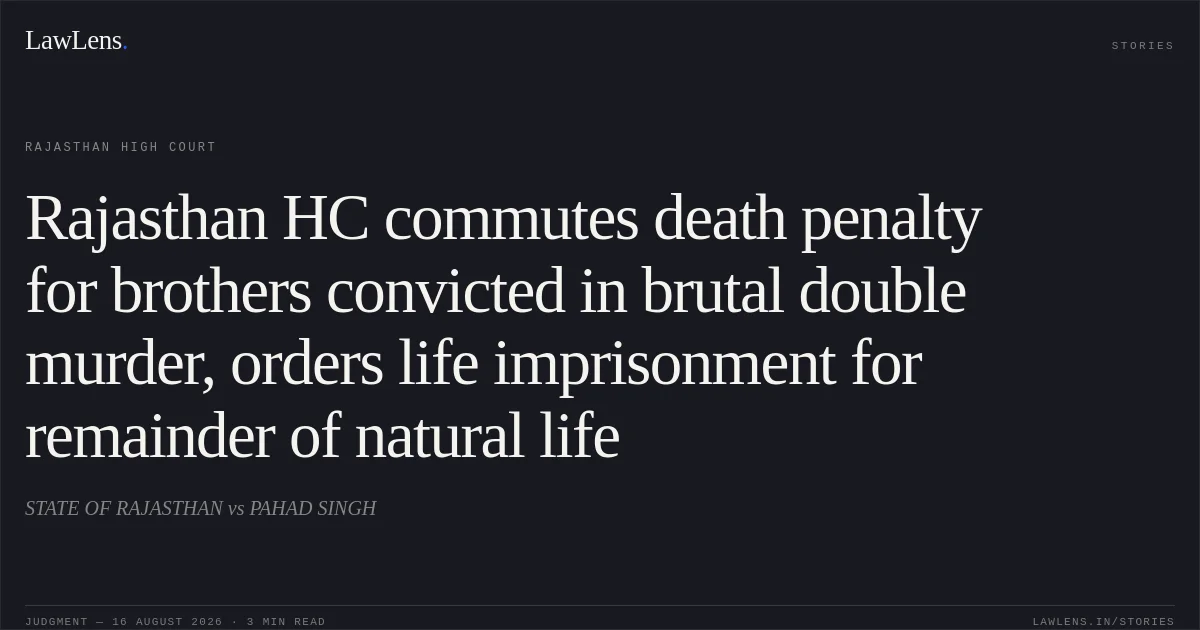
The High Court affirmed the convictions of Pahad Singh and Dungar Singh under Sections 341, 323/34, 324/34, 325/34, 307/34 and 302/34 IPC.
It answered the death reference in the negative and rejected confirmation of the death penalty.
Source reference: paras. 79–80The death sentences under Section 302/34 IPC were commuted to imprisonment for life for the remainder of the accused’s natural lives, subject to the fines imposed by the Trial Court; the sentences for the remaining offences were left unaltered.
Source reference: paras. 79–80The criminal appeal was partly allowed only to that extent, and the Trial Court record was directed to be returned.
Source reference: paras. 80–81Acts & Sections Cited
12 provisions across 3 statutes referred to in this judgment. Each provision opens on LawLens.
Code of Criminal Procedure, 19732
Bharatiya Nagarik Suraksha Sanhita, 20232
Indian Penal Code, 18608
Original Court PDF
STATE OF RAJASTHANvsPAHAD SINGH
Click to open original judgment
Original judgment, available to read, download and summarize on LawLens.in