Facts
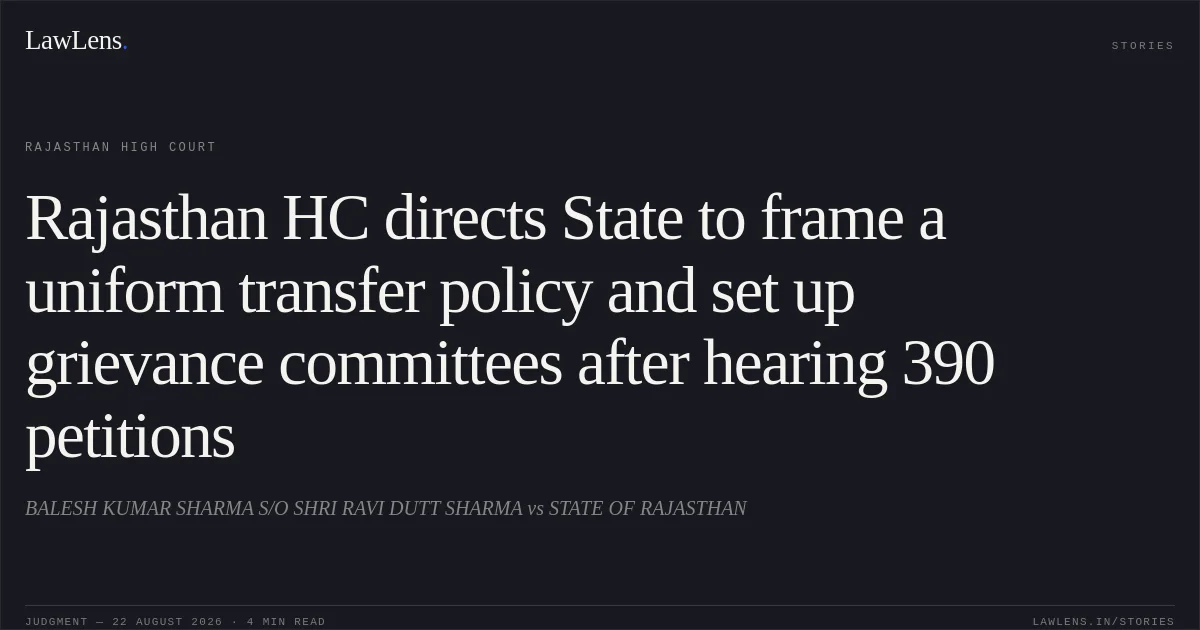
The lead petition and approximately 390 connected writ petitions challenged transfer orders issued by various State departments, Boards, Nigams, Discoms, local authorities, financial institutions and other establishments.
Source reference: paras. 1, 5–9, pp. 37–50The petitioners alleged that the transfers were blanket, premature, arbitrary and, in some cases, mala fide; that individual circumstances such as medical conditions, disability, spouse-related grounds, proximity to retirement, dependent family members and prior service in difficult areas had not been considered; and that applicable statutory provisions, transfer policies and procedural safeguards had been violated.
Source reference: paras. 1, 5–9, pp. 37–50The respondents contended that transfer was an ordinary incident of service, that employees had no vested right to remain at a particular station, and that the writ petitions were not maintainable absent mala fides, jurisdictional error or violation of a mandatory statutory provision.
Source reference: paras. 10–24, pp. 50–59The Court also considered the recurring nature of transfer litigation and the alleged ineffective functioning of the Rajasthan Civil Services Appellate Tribunal (“RCSAT”).
Source reference: paras. 3, 25, 32–34, pp. 38–39, 59–68Issues
Whether the impugned transfer orders were liable to judicial interference on the grounds of lack of competence, violation of mandatory statutory provisions, mala fides, extraneous considerations, colourable exercise of power or patent arbitrariness.
Source reference: paras. 4–5, 25, 27–29, 35–38, pp. 39–40, 59–70Whether departure from transfer guidelines, non-consideration of personal circumstances, premature or repeated transfers, and alleged absence of sanctioned posts or administrative exigency, by themselves, invalidated the transfer orders.
Source reference: paras. 6–9, 18–23, 30–31, 35–38, pp. 40–50, 55–59, 64–70Whether the Court should formulate a uniform transfer framework or instead direct the executive authorities to create an administrative mechanism for consideration of individual transfer grievances.
Source reference: paras. 32–34, 39–40, 52–54, pp. 67–77What interim and remedial directions should govern petitioners who had not joined at the transferred station or against whom disciplinary proceedings had been initiated for non-joining.
Source reference: paras. 42–49, 57–60, pp. 71–81Law Applied
The Court applied the settled rule that transfer is an incident of service and that an employee holding a transferable post has no vested right to remain posted at a particular place, as recognised in Gujarat Electricity Board v. Atmaram Sungomal Poshani, (1989) 2 SCC 602; Shilpi Bose v. State of Bihar, 1991 Supp (2) SCC 659; Union of India v. S.L. Abbas, (1993) 4 SCC 357; State of U.P. v. Gobardhan Lal, (2004) 11 SCC 402; and Rajendra Singh v. State of U.P., (2009) 15 SCC 178.
Source reference: paras. 4, 11–13, 19–20, 27–29, pp. 39–40, 50–57, 61–64Judicial review remains available where the transfer is made by an incompetent authority, violates a mandatory statutory provision, is mala fide, founded on extraneous considerations, or is patently arbitrary or colourable.
Source reference: paras. 4, 29, 35–38, pp. 39–40, 64–70Mere breach of a non-statutory executive guideline ordinarily does not invalidate a transfer, although a duly adopted and operative policy binds the Government unless lawfully amended or withdrawn, following Bhika Ram v. State of Rajasthan, (2025) SCC OnLine SC 2891.
Source reference: para. 30, p. 64–65The Court also applied Rule 20 of the Rajasthan Service Rules, 1951, concerning transfer to a lower-paid post, and Section 89(8)(ii) of the Rajasthan Panchayati Raj Act, 1994, requiring consultation in specified transfers.
Source reference: paras. 7.9–7.10, 35–36, pp. 45–49, 68–69Personal hardship, spouse-related circumstances, medical conditions, disability and proximity to retirement may require administrative consideration but do not, absent a statutory mandate or binding policy, create an enforceable right to a particular posting.
Source reference: paras. 21, 31, 38, pp. 56–57, 65–70Reasoning
The Court distinguished between the existence of the power to transfer and the legality of its exercise. It declined to act as an appellate authority over administrative choices or to substitute its assessment of staffing needs and administrative convenience for that of the employer.
Source reference: paras. 27–29, pp. 61–64At the same time, the expression “administrative exigency” could not provide immunity from judicial review where the record disclosed incompetence, breach of a mandatory statutory requirement, mala fides, political or extraneous interference, punitive transfer, non-application of mind or disregard of relevant and compelling circumstances.
Source reference: paras. 29, 35, 38, pp. 64–70Since the batch involved materially different factual circumstances and the Court was not equipped to adjudicate every individual grievance collectively, it considered it appropriate for competent departmental authorities to examine each petitioner’s specific case.
Source reference: paras. 31–34, 39–40, pp. 65–71The Court therefore required a reasoned assessment of statutory compliance, tenure, premature or repeated transfer, protected circumstances, sanctioned-post availability, applicable policies and allegations of mala fides, while preserving the administration’s power to transfer employees for genuine public or administrative reasons.
Source reference: paras. 31–34, 39–40, pp. 65–71Holding
The Court disposed of the entire batch without quashing the transfer orders generally and without conferring any right to retention at a chosen station.
Each petitioner was permitted to submit a comprehensive representation to the competent authority within fifteen days, supported by relevant documents.
Source reference: paras. 43–44, pp. 71–73The competent authority or departmental committee was directed to decide each representation within fifteen days of filing, after considering the specified statutory, factual and equitable grounds and issuing a brief but intelligible, non-mechanical order.
Source reference: paras. 45–46, pp. 72–74The impugned transfers were to remain in abeyance for the petitioners, subject to stated qualifications for those who had already joined, until disposal of the representation or thirty days from the judgment, whichever was earlier; protection would continue where a representation was filed within time until its decision.
Source reference: paras. 47–48, pp. 73–74Departments and establishments were directed to constitute Transfer Grievance Committees within seven working days.
Source reference: paras. 49–51, pp. 74–75A State-Level Committee, including a former High Court Judge, the Advocate General and the Chief Secretary, was proposed to formulate a comprehensive State transfer policy within two months.
Source reference: paras. 52–54, pp. 75–77The State was further directed to take steps to improve the functioning of the RCSAT, including appropriate supervisory arrangements and filling vacancies, and disciplinary proceedings based solely on non-joining were to take account of the representation and its outcome before proceeding further.
Source reference: paras. 55–57, pp. 77–80Acts & Sections Cited
2 provisions across 2 statutes referred to in this judgment. Each provision opens on LawLens.
Rajasthan Panchayati Raj Act, 19941
RAJASTHAN MUNICIPALITIES ACT,20091
Original Court PDF
BALESH KUMAR SHARMA S/O SHRI RAVI DUTT SHARMAvsSTATE OF RAJASTHAN
Click to open original judgment
Original judgment, available to read, download and summarize on LawLens.in