Facts
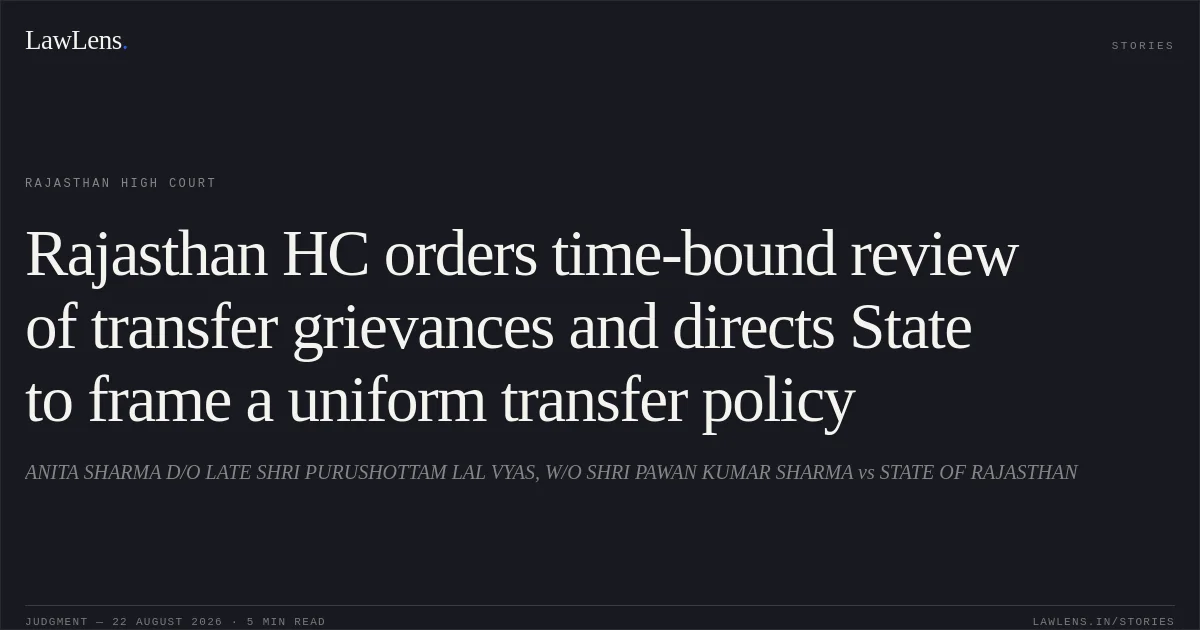
The petitioner and several hundred employees challenged transfer orders issued by various departments, Boards, Nigams, Discoms, local authorities and other establishments.
Source reference: para. 1, paras. 5–9The challenges alleged blanket, premature, repeated and mechanically issued transfers; violation of statutory provisions and departmental guidelines; non-consideration of medical, spouse-related, disability, retirement and family circumstances; absence of sanctioned or suitable posts; mala fides, political interference and punitive transfers disguised as administrative transfers.
Source reference: para. 1, paras. 5–9The lead petitioner sought quashing of his transfer order dated 10 July 2026 and continuation as Senior Veterinary Officer at First Class Veterinary Hospital, Sultanpura, Kota.
Source reference: para. 2The Court heard the batch together because the petitions raised common questions of law and fact, while recognising that their factual circumstances differed.
Source reference: para. 1The Court also considered concerns regarding the ineffective functioning and substantial pendency of the Rajasthan Civil Services Appellate Tribunal (“RCSAT”).
Source reference: paras. 3, 25, 32Issues
1. Whether transfer orders issued by competent authorities could be judicially interfered with merely because they caused personal hardship, were premature, departed from executive guidelines, or failed to accommodate the employee’s preferred posting.
Source reference: paras. 27–31, 35–382. Whether a transfer order is amenable to judicial review where it is issued by an incompetent authority, violates a mandatory statutory provision, is mala fide, colourable, arbitrary, or founded on extraneous considerations.
Source reference: paras. 4, 29, 35–363. Whether personal circumstances, including medical conditions, spouse-related grounds, disability, proximity to retirement, dependent family responsibilities and prior service in difficult areas, require structured consideration by the competent authority.
Source reference: paras. 31, 41, 43–464. Whether the alleged violation of statutory provisions, including Rule 20 of the Rajasthan Service Rules, 1951 and Section 89(8)(ii) of the Rajasthan Panchayati Raj Act, 1994, materially affects the legality of the impugned transfers.
Source reference: paras. 7.9–7.10, 35–365. Whether institutional and transitional directions should be issued to secure time-bound consideration of transfer grievances, improve departmental mechanisms, formulate a State-wide transfer policy and strengthen the functioning of the RCSAT.
Source reference: paras. 32–34, 39–40, 42–60Law Applied
Transfer is ordinarily an incident of service, and an employee holding a transferable post has no vested right to remain posted at a particular place: Gujarat Electricity Board v. Atmaram Sungomal Poshani, (1989) 2 SCC 602; Shilpi Bose v. State of Bihar, 1991 Supp (2) SCC 659; Union of India v. S.L. Abbas, (1993) 4 SCC 357; State of U.P. v. Gobardhan Lal, (2004) 11 SCC 402; and Rajendra Singh v. State of U.P., (2009) 15 SCC 178.
Source reference: paras. 4, 11–13, 27–28Judicial review remains available where the transfer is mala fide, arbitrary, colourable, based on extraneous considerations, issued without jurisdiction, or contrary to a mandatory statutory provision.
Source reference: paras. 4, 29, 35–36Executive guidelines ordinarily do not create enforceable rights, whereas an adopted and operative Government policy binds the Government unless lawfully amended or withdrawn, as recognised in Bhika Ram v. State of Rajasthan, (2025) SCC OnLine SC 2891.
Source reference: para. 30Rule 20 of the Rajasthan Service Rules, 1951 restricts substantive transfer to a lower-paid post except on grounds of inefficiency, misbehaviour or written request, and treats such transfer as reduction in rank requiring disciplinary procedure.
Source reference: paras. 7.10, 35Section 89(8)(ii) of the Rajasthan Panchayati Raj Act, 1994 requires consultation with the concerned Pradhans or Pramukhs before specified transfers.
Source reference: paras. 7.9, 35Personal hardship and spouse, medical, disability or retirement grounds ordinarily warrant administrative consideration but do not, absent a statutory or binding policy mandate, create an absolute right to a particular posting.
Source reference: paras. 21, 31, 38The Court also relied on L. Chandra Kumar v. Union of India, AIR 1997 SC 1125 and Madras Bar Association v. Union of India, (2022) 12 SCC 455 concerning the importance of an effective tribunal mechanism.
Source reference: paras. 7.12, 55–56Reasoning
The Court drew a distinction between the existence of the power to transfer and the legality of its exercise.
Source reference: paras. 29, 35It held that administrative authorities must retain discretion to deploy employees in the public interest, and that the Court cannot substitute its assessment of administrative convenience or personal preference for that of the employer.
Source reference: paras. 27–28, 35Nevertheless, the power is not unfettered: the authority must be competent, act for a legitimate administrative purpose, consider relevant circumstances and comply with mandatory statutory requirements.
Source reference: paras. 29, 35–38Thus, ordinary personal inconvenience, premature transfer or departure from a non-statutory guideline would generally justify a representation rather than quashing of the transfer.
Source reference: paras. 36, 38Conversely, allegations concerning statutory violations, lack of sanctioned posts, incompetence, mala fides, political or extraneous influence, punitive use of transfer, repeated transfers or patent non-application of mind required consideration through a reasoned administrative process.
Source reference: paras. 36, 38, 43–46Because the large number of petitions and the ineffective functioning of the RCSAT created a practical remedial gap, the Court adopted a transitional mechanism requiring individual representations, time-bound decisions, interim protection and institutional reforms, without adjudicating the merits of every individual transfer order.
Source reference: paras. 32–34, 39–40, 47–48, 58–60Holding
The Court did not quash the transfer orders as a general rule and did not confer any right upon the petitioners to remain at their existing stations.
The entire batch was disposed of with directions that each petitioner may submit a comprehensive representation within fifteen days, supported by relevant material, raising statutory, factual and personal grounds.
Source reference: paras. 42–44The competent authority must decide each representation within fifteen days, after appropriate consideration or hearing, by a brief but intelligible and reasoned order addressing competence, statutory compliance, tenure, premature transfer, protected circumstances, availability of a sanctioned post, repeated transfers, mala fides and applicable policies.
Source reference: paras. 45–46The impugned transfers were kept in abeyance for the petitioners who had not joined, until disposal of the representation or thirty days from the judgment, whichever was earlier; those who had already joined remained subject to the outcome of their representations.
Source reference: para. 47Departments and establishments were directed to constitute Transfer Grievance Committees within seven working days.
Source reference: paras. 49–51A State-Level Committee was directed to formulate and place before the Government a comprehensive transfer policy within two months.
Source reference: paras. 52–54The State was further directed to take transitional steps to strengthen and supervise the RCSAT and fill requisite vacancies.
Source reference: paras. 55–56Disciplinary proceedings based solely on non-joining were to take the decision on the employee’s representation into account before proceeding further.
Source reference: para. 57Pending applications were also disposed of.
Source reference: para. 61Acts & Sections Cited
2 provisions across 2 statutes referred to in this judgment. Each provision opens on LawLens.
Rajasthan Panchayati Raj Act, 19941
RAJASTHAN MUNICIPALITIES ACT,20091
Original Court PDF
ANITA SHARMA D/O LATE SHRI PURUSHOTTAM LAL VYAS, W/O SHRI PAWAN KUMAR SHARMAvsSTATE OF RAJASTHAN
Click to open original judgment
Original judgment, available to read, download and summarize on LawLens.in