Facts
The petitioner was in custody in connection with RC-29(S)/2023/CBI/SCB/Kolkata when the CBI sought a production warrant on 17 January 2026 for his production in the present case, RC-6(S)/2023/CBI/SCB/Kolkata. The application was allowed, and the petitioner was formally arrested in the latter case. Although the order permitting arrest was stated to have been passed at 12:30 p.m., the arrest memo recorded the arrest time as 12:25 p.m.
Source reference: pp. 2–3The Special Judge, CBI, accepted the petitioner’s challenge to the arrest as procedurally defective and granted bail on 29 May 2026. However, the court observed that the CBI would not be precluded from again seeking a production warrant and the petitioner’s arrest by following the procedure established by law. The petitioner was not actually released because his bail bond was defective and was subsequently not submitted pursuant to an undertaking.
Source reference: p. 3The CBI thereafter applied for a production warrant and permission to re-arrest the petitioner. The application was allowed, the warrant was issued, and the petitioner was re-arrested and remanded to custody. The petitioner challenged the order under Section 528 of the BNSS, 2023, contending that the CBI was required to first seek cancellation of the bail order before applying for his re-arrest.
Source reference: pp. 2–4Issues
Whether an order permitting re-arrest of an accused who has been granted bail on technical or procedural grounds must necessarily be preceded by a formal order cancelling bail.
Source reference: pp. 4, 7–10Whether the production warrant and re-arrest order passed by the Special Judge, CBI, were legally sustainable when the petitioner had not actually been released from custody pursuant to the bail order.
Source reference: pp. 3, 7–10Law Applied
The Court considered Section 528 of the BNSS, 2023, governing the High Court’s inherent powers, and Sections 437(5) and 439(2) of the CrPC, corresponding to Sections 480(5) and 483(3) of the BNSS, which empower the competent court to direct that a person released on bail be arrested and committed to custody.
Source reference: pp. 2, 7–8It relied on Dolat Ram v. State of Haryana, (1995) 1 SCC 349, for the principle that bail granted on merits should not be cancelled mechanically and ordinarily requires cogent and overwhelming circumstances, such as abuse of the concession, interference with justice, witness intimidation, or likelihood of absconding.
Source reference: pp. 8–9It also considered Satyajit Ballubhai Desai v. State of Gujarat, (2014) 14 SCC 434, and Pogadadabnda Revathi v. State of Telangana, 2026 INSC 75, which hold that police custody of an accused already released on bail cannot ordinarily be granted without first following the legal requirements for cancellation of bail.
Source reference: pp. 4–6However, distinguishing those authorities, the Court relied on Rakesh Kumar Paul v. State of Assam, (2017) 15 SCC 67, and Mihir Rajesh Shah v. State of Maharashtra, 2025 INSC 1288, for the principle that where release is granted because of an illegality or technical defect in the initial arrest, the accused may be re-arrested upon compliance with lawful procedure, without a separate cancellation order.
Source reference: p. 9The Court also distinguished Sumit v. State of U.P., 2026 INSC 145, which concerned the effect of adding graver offences after bail and held that cancellation is not invariably required in that context.
Source reference: pp. 6–7Reasoning
The Court distinguished between bail granted on merits and bail granted because the initial arrest suffered from a curable technical or procedural defect. The petitioner’s bail was granted solely because the arrest memo preceded the order authorising arrest; it was not a merits-based determination that continued custody was unjustified.
Source reference: pp. 3, 8–9Accordingly, the principles governing cancellation of substantive bail under Dolat Ram and Pogadadabnda Revathi were not directly applicable. Although the petitioner had not physically secured release because of the defective or absent bail bond, the Court held that the proposed re-arrest nevertheless affected his prospective liberty and therefore required adherence to natural justice.
Source reference: p. 7The CBI had applied for a production warrant and re-arrest, and the petitioner was heard before the competent court. The expression “procedure established by law” in the earlier bail order did not require a separate formal application and order cancelling bail; an application for a production warrant and re-arrest, considered in accordance with law, was sufficient.
Source reference: p. 10The Court consequently found no legal infirmity in the impugned order.
Source reference: p. 10Holding
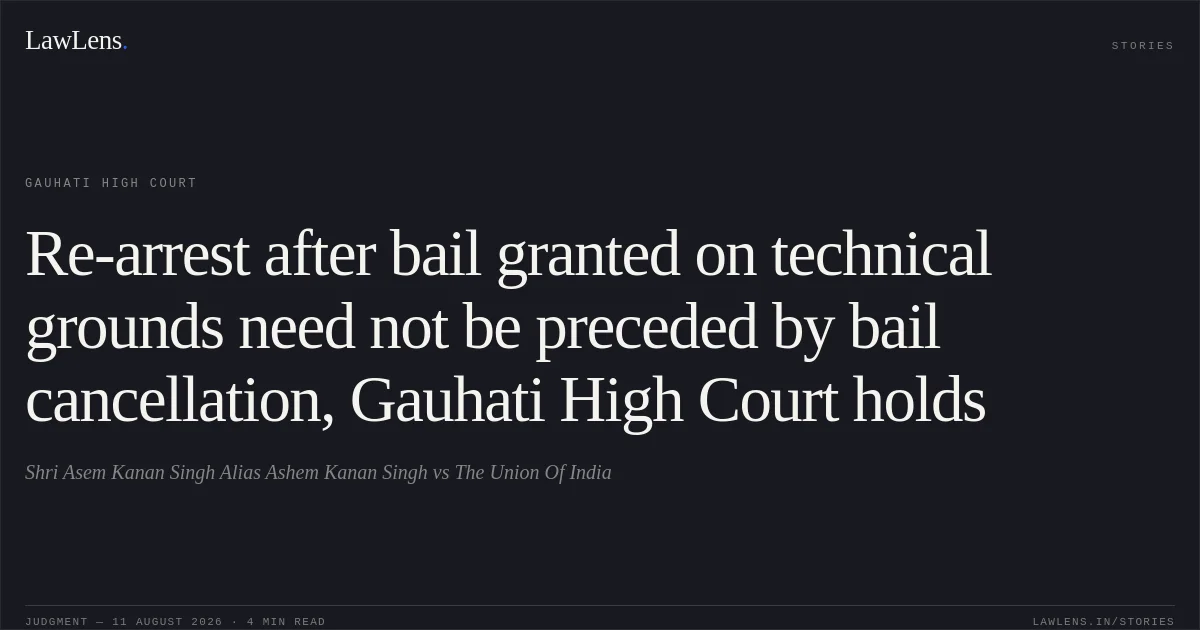
The Court held that a separate order cancelling bail is not mandatory where bail was granted on technical or procedural grounds arising from an unlawful initial arrest, rather than on merits.
In such circumstances, the investigating agency may seek a production warrant and re-arrest, provided the competent court follows lawful procedure and observes natural justice.
Source reference: p. 10Finding no infirmity in the order permitting the production warrant and re-arrest, the Gauhati High Court dismissed the criminal petition.
Source reference: p. 10Acts & Sections Cited
5 provisions across 2 statutes referred to in this judgment. Each provision opens on LawLens.
Bharatiya Nagarik Suraksha Sanhita, 20233
Code of Criminal Procedure, 19732
Original Court PDF
Shri Asem Kanan Singh Alias Ashem Kanan SinghvsThe Union Of India
Click to open original judgment
Original judgment, available to read, download and summarize on LawLens.in