Facts
The appellant filed Bill of Entry No. 7951240 dated 22 September 2023 for clearance of one container of mixed metal scrap imported from Belgium.
Source reference: p. 2Upon examination and assessment based on a Chartered Engineer’s report, the goods were found to comprise broken and damaged electrical and electronic articles, printed circuit boards, electrical meters and similar materials, rather than the declared mixed metal scrap.
Source reference: p. 2The goods were seized on 28 October 2023.
Source reference: p. 2By Order-in-Original dated 22 November 2023, the Additional Commissioner rejected the declared classification, treated the goods as e-waste, confiscated them under Sections 111(d) and 111(m) of the Customs Act, 1962, and permitted re-export on payment of redemption fine of ₹7,50,000 under Section 125 and penalty of ₹2,50,000 under Section 112(a)(i).
Source reference: p. 2The Commissioner (Appeals) upheld that order.
Source reference: p. 2During the appeal, the appellant established that the entire consignment had been re-exported under Shipping Bill No. 1699964 dated 15 June 2024, with the Let Export Order granted on 6 July 2024, and sought deletion or substantial reduction of the redemption fine and penalty.
Source reference: p. 3Issues
Whether the redemption fine of ₹7,50,000 imposed under Section 125 of the Customs Act, 1962, and the penalty of ₹2,50,000 imposed under Section 112(a)(i) were liable to be set aside or reduced after the confiscated goods had been completely re-exported and had not entered domestic consumption?
Source reference: pp. 3–5Whether the classification of the goods as e-waste, based principally on the Chartered Engineer’s report, justified the quantum of redemption fine and penalty imposed by the adjudicating authority?
Source reference: pp. 4–5Law Applied
The Tribunal applied Sections 111(d) and 111(m) of the Customs Act, 1962, concerning confiscation of improperly imported goods and goods not corresponding with the declaration; Section 125, which permits release of confiscated goods on payment of redemption fine; and Section 112(a)(i), which authorises penalty for acts rendering goods liable to confiscation under Section 111.
Source reference: p. 2The Tribunal also applied the principle that the quantum of redemption fine and penalty must be proportionate to the circumstances of the import, including whether the goods were released for domestic consumption, whether revenue or environmental interests were prejudiced, and whether the importer complied with the direction of re-export.
Source reference: pp. 3–5The appellant relied on M/s Selvam Industries Ltd. v. Commissioner of Customs, Ludhiana, 2021 (377) E.L.T. 458; M/s Siemens Limited v. Collector of Customs, 1999 (113) E.L.T. 776 (S.C.); and Commissioner of Customs (Import) v. Stoneman Marble Industries, 2011 (264) E.L.T. 3 (S.C.).
Source reference: p. 3Reasoning
The Tribunal accepted that the goods had been found different from the declaration and that the Department had treated them as e-waste on the basis of the Chartered Engineer’s report.
Source reference: p. 4However, the goods were never cleared for home consumption and had already been re-exported in compliance with the adjudication order; consequently, there was no continuing domestic circulation, environmental risk, or revenue prejudice identified in the appeal.
Source reference: p. 3The Tribunal further observed that the classification was based only on the Chartered Engineer’s report, which was not conclusive evidence of classification.
Source reference: p. 5Although the confiscation and the appellant’s liability under the Customs Act were not wholly annulled, these mitigating circumstances warranted interference with the quantum of the redemption fine and penalty.
Source reference: p. 5The Tribunal therefore treated the original amounts as excessive and reduced them substantially rather than setting them aside altogether.
Source reference: p. 5Holding
The appeal was partly allowed.
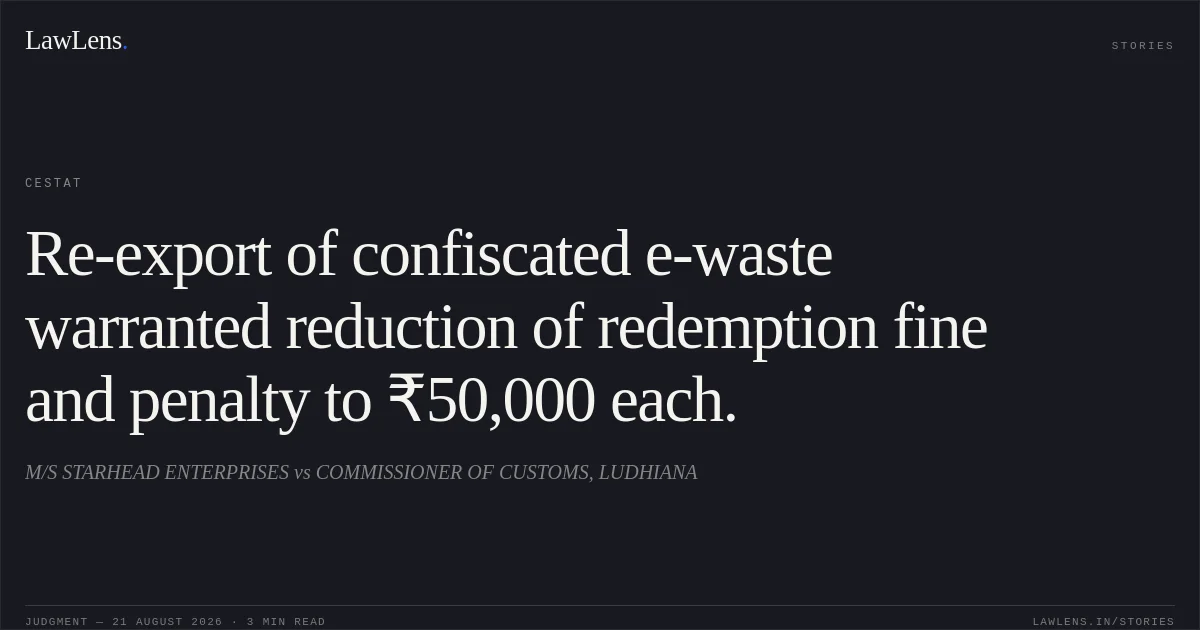
The Tribunal modified the impugned order by reducing the redemption fine under Section 125 from ₹7,50,000 to ₹50,000, and the penalty under Section 112(a)(i) from ₹2,50,000 to ₹50,000.
Source reference: p. 5The reduction was granted principally because the entire consignment had already been re-exported, had not been cleared for home consumption, and the classification as e-waste rested only on the Chartered Engineer’s report.
Source reference: p. 5Acts & Sections Cited
3 provisions across 1 statute referred to in this judgment. Each provision opens on LawLens.
Customs Act,19623
Original Court PDF
M/S STARHEAD ENTERPRISESvsCOMMISSIONER OF CUSTOMS, LUDHIANA
Click to open original judgment
Original judgment, available to read, download and summarize on LawLens.in