Facts
The petitioner, Devendra Munda, challenged a preventive detention order passed by the Principal Secretary, Home Department, Jharkhand, under Section 3(1) of the Prevention of Illicit Traffic in Narcotic Drugs and Psychotropic Substances (PITNDPS) Act, 1988.
Source reference: para. 1The order, dated 14.10.2025, directed his detention for one year.
Source reference: para. 1The grounds for detention included the petitioner’s prior conviction in 2018 for possession of 2.7 kg of opium (released on bail in 2021), a pending 2024 case involving 2.2 kg of opium (released on bail in May 2025), and three 'Sanha' (police diary entries) from June and July 2025 alleging he was enticing youth into the drug trade.
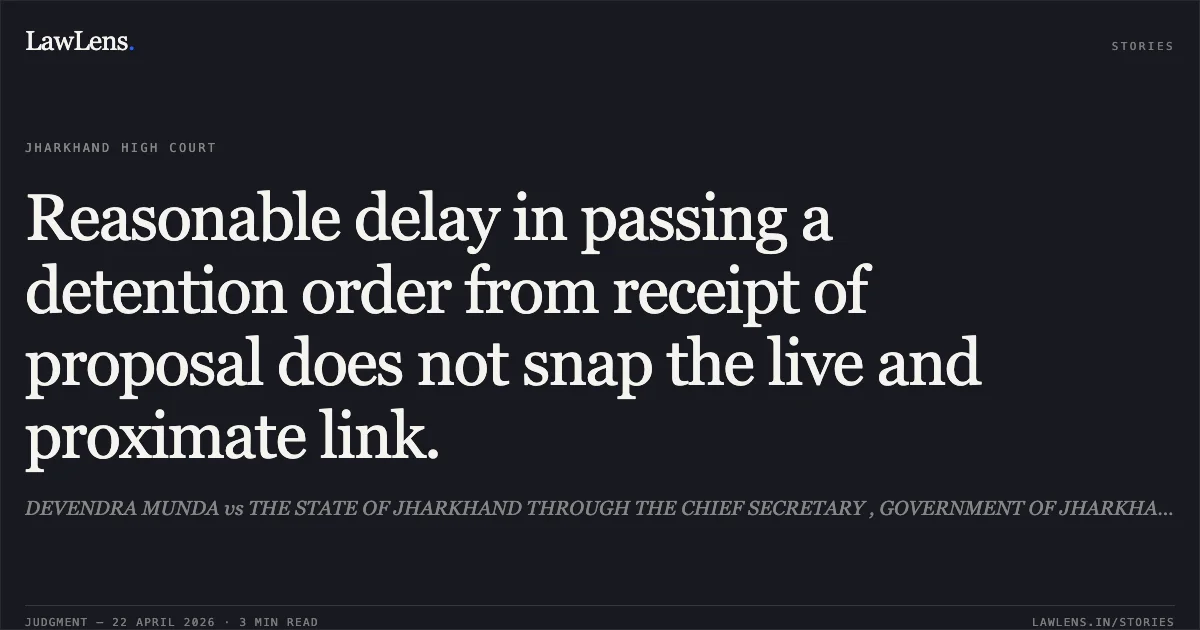
Source reference: para. 5, 24The petitioner contended that the proposal for detention was initiated on 31.07.2025, but the order was passed only on 14.10.2025, leading to an unexplained delay of 2.5 months.
Source reference: para. 6, 12Issues
1. Whether there was an unreasonable delay in passing the detention order that snapped the "live and proximate link" between the petitioner's activities and the purpose of detention?
Source reference: para. 11(i) & (ii)2. Whether the fact that the petitioner had been granted bail in the underlying criminal cases precluded the authority from passing a preventive detention order?
Source reference: para. 11(iii)Law Applied
Section 3(1) of the PITNDPS Act regarding the power to make orders detaining certain persons.
Source reference: para. 11Sushanta Kumar Banik v. State of Tripura (2022 SCC OnLine SC 1333), which establishes that an unexplained delay between the proposal and the detention order can vitiate the order if it snaps the "live and proximate link".
Source reference: para. 7, 18The principles from Ameena Begum v. State of Telangana (2023) 9 SCC 587 regarding judicial review of the "subjective satisfaction" of detaining authorities.
Source reference: para. 22D.M. Nagaraja v. Government of Karnataka (2011) 10 SCC 215, which holds that preventive detention is permissible even if a person is on bail if the ordinary law is insufficient to deter habitual criminal activities.
Source reference: para. 41Reasoning
The Court clarified that the internal police correspondence starting 31.07.2025 were preliminary reports; the formal proposal only reached the detaining authority (Respondent No. 2) on 03.10.2025.
Source reference: para. 14-16Since the order was passed on 14.10.2025 (within 11 days of receipt), there was no "unreasonable delay".
Source reference: para. 20The Court distinguished Sushanta Kumar Banik, noting that the delay here was significantly shorter and the "live link" remained intact due to the petitioner’s habitual involvement in NDPS offenses despite a prior conviction.
Source reference: para. 28-33The Court reasoned that the detaining authority exercised "subjective satisfaction" that the petitioner’s activities posed a threat to public order that ordinary criminal law (bail conditions) could not control, especially since he resumed drug trafficking shortly after his 2021 release.
Source reference: para. 39-44Holding
The Court held that there was no snapping of the "live and proximate link" as the detaining authority acted promptly once the formal proposal was received.
The Court held that the grant of bail by a court in a substantive criminal case does not bar preventive detention if the authority is satisfied that the detenu is a habitual offender not amenable to the ordinary course of law.
Source reference: para. 41-44The High Court dismissed the writ petition, upholding the detention order and its confirmation, and declined all prayers for an independent investigation by the CID/CBI.
Source reference: para. 1, 45-46Acts & Sections Cited
9 provisions across 2 statutes referred to in this judgment. Each provision opens on LawLens.
Narcotic Drugs and Psychotropic Substances Act, 19858
Prevention of Illicit Traffic in Narcotic Drugs and Psychotropic Substances Act, 19881
Original Court PDF
DEVENDRA MUNDAvsTHE STATE OF JHARKHAND THROUGH THE CHIEF SECRETARY , GOVERNMENT OF JHARKHAND
Click to open original judgment
Original judgment, available to read, download and summarize on LawLens.in