01Facts
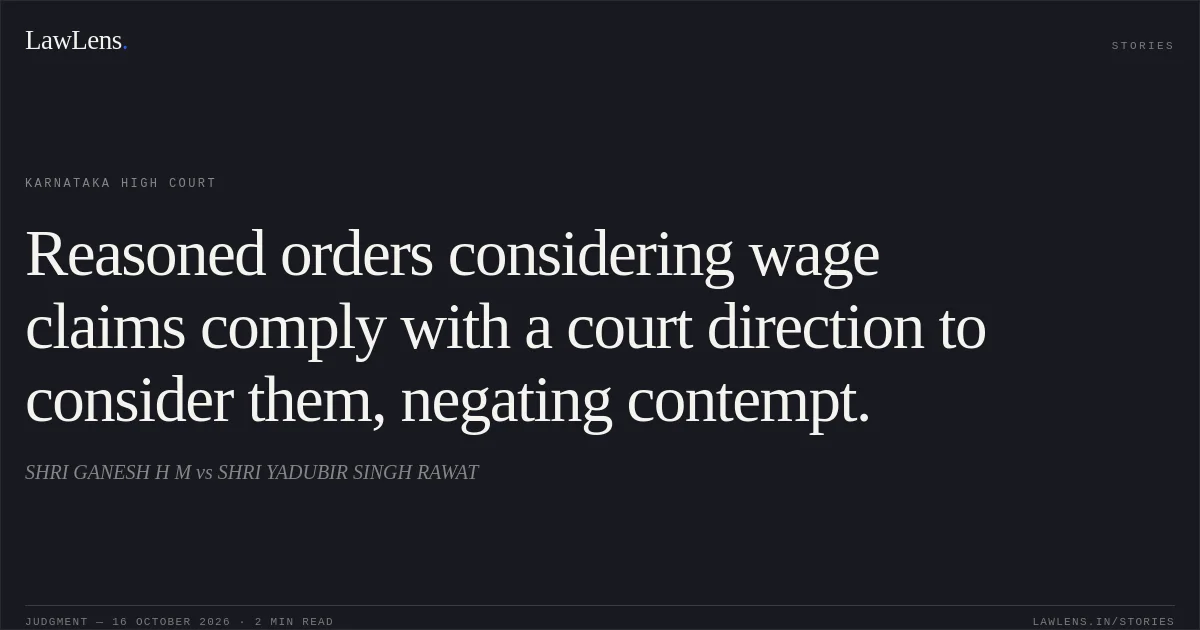
The complainants alleged wilful disobedience of the order in W.P. No. 13164/2024, which directed the respondents to consider their claims for wages in accordance with the directions in an earlier writ petition.
pp. 16–17The Court had previously expressed a prima facie view that denying payment of 1/30th of the relevant pay on the ground that some complainants worked under contractors might not comply with the writ direction.
p. 17The respondents relied on individual orders dated 6 and 7 August 2026, stating that each complainant’s eligibility had been considered and a reasoned decision made.
p. 19The complainants argued that similarly situated workers had received 1/30th of the relevant pay plus dearness allowance, while they had been denied that benefit.
p. 2002Issues
i.1. Whether the respondents wilfully disobeyed the writ court’s direction to consider the complainants’ wage claims.
pp. 16–17ii.2. Whether the individual orders dated 6 and 7 August 2026 constituted compliance with that direction.
pp. 19–2003Law Applied
Sections 11 and 12 of the Contempt of Courts Act, 1971, read with Article 215 of the Constitution, were invoked in the contempt petition.
p. 15Where a court directs an authority to consider a claim, compliance may be established by showing that the authority considered the claim and issued a decision; the direction does not itself amount to an order granting the claimed benefit.
pp. 17, 19–20Provisions in the judgment · 2 · Linked ones open on LawLens
Contempt of Courts Act, 1971 Section 11Section 12
04Reasoning
The writ order required consideration of the complainants’ wage claims in accordance with earlier directions, rather than expressly directing payment of the claimed wages.
p. 17The respondents produced individual orders recording that eligibility had been considered and reasoned decisions issued.
p. 19On that basis, the Court found the writ order had been complied with, notwithstanding the complainants’ contention that comparable workers had received the benefit.
pp. 19–20The Court did not determine in this contempt proceeding whether the wage benefit had been correctly denied on the merits.
05Holding
The Court held that the order of the writ court had been complied with and found no basis to proceed with the contempt petition.
p. 20It consigned the petition and discharged the accused; it also allowed accused No. 1’s application for exemption from appearance that day.
pp. 20–21Original Court PDF
SHRI GANESH H MvsSHRI YADUBIR SINGH RAWAT
Click to open original judgment
Original judgment, available to read, download and summarize on LawLens.in