Facts
The appellant, an employee of the Border Security Force (BSF) since 1994, was compulsorily retired on grounds of unsuitability on 31.07.2021
Source reference: para. 3-4Following his retirement, he filed an appeal from his native residence in Saharsa, Bihar, which was rejected by the BSF authorities via correspondence sent to his Bihar address
Source reference: para. 5, 14The appellant challenged his retirement in the Patna High Court via C.W.J.C. No. 9289 of 2022. The learned Single Judge disposed of the writ petition on 31.01.2026, holding that the court lacked territorial jurisdiction because the primary cause of action arose in Chhattisgarh
Source reference: para. 1The appellant filed the present Letters Patent Appeal (LPA) solely to challenge the finding on jurisdiction
Source reference: para. 8Issues
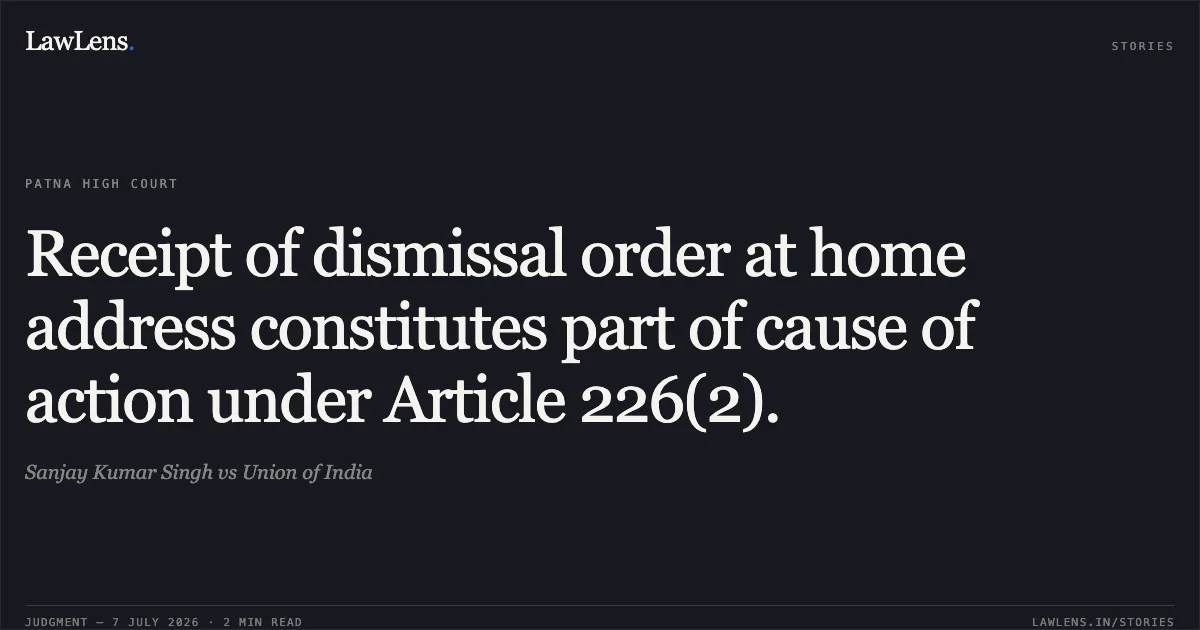
1. Whether the Patna High Court has territorial jurisdiction to entertain the writ petition under Article 226(2) of the Constitution when the order of retirement/rejection of representation was communicated to the appellant at his residence in Bihar
Source reference: para. 9, 15Law Applied
Article 226(2) of the Constitution of India, which empowers a High Court to issue writs if the cause of action arises "wholly or in part" within its territories, regardless of the seat of government or authority
Source reference: para. 11Section 20(c) of the CPC for interpreting "cause of action" as the bundle of facts necessary for the plaintiff to prove his right to judgment
Source reference: para. 12.1Kusum Ingots and Alloys Ltd. v. Union of India, establishing that even a small fraction of the cause of action grants jurisdiction
Source reference: para. 12.1Nawal Kishore Sharma v. Union of India and Rameshwar Prasad v. Union of India were applied to establish that the communication of an adverse order or rejection of representation to a petitioner’s native address in a particular State constitutes a part of the cause of action in that State.
Source reference: para. 12.2, 13Reasoning
The Court reasoned that "cause of action" includes not only the infraction of a right but also the factual situation entitling a person to a remedy
Source reference: para. 12.1In the present case, while the initial retirement order might have originated elsewhere, the appellant’s representation was sent from Bihar, and the BSF’s subsequent refusal to reinstate him (Annexure R-8) was communicated directly to his address in Saharsa, Bihar
Source reference: para. 14Following the precedent in Rameshwar Prasad, the Court observed that a dismissal or retirement order becomes effective and "known" to the person only upon communication. Since a fraction of the cause of action—specifically the communication of the rejection of his reinstatement plea—occurred within Bihar, the Patna High Court possesses the territorial jurisdiction to hear the matter
Source reference: para. 13, 15Holding
The Court held that the learned Single Judge erred in dismissing the writ petition for lack of jurisdiction
The Division Bench set aside the impugned order dated 31.01.2026 and revived C.W.J.C. No. 9289 of 2022. The matter was remanded to the learned Single Judge for a hearing on the merits, as the Patna High Court has the jurisdiction to adjudicate the dispute
Source reference: para. 16, 18Acts & Sections Cited
2 provisions across 1 statute referred to in this judgment. Each provision opens on LawLens.
Code of Civil Procedure, 19082
Original Court PDF
Sanjay Kumar SinghvsUnion of India
Click to open original judgment
Original judgment, available to read, download and summarize on LawLens.in