Facts
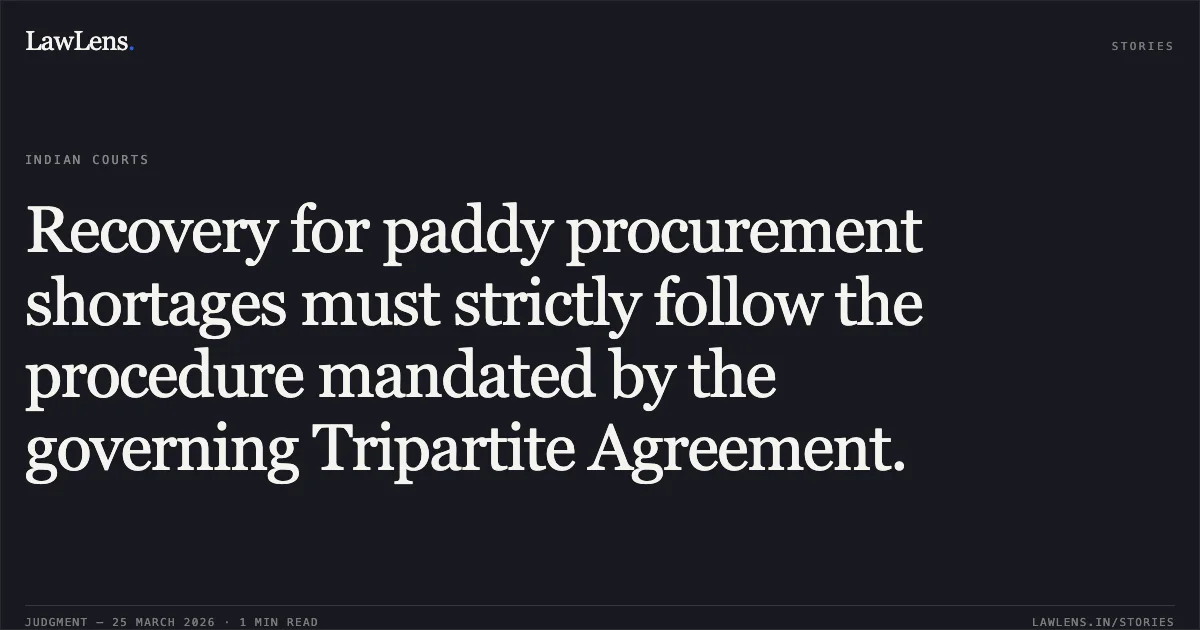
The Petitioner, a Salesman and In-charge of a Paddy Procurement Centre, purchased paddy under a state-formulated policy governed by a tripartite agreement.
Source reference: para 2Under the agreement, the Marketing Federation was required to lift the paddy by 31.01.2025; however, they failed to do so, leaving the stock exposed to sunlight, which resulted in weight loss due to moisture evaporation.
Source reference: para 2The Petitioner alleged that the authorities, through police intervention, were threatening him with criminal cases and recovery of losses without conducting a proper enquiry or assessment.
Source reference: para 2Consequently, the Petitioner submitted representations on 30.10.2025 and 24.02.2026 to the Collector, which remained undecided.
Source reference: para 2Issues
1. Whether the respondents are required to follow the recovery and arbitration procedures stipulated in the Tripartite Agreement before taking coercive action against the Petitioner for paddy shortages?
Source reference: para 5-72. Whether the District Collector is mandated to decide the Petitioner's pending representations regarding the lack of personal liability for the alleged shortages?
Source reference: para 8Law Applied
Clause 5.6 of the Agreement stipulates that any recovery for loss of paddy must first be adjusted against the Society’s commission and other dues, and any remaining balance must be recovered via proceedings under the Chhattisgarh Co-operative Societies Act, 1960.
Source reference: para 5, 7Clause 13 of the Agreement serves as an arbitration clause, designating the District Collector as the final authority for dispute resolution, with a provision for appeal to the Divisional Commissioner.
Source reference: para 6The Court also relied on the precedent of Revaram Sahu v. State of Chhattisgarh (WPC No. 2651 of 2025).
Source reference: para 4, 8Reasoning
The Court examined the specific mechanism for loss recovery provided under Clause 5.6, noting that it prioritizes recovery from society commissions before initiating legal proceedings.
Source reference: para 7The Petitioner contended that the shortage was not due to his fault but due to the Federation's failure to lift the paddy timely, leading to environmental degradation of the stock.
Source reference: para 2The Court found that since a dispute regarding liability existed, it fell within the ambit of the arbitration mechanism provided in Clause 13.
Source reference: para 6The State counsel did not dispute the applicability of these clauses or the fact that the matter was covered by previous judicial directions in similar cases.
Source reference: para 3Therefore, the Court reasoned that the Collector must exercise his adjudicatory power under the agreement to resolve the Petitioner's pending representations before any further action is taken.
Source reference: para 8Holding
The High Court disposed of the writ petition with a direction to Respondent No. 2 (Collector, District Kabirdham) to decide the Petitioner's pending representations dated 30.10.2025 and 24.02.2026.
The Court ordered that the decision be passed through a speaking order, following the procedures contemplated in the tripartite agreement, within a period of 60 days from the date of receipt of the court’s order.
Source reference: para 8All pending interlocutory applications were likewise disposed of.
Source reference: para 10Original Court PDF
RAMASHANKAR CHANDRAKARvsSTATE OF C.G.
Click to open original judgment
Original judgment, available to read, download and summarize on LawLens.in