Facts
The prosecution alleged that A1, the deceased’s son, and the petitioner (A2) conspired to murder the deceased following a property dispute.
Source reference: p. 2–3It alleged that A1 held the deceased while the petitioner stabbed him, and that A1 then inflicted a further cut injury.
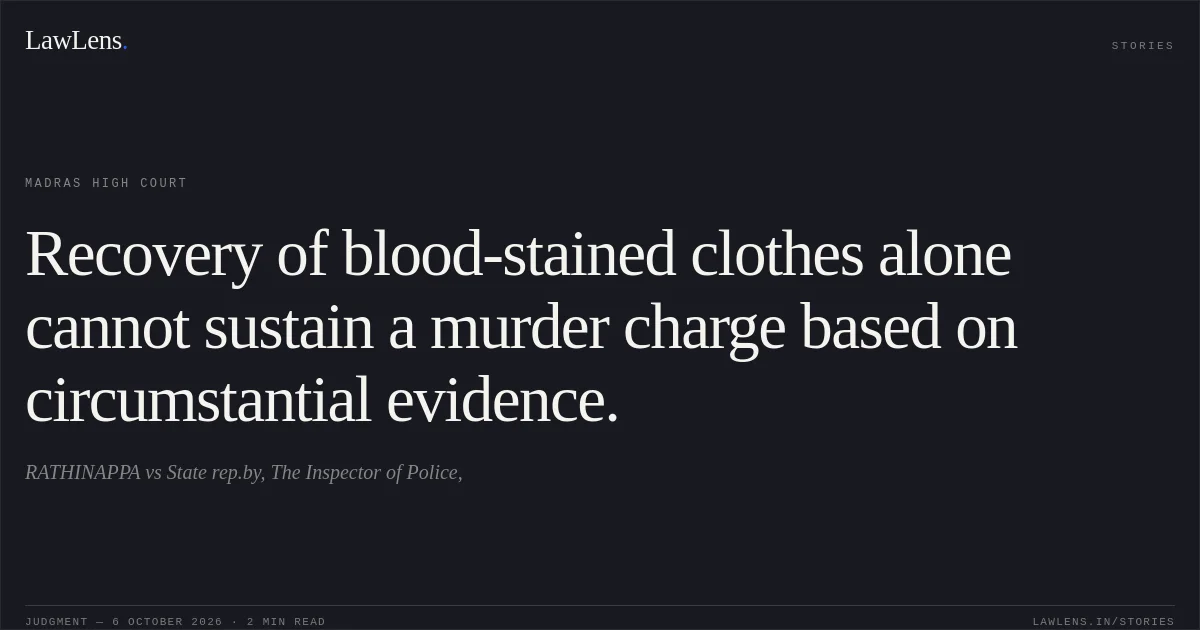
Source reference: p. 2–3The case against the petitioner was based principally on alleged recovery of his blood-stained clothes, said to bear blood matching the deceased’s blood group, and police confessions.
Source reference: p. 2–3The prosecution witnesses spoke to motive and the deceased being last seen with A1, but none implicated the petitioner in those circumstances.
Source reference: p. 6–7The alleged conspiracy meeting was also not spoken to by LW1.
Source reference: p. 6–7The petitioner’s application for discharge was dismissed by the Sessions Court, and he challenged that order in revision.
Source reference: p. 1, 4–5Issues
1. Whether the material on record disclosed sufficient ground, or grave suspicion, to frame a charge against the petitioner for conspiracy to commit murder
Source reference: p. 4–5, 82. Whether recovery of blood-stained clothes, allegedly bearing blood matching the deceased’s blood group, could alone sustain the charge against the petitioner in the absence of evidence connecting him to motive or the deceased’s last-seen circumstances
Source reference: p. 5–8Law Applied
The prosecution charged the petitioner under Sections 120B read with 302 of the Indian Penal Code.
Source reference: p. 3At the discharge stage, a charge requires sufficient ground to proceed; the Court held that the material against this petitioner did not raise even grave suspicion.
Source reference: p. 8Relying on Raja Naykar v. State of Chhattisgarh, (2024) 3 SCC 481, the Court reiterated that recovery of a blood-stained weapon or clothing, even where the blood group matches that of the deceased, is not by itself sufficient to prove murder.
Source reference: p. 8The second respondent also invoked Section 106 of the Indian Evidence Act concerning the petitioner’s explanation for the clothes, but the Court did not treat that submission as supplying the missing evidentiary links.
Source reference: p. 5Reasoning
The Court found no witness evidence that the petitioner had a motive to kill the deceased or was last seen with him; the evidence concerning motive and the last-seen circumstance related to A1.
Source reference: p. 6–7Nor did LW1 support the alleged conspiracy meeting between A1 and the petitioner.
Source reference: p. 6In those circumstances, the alleged recovery of blood-stained clothes—even with a matching blood group—could not complete a chain of circumstances implicating the petitioner.
Source reference: p. 8The Court further noted that the petitioner had been implicated on the basis of A1’s police confession, and concluded that the remaining material amounted only to suspicion.
Source reference: p. 8Holding
The Court held that there was no sufficient ground to frame a charge against the petitioner.
It allowed the revision, set aside the Sessions Court’s order, and discharged the petitioner.
Source reference: p. 8The trial against the other accused was to proceed in accordance with law and without being influenced by the Court’s observations.
Source reference: p. 8Acts & Sections Cited
3 provisions across 2 statutes referred to in this judgment. Each provision opens on LawLens.
Code of Criminal Procedure, 19732
Indian Penal Code, 18601
Original Court PDF
RATHINAPPAvsState rep.by, The Inspector of Police,
Click to open original judgment
Original judgment, available to read, download and summarize on LawLens.in