Facts
The petitioner was appointed as a Head Master, subsequently promoted as a Lecturer, and later retired upon attaining the age of superannuation.
Source reference: para. 2The respondents passed recovery orders dated 9 September 2013 and 15 January 2014, seeking recovery of ₹1,20,302 allegedly paid in excess during the period 1997–2005. The recovery was reflected in a Pension Payment Order dated 31 August 2018.
Source reference: paras. 2, 4The petitioner contended that his pay was retrospectively reduced and recovery was ordered without prior notice or an opportunity of hearing, and that there was no allegation of fraud, misrepresentation, or suppression on his part.
Source reference: paras. 2–3, 7The respondents justified the recovery on the basis of an objection raised by the District Pension Officer during scrutiny of the petitioner’s pension case.
Source reference: para. 4Issues
Whether recovery of alleged excess payment from the petitioner’s retiral dues, after retirement and without issuing notice or affording an opportunity of hearing, violated the principles of natural justice.
Source reference: paras. 2–3, 7Whether recovery of excess payment made during 1997–2005 was impermissible under the principles laid down in State of Punjab v. Rafiq Masih (White Washer), particularly where the petitioner was treated as a Class-III employee and the recovery was sought after retirement.
Source reference: paras. 6–8Law Applied
The Court applied the principles of natural justice, holding that an adverse order affecting retiral benefits cannot ordinarily be passed without notice and an opportunity of hearing.
Source reference: para. 7It relied principally on State of Punjab v. Rafiq Masih (White Washer), (2015) 4 SCC 334, which identifies circumstances in which recovery of excess payments is impermissible, including recovery from Class-III or Class-IV employees, recovery from retired employees or employees nearing retirement, and recovery of payments made more than five years before the recovery order; recovery is also barred where it would be inequitable, harsh, or arbitrary.
Source reference: para. 6The Court further recognised that recovery may be sustainable where the employee obtained the benefit through fraud, misrepresentation, or suppression of material facts, but found no such circumstance in the present case.
Source reference: para. 7Reasoning
The Court found that the petitioner had retired and that the respondents had retrospectively reduced his pay and ordered recovery of ₹1,20,302 without issuing any notice or granting a hearing.
Source reference: para. 7There was no material showing that the petitioner had secured the alleged excess payment through fraud, misrepresentation, or suppression, nor was the excess payment attributable to any fault on his part.
Source reference: paras. 7–8Since the amount had allegedly been paid between 1997 and 2005, the recovery was sought several years after the payments, and the petitioner was treated by the Court as a Class-III employee who had already retired. The case therefore fell within categories (i), (ii), and (iii) of Rafiq Masih, making the recovery impermissible.
Source reference: paras. 6, 8The absence of procedural fairness independently rendered the recovery orders unsustainable.
Source reference: para. 7Holding
The Court held that the recovery orders dated 9 September 2013 and 15 January 2014, along with the consequential PPO dated 31 August 2018, could not withstand judicial scrutiny and quashed them.
The respondents were directed to refund the entire amount sought to be recovered, or already recovered, within three months from the date of production of a certified copy of the judgment.
Source reference: para. 10The writ petition was accordingly disposed of.
Source reference: para. 11Original Court PDF
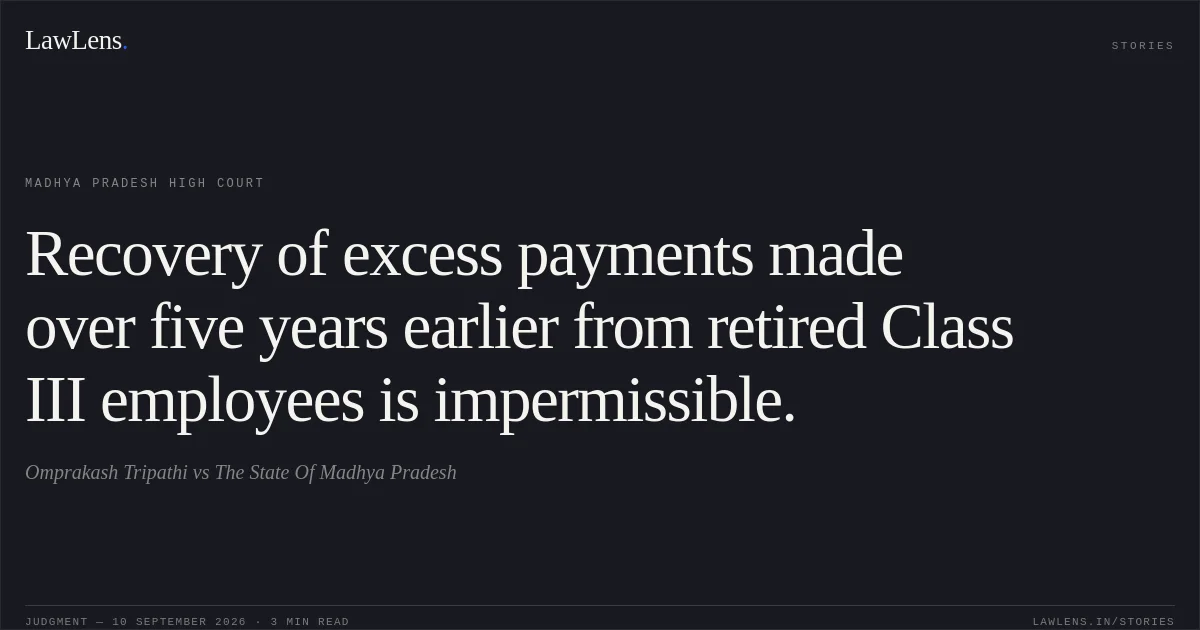
Omprakash TripathivsThe State Of Madhya Pradesh
Click to open original judgment
Original judgment, available to read, download and summarize on LawLens.in