Facts
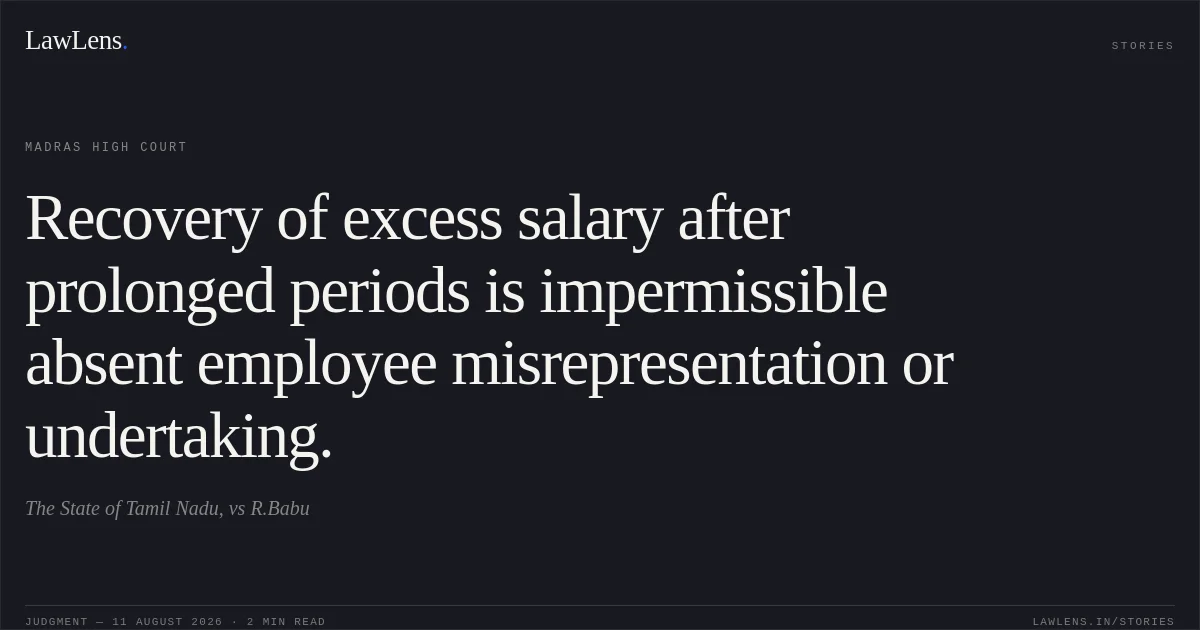
R. Babu, a retired Sub-Inspector of Police, challenged the recovery of excess salary allegedly paid to him.
Source reference: p.2In W.P. No. 34516 of 2025, the Writ Court held that recovery of excess salary was impermissible under the Supreme Court’s decision in State of Punjab v. Rafiq Masih, (2015) 4 SCC 334. However, it permitted the authorities to refix his pay in accordance with the applicable Pay Rules and Government Orders, observing that an erroneous pay fixation could be corrected, although recovery after a prolonged period—particularly in the absence of misrepresentation or a clear undertaking—would cause hardship. The State and police authorities filed the present writ appeal against that order.
Source reference: p.2Issues
1. Whether the authorities could recover excess salary paid to the retired employee in the absence of misrepresentation or a clear undertaking by him
Source reference: p.22. Whether the authorities were nevertheless entitled to refix the employee’s pay in accordance with the applicable Pay Rules and Government Orders
Source reference: p.23. Whether the excess salary already recovered was required to be refunded to the respondent
Source reference: p.3Law Applied
The Court applied the principle laid down in State of Punjab v. Rafiq Masih, (2015) 4 SCC 334, that recovery of excess payments is generally impermissible where it would cause hardship, particularly in cases involving retired employees, prolonged recovery, and absence of fraud, misrepresentation, or a clear undertaking by the employee.
Source reference: p.2At the same time, an erroneous pay fixation may be corrected prospectively or otherwise refixed in accordance with the governing Pay Rules and Government Orders; the prohibition on recovery does not prevent the competent authority from determining the employee’s correct entitlement.
Source reference: p.2Reasoning
The Writ Court had correctly distinguished between correction of an erroneous pay fixation and recovery of amounts already paid.
Source reference: p.2The authorities could determine and refix the salary payable to the respondent under the applicable rules, but recovery of the excess amount, after a prolonged period and without any finding of misrepresentation or undertaking, was barred by the hardship principle in Rafiq Masih. The Division Bench found no infirmity in that approach and further directed restitution of the amount that had already been recovered from the respondent.
Source reference: p.2; p.3Holding
The authorities were permitted to refix the respondent’s pay in accordance with the applicable rules, but were not entitled to recover the excess salary in the circumstances of the case.
The writ appeal was disposed of without interference with the Writ Court’s order. They were directed to refund the excess amount already recovered within twelve weeks from receipt of the order’s copy. No costs were imposed, and the connected miscellaneous petition was closed.
Source reference: p.3Original Court PDF
The State of Tamil Nadu,vsR.Babu
Click to open original judgment
Original judgment, available to read, download and summarize on LawLens.in