Facts
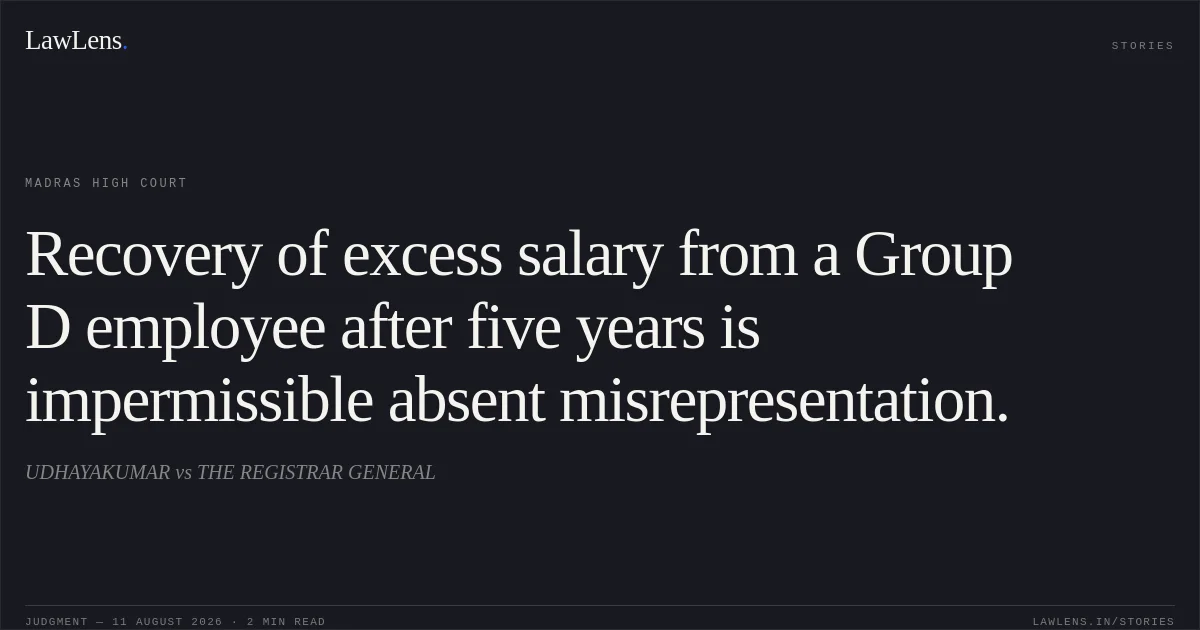
The petitioner, appointed as a Night Watchman on 01.12.2011 and serving at the District Munsif-cum-Judicial Magistrate Court, Pochampalli, was granted an increment pursuant to a Pay Cell communication.
Source reference: p.2Following a High Court audit objection, the respondents determined that the increment and consequent pay fixation were erroneous and ordered recovery of excess pay and allowances amounting to ₹1,23,209 for the period from 01.08.2013 to 31.03.2023, in 24 monthly instalments with effect from 01.04.2023.
Source reference: p.2The petitioner challenged Office Order No. 28/2023 dated 26.04.2023, contending that the excess payment resulted from an establishment error, without any misrepresentation on his part, and that recovery after several years would cause hardship.
Source reference: pp.2–3Issues
1. Whether the respondents were entitled to revise the petitioner’s pay fixation and correct the erroneous increment granted pursuant to the Pay Cell communication.
Source reference: pp.2–32. Whether recovery of ₹1,23,209 from the petitioner, a Class IV/Group D employee, for excess payments made over a period exceeding five years and without any misrepresentation by him, was legally permissible.
Source reference: pp.3–4Law Applied
The Court held that unjust enrichment from public funds is impermissible and that competent authorities may rectify erroneous pay fixation in accordance with the applicable Pay Rules and Government Orders; such revised pay fixation may therefore be sustained.
Source reference: p.2However, it relied on State of Punjab v. Rafiq Masih, (2015) 4 SCC 334, which identifies circumstances in which recovery of excess payments is impermissible, including recovery from Class III and Class IV employees, recovery of payments made for a period exceeding five years before the recovery order, and recovery that would be harsh, arbitrary, or inequitable.
Source reference: pp.3–4Reasoning
The Court distinguished between correcting the petitioner’s pay fixation and recovering amounts already paid.
Source reference: p.2Since the increment had been erroneously granted, the respondents were competent to revise the petitioner’s pay in accordance with the governing rules and audit objection.
Source reference: p.2Nevertheless, the petitioner was a Night Watchman, falling within the Class IV/Group D category, and the excess payment had accrued over approximately ten years—from 01.08.2013 to 31.03.2023—before the recovery order dated 26.04.2023.
Source reference: pp.2–3The Court further found no misrepresentation by the petitioner; the error was attributable to the establishment.
Source reference: pp.3–4Applying the principles in Rafiq Masih, it held that recovery after such a long period would cause extreme hardship and would be impermissible, although correction of the pay fixation itself could continue.
Source reference: pp.3–4Holding
The Court confirmed the revision of the petitioner’s pay pursuant to the audit objection but set aside the recovery of the excess salary of ₹1,23,209.
Any amount already recovered under the impugned order was directed to be repaid to the petitioner within 12 weeks from receipt of a copy of the order.
Source reference: p.4The writ petition was accordingly partly allowed; the connected miscellaneous petitions were closed, and there was no order as to costs.
Source reference: p.4Original Court PDF
UDHAYAKUMARvsTHE REGISTRAR GENERAL
Click to open original judgment
Original judgment, available to read, download and summarize on LawLens.in