Facts
The petitioner, Sakthivel, was appointed as a Typist on 8 August 2009 and was serving in the II Additional District Court, Tiruchengode.
Source reference: p.2Following an internal audit, the respondents found that an inadmissible promotional increment had been granted due to an erroneous fixation of pay.
Source reference: p.2By proceedings dated 4 July 2026, the third respondent ordered recovery of ₹2,08,991 as excess pay and allowances allegedly paid during the period from 1 February 2011 to 30 June 2026.
Source reference: p.2The petitioner challenged the recovery proceedings under Article 226 of the Constitution.
Source reference: no citationThe respondents did not establish that the excess payment resulted from any misrepresentation by the petitioner.
Source reference: p.3Issues
Whether the respondents were entitled to revise the petitioner’s pay fixation upon discovering an erroneous promotional increment granted contrary to the applicable Pay Rules and Government Orders.
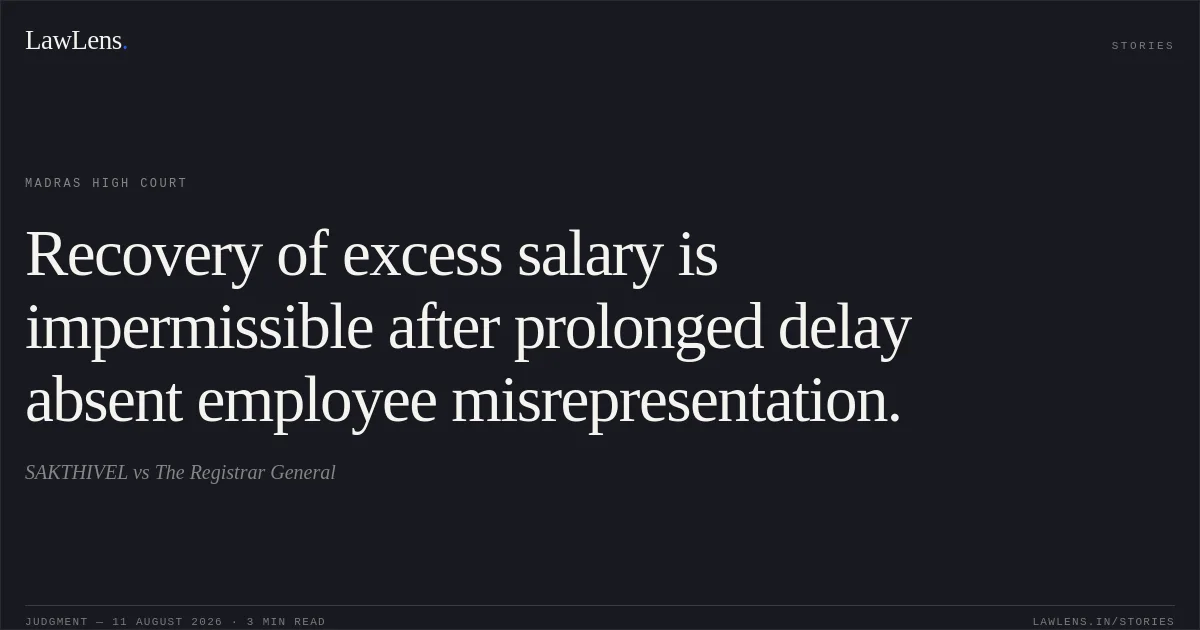
Source reference: pp.2–3Whether recovery of ₹2,08,991 paid as excess salary and allowances over a period exceeding five years, in the absence of misrepresentation by the petitioner, was legally permissible.
Source reference: pp.3–4Law Applied
The Court held that public authorities may rectify an erroneous fixation of pay and revise an employee’s salary in accordance with the applicable Pay Rules and Government Orders, since an employee cannot claim an unjust gain from public funds.
Source reference: p.2However, it relied on State of Punjab v. Rafiq Masih, (2015) 4 SCC 334, particularly the principles that recovery of excess payments is ordinarily impermissible where it is made from Group C or Group D employees, from retired employees or those nearing retirement, where the excess payment has continued for more than five years before the recovery order, where the employee was required to perform higher-post duties, or where recovery would be harsh, inequitable or arbitrary.
Source reference: pp.3–4The Court further applied the principle that recovery should not be imposed upon an employee where the excess payment resulted from the establishment’s error and not from employee misrepresentation.
Source reference: p.3Reasoning
The Court distinguished between correction of the erroneous pay fixation and recovery of the excess amount.
Source reference: no citationIt accepted that the authorities were competent to correct the petitioner’s pay in accordance with the governing Pay Rules and Government Orders, and therefore upheld the revised pay fixation.
Source reference: pp.2–3However, the excess payments had continued for more than fifteen years before the recovery order, and the respondents failed to show any misrepresentation or fraud by the petitioner.
Source reference: pp.2–3Applying the principles in Rafiq Masih, the Court found that recovery after such a prolonged period, when the mistake was attributable to the establishment, would cause extreme hardship and would be inequitable.
Source reference: p.3Accordingly, the Court held that the pay could be revised prospectively or otherwise correctly, but the past excess salary could not be recovered from the petitioner.
Source reference: p.4Holding
The writ petition was partly allowed.
The Court confirmed the revision of the petitioner’s pay pursuant to the audit objection but set aside the recovery of ₹2,08,991 towards excess pay and allowances.
Source reference: p.4Any amount already recovered under the impugned order was directed to be repaid to the petitioner within twelve weeks from the date of receipt of a copy of the order.
Source reference: p.4The impugned proceedings dated 4 July 2026 were set aside only insofar as they directed recovery of the excess salary.
Source reference: p.4No order as to costs was made.
Source reference: p.4Original Court PDF
SAKTHIVELvsThe Registrar General
Click to open original judgment
Original judgment, available to read, download and summarize on LawLens.in