Facts
The petitioner was appointed as a Stenographer Grade III on 25 June 1999 and was subsequently promoted as Stenographer Grade I with effect from 2 March 2015.
Source reference: no citationAn internal audit of the High Court found that her pay had been wrongly fixed and that she had received an inadmissible promotional increment.
Source reference: no citationPursuant to the audit objection, the respondents ordered recovery of excess pay and allowances amounting to ₹4,47,106 for the period from 1 April 2006 to 31 October 2025, through the order dated 9 December 2025 in Dis. No. 3005/2025.
Source reference: p.2The petitioner challenged the recovery and sought reimbursement of the amount deducted from her salary from November 2025.
Source reference: p.1The respondents were unable to establish that the petitioner had made any misrepresentation in relation to the pay fixation.
Source reference: p.3Issues
Whether the respondents were entitled to recover the excess pay and allowances arising from an erroneous pay fixation made by the establishment, in the absence of any misrepresentation by the petitioner.
Source reference: p.3Whether recovery of ₹4,47,106, relating to payments made over a period exceeding five years, would be impermissible on account of the hardship and inequity caused to the petitioner.
Source reference: pp.3–4Whether the revised pay fixation made pursuant to the audit objection could nevertheless be sustained.
Source reference: p.2; p.4Law Applied
The Court held that authorities competent under the applicable Pay Rules and Government Orders may rectify an erroneous pay fixation and continue the correct revised fixation; however, recovery of excess salary may be impermissible where the excess payment resulted from the employer’s mistake, without employee misrepresentation, and recovery after a prolonged period would cause undue hardship.
Source reference: p.2; p.3The Court relied on State of Punjab v. Rafiq Masih, (2015) 4 SCC 334, which identifies situations where recovery is impermissible, including recovery from Class III/Class IV or Group C/Group D employees, retired employees or those nearing retirement, recovery relating to payments made for more than five years before the recovery order, and cases where recovery would be iniquitous, harsh or arbitrary.
Source reference: pp.3–4The governing principle is that the employer’s right to correct an erroneous pay fixation does not invariably include a right to recover past excess payments when recovery would be inequitable.
Source reference: no citationReasoning
The Court distinguished between correction of the petitioner’s future pay and recovery of past payments.
Source reference: no citationSince the erroneous promotional increment resulted from an establishment-level mistake and there was no demonstrated misrepresentation by the petitioner, the petitioner could not be penalised for the error after many years.
Source reference: p.3The proposed recovery covered the period from 1 April 2006 to 31 October 2025, substantially exceeding the five-year period identified in Rafiq Masih.
Source reference: no citationRecovery after such a long interval was therefore found to impose extreme hardship and to be inequitable.
Source reference: no citationAt the same time, the Court accepted the respondents’ authority to revise the pay fixation in accordance with the applicable Pay Rules and Government Orders.
Source reference: p.2; p.4Holding
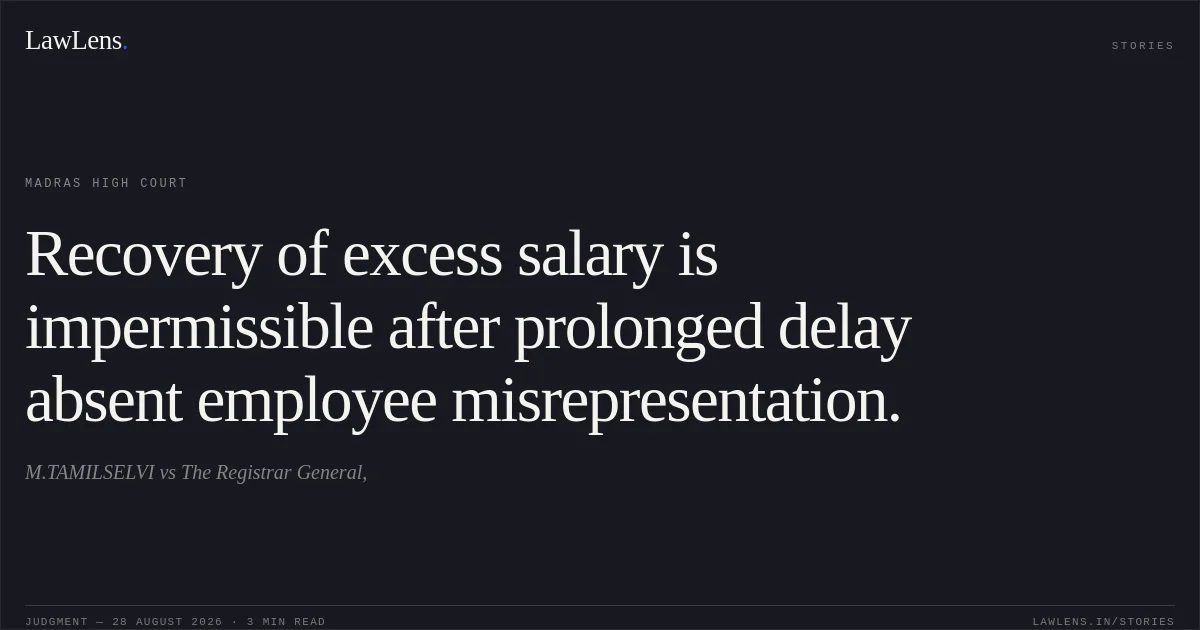
The writ petition was partly allowed.
The revised pay fixation made pursuant to the audit objection was confirmed, but the recovery of ₹4,47,106 towards excess pay and allowances was set aside.
Source reference: p.4Any amount already recovered pursuant to the impugned order was directed to be repaid to the petitioner within twelve weeks from the date of receipt of a copy of the order.
Source reference: p.4The connected miscellaneous petition was closed, with no order as to costs.
Source reference: p.4Original Court PDF
M.TAMILSELVIvsThe Registrar General,
Click to open original judgment
Original judgment, available to read, download and summarize on LawLens.in
![Courts will not interfere with transfers absent mala fides or violation of statutory rules.. M Ramya vs EMPLOYEES STATE INSURANCE CORPORATION (ESIC). CAT - ['Chennai']. LawLens](/stories/thumbnails/courts-will-not-interfere-with-transfers-absent-mala-fides-or-violation-of-statutory-rules-a6845e9ca6f548fca284c51c8351957f.webp)
![Courts cannot direct one-time recruitment age relaxation absent authority in the governing rules or advertisement.. UT OF PUDUCHERRY vs M ANDAL. CAT - ['Chennai']. LawLens](/stories/thumbnails/courts-cannot-direct-one-time-recruitment-age-relaxation-absent-authority-in-the-governing-895d78fde47143e2a8ed0207c4b6a44f.webp)
![A review cannot correct an allegedly erroneous decision absent an error apparent on the record.. Ajit Kumar Jha vs RAILWAY BOARD. CAT - ['Delhi']. LawLens](/stories/thumbnails/a-review-cannot-correct-an-allegedly-erroneous-decision-absent-an-error-apparent-on-the-re-8ac952fd4eba470c92f7da20af72a220.webp)