Facts
The petitioner, originally a Translator, was promoted from Assistant to Bench Clerk Grade III on December 14, 2013.
Source reference: p. 2Upon promotion, he was sanctioned a 3% promotional increment effective from April 1, 2014.
Source reference: p. 2Following an audit report issued by the 1st Respondent, it was determined that the sanction of the increment was inadmissible.
Source reference: p. 2Consequently, the 2nd Respondent issued an impugned order dated October 16, 2025, seeking to recover excess pay and allowances amounting to ₹2,44,494/- for the period between 2014 and 2025.
Source reference: p. 2The petitioner challenged this recovery via a Writ of Certiorarified Mandamus.
Source reference: p. 1-2Issues
1. Whether the authorities are empowered to rectify errors in pay fixation and grant the correct pay in cases of unjust gain of public money.
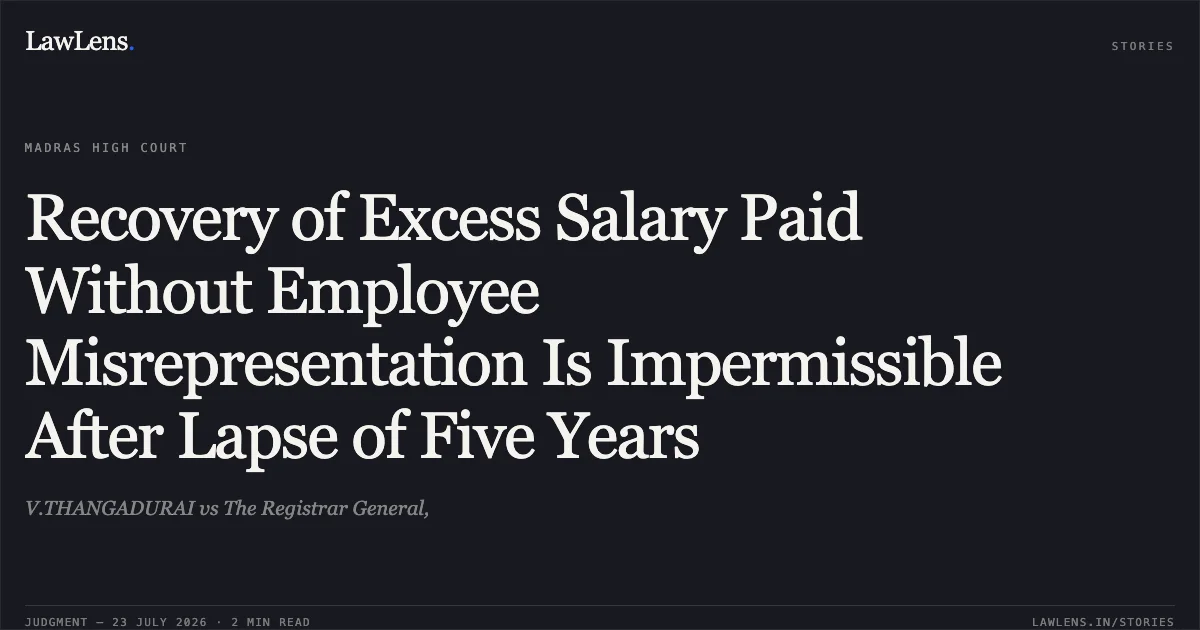
Source reference: p. 2-32. Whether the recovery of excess pay from an employee is permissible when the error was committed by the establishment without any misrepresentation by the employee and after a significant lapse of time.
Source reference: p. 3Law Applied
The Court applied the principle that while authorities have the power to rectify pay fixation errors to prevent unjust gain of public money, such power is limited by the doctrine of hardship.
Source reference: p. 3The Court relied primarily on the legal principles summarized by the Hon’ble Supreme Court in State of Punjab v. Rafiq Masih (White Washer) (2015) 4 SCC 334, which establishes that recovery is impermissible from employees belonging to Class III/IV (Group C/D), or when excess payment has been made for a period exceeding five years before the recovery order, or where recovery would be iniquitous, harsh, or arbitrary.
Source reference: p. 3-4Reasoning
The Court observed that while the revised pay fixation (downward revision) was legally valid to ensure correct pay according to Rules, the recovery of past excesses was unsustainable.
Source reference: p. 3The Court noted that the respondents failed to establish any misrepresentation by the petitioner; rather, the overpayment was an administrative error by the Establishment.
Source reference: p. 3Applying the Rafiq Masih criteria, the Court reasoned that since the excess payment spanned over eleven years (2014 to 2025), a recovery at this stage would cause "extreme hardship" to the employee, making it iniquitous and arbitrary.
Source reference: p. 3-4Holding
The Court partly allowed the Writ Petition, upholding the revision of pay to the correct scale but quashing the impugned order specifically regarding the recovery of the ₹2,44,494/-.
The Respondents were directed to remit any amount already recovered back to the petitioner within 12 weeks of receipt of the order.
Source reference: p. 4-5Original Court PDF
V.THANGADURAIvsThe Registrar General,
Click to open original judgment
Original judgment, available to read, download and summarize on LawLens.in