01Facts
The petitioner was initially appointed as a Compounder in 1983 and subsequently retired as an Ayurved Chikitsa Adhikari on 31 March 2017.
p. 2At the time of retirement, his service book and pay fixation were scrutinised by the Joint Director, Treasury, Accounts and Pension Department.
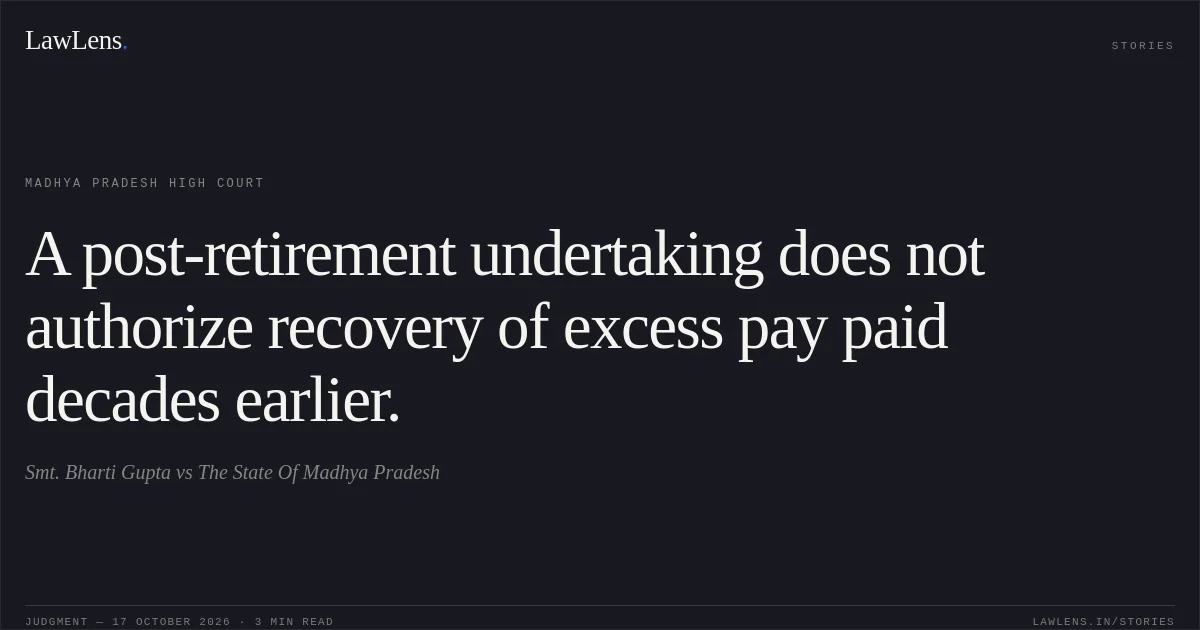
p. 2On the basis of an alleged erroneous pay fixation, the respondents ordered recovery of ₹2,10,657, relating to excess payments made from January 1997 until retirement.
p. 2The petitioner contended that the recovery was ordered without a show-cause notice or opportunity of hearing and that he was not responsible for the alleged error in pay fixation.
p. 2During the proceedings, the petitioner confined his claim to the recovery issue because the benefit of third kramonnati had already been granted with effect from 1 April 2015.
p. 2The State argued that recovery was permissible because the petitioner was a Class-II employee and the excess payment resulted from erroneous pay fixation.
p. 302Issues
i.1. Whether recovery of ₹2,10,657 from the petitioner after his retirement, in respect of excess payments made over a period exceeding five years, was legally permissible?
pp. 2–3, 8–9ii.2. Whether recovery could be sustained in the absence of a show-cause notice, opportunity of hearing, or a voluntarily furnished undertaking by the petitioner?
pp. 2–3, 6–9iii.3. Whether the petitioner’s status as a Class-II employee excluded him from the protection against recovery recognised in State of Punjab v. Rafiq Masih?
pp. 3, 8–903Law Applied
The Court applied the principles in State of Punjab v. Rafiq Masih (White Washer), (2015) 4 SCC 334, which identify recovery as impermissible, inter alia, from retired employees or those nearing retirement and where the excess payment relates to a period exceeding five years before the recovery order.
pp. 4–5, 7–8It relied on the Full Bench decision in State of Madhya Pradesh v. Jagdish Prasad Dubey, (2024) 2 M.P.L.J. 198, holding that recovery may be made on the basis of an undertaking only where the undertaking was voluntarily given, and that an undertaking obtained at the time of retiral benefits in relation to an old pay fixation cannot ordinarily be enforced; recovery under the applicable service rules must also follow the prescribed procedure.
pp. 3–4The Court further relied on Jogeswar Sahoo v. District Judge, Cuttack, 2025 (3) M.P.L.J. (S.C.) 25, for the principle that recovery after retirement, without fraud or misrepresentation and without an opportunity of hearing, is unsustainable.
pp. 5–6The decision in Ravindra Kumar Joshi v. State of Madhya Pradesh, W.P. No. 17831 of 2019, was applied to hold that an undertaking is unenforceable unless the State establishes that it was voluntarily furnished.
pp. 6–704Reasoning
The Court found that the alleged wrong pay fixation extended from January 1997 to 31 March 2017, and that the petitioner had already superannuated when the recovery was pursued.
pp. 8–9Since the excess payments related to a period substantially exceeding five years, the case fell within the independent protection recognised in clause (iii) of Rafiq Masih, irrespective of the petitioner’s Class-II status.
p. 8The Court also noted that no show-cause notice or opportunity of hearing had been provided.
pp. 2, 8–9There was no specific undertaking furnished by the petitioner at the time of the 1997 pay fixation, and the State failed to establish that any later undertaking had been given voluntarily; consequently, such undertaking could not validate the recovery under Jagdish Prasad Dubey and Ravindra Kumar Joshi.
pp. 6–7, 8In these circumstances, recovery from the petitioner was held to be inequitable and legally impermissible.
p. 905Holding
The Court allowed the petitioner’s challenge to the recovery and set aside the recovery of ₹2,10,657.
p. 9The respondents were directed to refund any amount recovered, together with interest at 6% per annum from the date of retirement or, where recovery had already occurred pursuant to the interim order, from the date of receipt of the certified copy of the judgment, as applicable.
p. 9The exercise was directed to be completed within 90 days of submission of the certified copy; failing compliance, the entire amount would carry interest at 12% per annum from the date of retirement until actual payment.
p. 9The petition was accordingly disposed of.
p. 9Original Court PDF
Dr. Om Prakash RaghuvanshivsThe State Of Madhya Pradesh
Click to open original judgment
Original judgment, available to read, download and summarize on LawLens.in