01Facts
The petitioner, an Assistant Horticultural Officer, was charged with approving a drip-irrigation subsidy of ₹15,538 without properly verifying the supporting documents.
pp. 19–20, paras 20–22The beneficiary testified that she had neither received the subsidy nor installed drip irrigation, and the petitioner did not cross-examine her.
pp. 19–20, paras 20–22Following a departmental inquiry, the State Government dismissed the petitioner from service.
pp. 4–5, paras 4–6The Karnataka State Administrative Tribunal quashed the dismissal, directed reinstatement, substituted a penalty of withholding one increment with cumulative effect, and treated the intervening period as dies non.
p. 6, para 7The petitioner sought review of the Tribunal’s order insofar as it denied continuity of service and back wages and imposed the substituted penalty.
p. 3 · p. 6, para 702Issues
i.1. Whether the Tribunal’s denial of continuity of service and back wages, and its treatment of the period between dismissal and reinstatement as dies non, warranted interference under Articles 226 and 227.
p. 3 · pp. 23–24, paras 28–30ii.2. Whether the petitioner’s contention that the subsidy amount had been recovered from another employee, and that he had not personally benefited, undermined the finding of misconduct or warranted further relief.
pp. 6–7, paras 8–10 · pp. 21–22, paras 24–27iii.3. Whether the High Court could reassess the evidence or revisit the proportionality of the Tribunal’s substituted penalty in judicial review.
pp. 9–18, paras 14–1903Law Applied
Under Articles 226 and 227 of the Constitution, judicial review of disciplinary proceedings concerns the legality and fairness of the decision-making process; the reviewing court does not reappreciate evidence, assess its adequacy or reliability, or substitute its view merely because another conclusion is possible.
pp. 9–18, paras 14–19Interference may be justified where there is a breach of natural justice or statutory procedure, no evidence supports the finding, the finding is perverse or arbitrary, or the punishment shocks the court’s conscience.
pp. 9–18, paras 14–19The Court relied on Union of India v. P. Gunasekaran, (2015) 2 SCC 610; State of Karnataka v. N. Gangaraj, (2020) 3 SCC 423; B.C. Chaturvedi v. Union of India; and Deputy General Manager (Appellate Authority) v. Ajai Kumar Srivastava, (2021) SCC 612.
pp. 9–18, paras 14–18The disciplinary proceedings were conducted under the Karnataka Civil Services (Classification, Control & Appeal) Rules, 1957, including Rule 11 and Rule 8(viii).
pp. 4–5, paras 4, 604Reasoning
The Court found that the charge was not merely that the petitioner had failed to prevent a loss; it was that he had approved the subsidy without verifying the relevant documents and the beneficiary’s entitlement.
pp. 20–22, paras 21–26The beneficiary’s evidence supported that charge, and the fact that the amount had been recovered from another employee did not exonerate the petitioner.
pp. 20–22, paras 21–26The Court rejected the petitioner’s reliance on J. Ahmed and Rajendra Yadav, finding that the charge involved an established failure to verify the subsidy approval and that the petitioner’s charge differed from that against the other employee.
pp. 21–22, paras 26–27Although the Court considered that the Tribunal had exceeded its jurisdiction by substituting a penalty for dismissal, it left the Tribunal’s order undisturbed because the State had not challenged it.
p. 23, para 28It also declined to disturb the Tribunal’s decisions on the penalty and dies non period.
pp. 23–24, paras 29–3005Holding
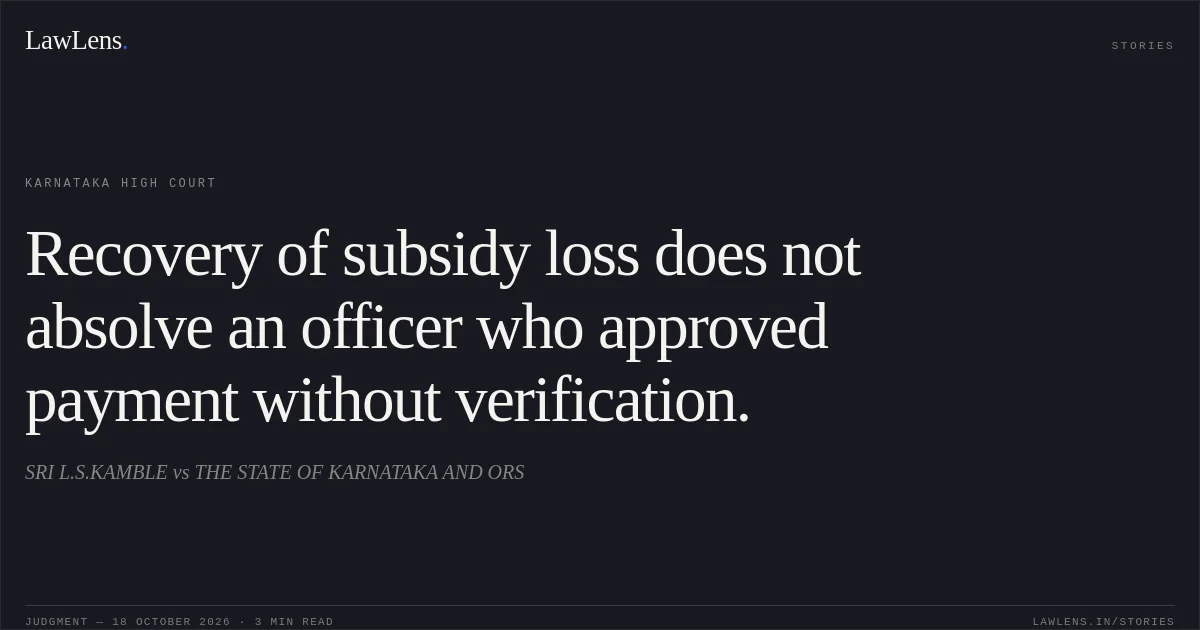
The High Court rejected the writ petition.
pp. 23–24, paras 28–30The Tribunal’s order—including reinstatement, withholding of one increment with cumulative effect, and treatment of the intervening period as dies non—was not disturbed; the petitioner was not granted continuity of service or back wages.
pp. 23–24, paras 28–30Original Court PDF
SRI L.S.KAMBLEvsTHE STATE OF KARNATAKA AND ORS
Click to open original judgment
Original judgment, available to read, download and summarize on LawLens.in