Facts
The appellant, a Record Keeper/UDC in the Sub-Registrar’s office, was accused of demanding ₹1,500 from Jagdish Prasad for supplying a certified copy of a property record.
Source reference: pp. 2–3, paras. 2–3After Prasad complained to the Anti-Corruption Branch, a trap was conducted; three treated ₹500 notes were recovered from the appellant, and his hand-wash tested positive for phenolphthalein.
Source reference: pp. 2–3, paras. 2–3Prasad died before giving evidence at trial.
Source reference: pp. 3–5, 10–12, paras. 4, 6, 21–23The panch witness, PW-5, supported the pre-trap and recovery proceedings but testified that he could not hear the conversation or say whether a demand was made.
Source reference: pp. 3–5, 10–12, paras. 4, 6, 21–23The Trial Court convicted the appellant under Sections 7 and 13(1)(d) read with Section 13(2) of the Prevention of Corruption Act, 1988; he appealed, principally challenging proof of demand.
Source reference: pp. 1, 3–4, paras. 1, 5Issues
Whether the prosecution proved beyond reasonable doubt the foundational fact of demand of illegal gratification, despite the complainant’s death and the panch witness’s inability to confirm that a demand was made?
Source reference: p. 9, para. 17; pp. 10–12, paras. 19–23Whether recovery of the treated currency and the positive hand-wash, without proof of demand, could sustain the convictions or trigger the presumption under Section 20 of the PC Act?
Source reference: pp. 12–15, paras. 26–32Law Applied
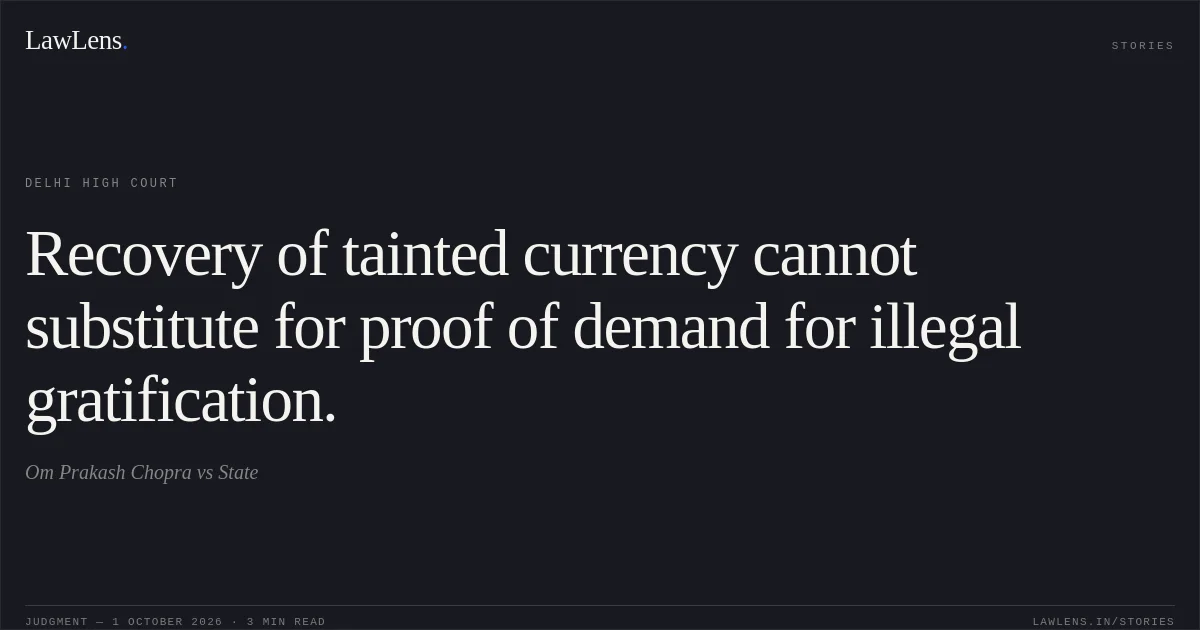
Sections 7 and 13(1)(d) read with Section 13(2) of the PC Act require proof of the essential ingredients of the charged offences, including demand of illegal gratification; recovery of tainted currency or chemical evidence of contact cannot, by itself, replace proof of demand.
Source reference: pp. 15–17, paras. 34–36Under Section 20, the statutory presumption cannot supply the foundational fact of demand and arises only in accordance with the statutory requirements.
Source reference: p. 9, 15, paras. 18, 31Neeraj Dutta v. State (Govt. of NCT of Delhi), (2023) 4 SCC 731, establishes that demand may be proved by circumstantial evidence where direct evidence is unavailable, provided the circumstances establish it beyond reasonable doubt.
Source reference: p. 9, para. 19P. Satyanarayana Murthy v. District Inspector of Police, (2015) 10 SCC 152, holds that proof of demand is indispensable and mere acceptance or recovery, without such proof, is insufficient to sustain conviction.
Source reference: pp. 16–17, para. 34A hostile witness’s testimony is not erased and may be relied upon to the extent credible and corroborated, but a prior statement to police is not substantive evidence merely because the witness admits making it.
Source reference: p. 14, para. 29Reasoning
The Court accepted that the matching currency notes were recovered from the appellant and that the positive hand-wash supported his contact with the treated money.
Source reference: pp. 12–13, paras. 25–26However, those circumstances established possession and handling, not the purpose for which the money was received.
Source reference: pp. 12–13, paras. 25–26The complainant’s complaint established that an allegation had been made, but, without his substantive testimony, did not prove the truth of its contents.
Source reference: pp. 10, 14, paras. 19, 29PW-5 could not confirm a demand, and the Raid Officer was not present during the conversation.
Source reference: pp. 11–12, paras. 21–24The unverified property-record application and discrepancy in its date added uncertainty, though neither was independently decisive.
Source reference: pp. 13–14, paras. 27–29, 33Consequently, the evidence did not establish demand beyond reasonable doubt, and Section 20 could not cure that deficiency.
Source reference: pp. 15–17, paras. 31–36Holding
The Court held that the prosecution failed to prove the foundational fact of demand and that the recovery and chemical evidence could not independently sustain the convictions.
It allowed the appeal, set aside the judgment of conviction and order on sentence, and acquitted Om Prakash Chopra of the offences under Sections 7 and 13(1)(d) read with Section 13(2) of the PC Act.
Source reference: pp. 17–18, paras. 36–40Bail bonds were discharged, and any deposited fine was to be dealt with in accordance with law.
Source reference: p. 18, para. 39Acts & Sections Cited
4 provisions across 2 statutes referred to in this judgment. Each provision opens on LawLens.
Prevention of Corruption Act, 19883
Code of Criminal Procedure, 19731
Original Court PDF
Om Prakash ChopravsState
Click to open original judgment
Original judgment, available to read, download and summarize on LawLens.in