Facts
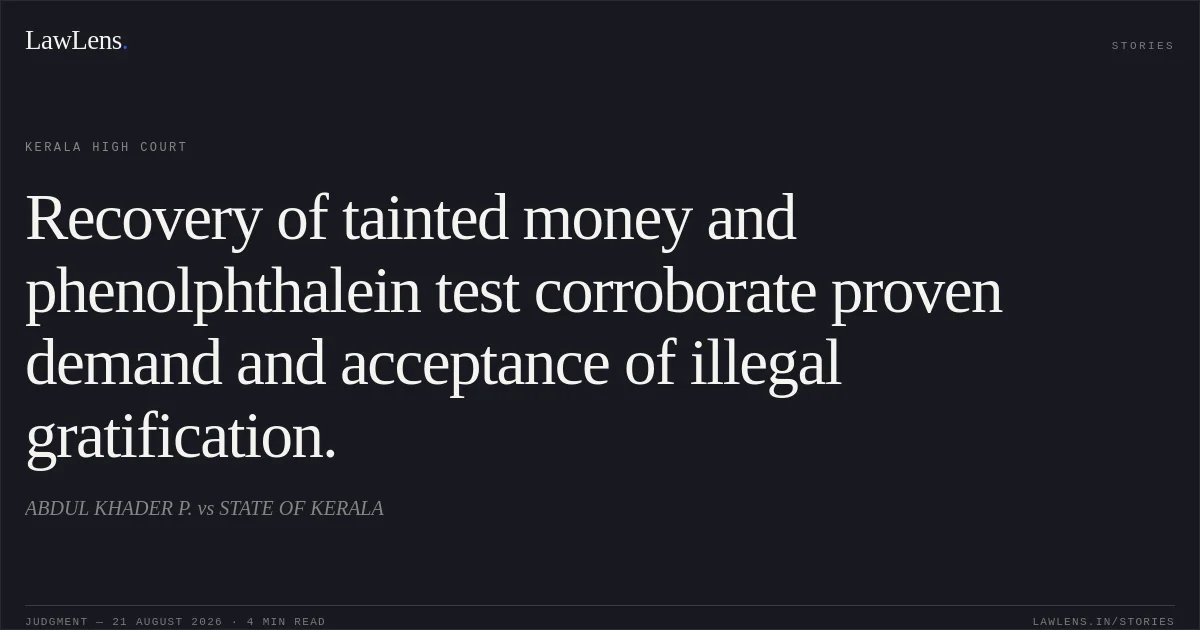
The appellant, a Grade-I Lineman of the Kerala State Electricity Board, was prosecuted under Sections 7 and 13(1)(d) read with Section 13(2) of the Prevention of Corruption Act, 1988.
Source reference: paras. 3, 10–16The prosecution alleged that he demanded ₹2,000 from PW1 for providing a domestic electricity connection, accepted ₹1,000 on 22 February 2007, directed PW1 to pay ₹200 to the vehicle driver, and subsequently demanded the balance ₹800.
Source reference: paras. 3, 10–16During the vigilance trap on 27 February 2007, the appellant allegedly accepted ₹800, returned ₹300, and placed the remaining currency notes in a nearby STD booth, from where the vigilance officials recovered them.
Source reference: paras. 3, 10–16The phenolphthalein test conducted on the appellant’s fingers and clothing was positive.
Source reference: paras. 3, 10–16The Special Judge, Thalassery, convicted the appellant and sentenced him to rigorous imprisonment for two years and a fine of ₹10,000 for each offence, with the substantive sentences directed to run concurrently.
Source reference: para. 5The appellant challenged the conviction, contending principally that the money was intended as lawful labour charges payable to workers engaged in providing the electricity connection, relying on Parappurath Damodaran v. State of Kerala.
Source reference: paras. 6–8Issues
Whether the prosecution proved the demand and acceptance of illegal gratification so as to establish the offence under Section 7 of the Prevention of Corruption Act, 1988.
Source reference: para. 9Whether the appellant’s conduct constituted criminal misconduct under Section 13(1)(d) read with Section 13(2) of the Prevention of Corruption Act, 1988.
Source reference: para. 9Whether the conviction and sentence imposed by the Special Court required interference in appeal.
Source reference: para. 9Law Applied
The court applied Sections 7 and 13(1)(d) read with Section 13(2) of the Prevention of Corruption Act, 1988.
Source reference: paras. 20–21Proof of demand and acceptance or obtainment of illegal gratification is a sine qua non for conviction under Sections 7 and 13(1)(d)(i) and (ii); mere recovery or acceptance of money, without proof of the foundational demand or offer, is insufficient.
Source reference: paras. 20–21This principle was drawn from the Constitution Bench decision in Neeraj Dutta v. State (NCT of Delhi), which also held that demand and acceptance may be proved through direct, documentary, or circumstantial evidence, and that Section 20 creates a mandatory presumption regarding the purpose of gratification once the foundational facts are established.
Source reference: paras. 20–21The court also relied on Sunil Kumar K. v. State of Kerala for the proposition that proof of demand remains essential and that mere recovery is inadequate.
Source reference: para. 22The court also relied on State of Kerala v. K.A. Abdul Rasheed regarding the evidentiary treatment of hostile witnesses.
Source reference: para. 23Parappurath Damodaran v. State of Kerala was distinguished on the ground that, there, the accused had been authorised to collect the amount as lawful remuneration, whereas no such authorisation existed in the present case.
Source reference: para. 26Reasoning
The court found PW1’s evidence sufficient to establish that the appellant demanded ₹2,000 as a condition for providing the electricity connection and thereafter accepted ₹1,000 and ₹800 in separate instalments.
Source reference: paras. 10–12, 24The evidence of PW3, PW10, and PW11 corroborated the trap proceedings, including the positive phenolphthalein test on the appellant’s fingers and clothing and the recovery of the marked currency notes from the STD booth where the appellant had placed them.
Source reference: paras. 13–15, 24–25The court rejected the defence that the money represented labour charges because PW4, the Assistant Engineer, categorically testified that the Board was required to provide the connection at its own expense and that the lineman was not authorised to receive any additional amount from the consumer after payment of the caution deposit.
Source reference: para. 16Accordingly, the payment was held to be illegal gratification rather than lawful remuneration.
Source reference: no citationThe court held that Parappurath Damodaran was factually distinguishable because the collection of money had been authorised in that case, unlike here.
Source reference: para. 26Holding
The High Court answered all material issues against the appellant and confirmed his conviction under Sections 7 and 13(1)(d) read with Section 13(2) of the Prevention of Corruption Act, 1988.
However, it partly allowed the appeal by reducing the substantive sentence from two years’ rigorous imprisonment for each offence to one year’s rigorous imprisonment for each offence, while maintaining the fine of ₹10,000 for each offence and the default imprisonment.
Source reference: para. 28The substantive sentences were directed to run concurrently, while the default sentences were to run separately.
Source reference: para. 29The suspension of sentence and bail were vacated, the bail bond was cancelled, and the appellant was directed to surrender before the Special Court forthwith, failing which the court was directed to execute the sentence.
Source reference: para. 30Acts & Sections Cited
6 provisions across 2 statutes referred to in this judgment. Each provision opens on LawLens.
Code of Criminal Procedure, 19732
Prevention of Corruption Act, 19884
Original Court PDF
ABDUL KHADER P.vsSTATE OF KERALA
Click to open original judgment
Original judgment, available to read, download and summarize on LawLens.in