Facts
The appellants filed an appeal under Section 23 of the Railway Claims Tribunal Act, 1987, challenging the Tribunal’s dismissal of their claim on 27.09.2018.
Source reference: p.2, para. 1On 31.10.2017, the deceased, Shadab Khan, was traveling from Hapur to Delhi with a valid second-class ticket.
Source reference: p.2, para. 3Between Delhi-Shahdara and Delhi Railway Station, he allegedly fell from the running train and died on the spot.
Source reference: p.2, para. 3The Railway Claims Tribunal (RCT) dismissed the claim, ruling that the deceased was not a bona fide passenger and the event did not constitute an "untoward incident".
Source reference: p.2, para. 2The appellants also sought condonation of a 316-day delay in filing the appeal, citing economic hardship.
Source reference: p.1, para. 1-2Issues
1. Whether the delay of 316 days in filing the appeal should be condoned based on the appellants' economic status.
Source reference: p.1, para. 12. Whether the death of the deceased qualifies as an "untoward incident" under Section 123(c) read with Section 124-A of the Railways Act, 1989.
Source reference: p.4, para. 73. Whether the deceased was a bona fide passenger at the time of the incident.
Source reference: p.4, para. 7Law Applied
The Court applied Section 123(c) and Section 124-A of the Railways Act, 1989, which define "untoward incident" and establish the principle of strict liability for the Railways, regardless of passenger negligence.
Source reference: p.4, para. 8; p.5, para. 10It relied on Mohsina v. Union of India regarding the condonation of delay for claimants from economically weaker sections.
Source reference: p.1, para. 3Further, it applied the precedent in Union of India v. Prabhakaran Vijaya Kumar, which clarifies that accidental falls from a train (including while boarding/alighting) constitute an untoward incident.
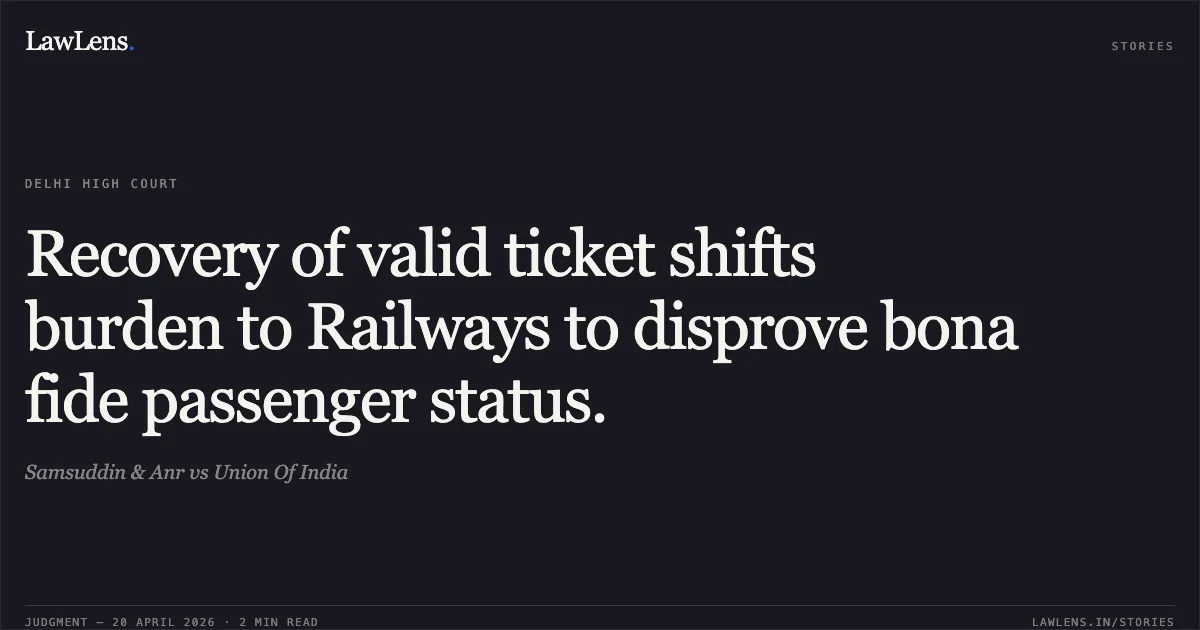
Source reference: p.5, para. 10Finally, the Court invoked the evidentiary standard from Union of India v. Rina Devi, establishing that the recovery of a ticket shifts the burden of proof to the Railways to disprove bona fide passenger status.
Source reference: p.6, para. 14Reasoning
Regarding the delay, the Court observed that the appellants' financial incapacity constituted "sufficient cause," following the beneficial nature of the legislation.
Source reference: p.2, para. 4On the merits, the Court found the RCT’s dismissal lacked evidentiary support.
Source reference: p.4, para. 8-9While the Tribunal claimed there were no eyewitnesses, the Court noted that the presence of the body on line No. 4 and the Station Master’s memo established the incident occurred during railway operations.
Source reference: p.4, para. 8-9The Court rejected the respondent's argument of negligence (unauthorized track crossing), noting that under Section 124-A, negligence is irrelevant unless a statutory exception like suicide or self-inflicted injury is proven, which the Railways failed to do.
Source reference: p.5, para. 10Regarding the status of the deceased, a valid journey ticket was recovered during jamatalashi and confirmed by the DRM report.
Source reference: p.5, para. 12Under the Rina Devi principle, this recovery created a presumption of bona fide travel that the respondent failed to rebut with cogent evidence.
Source reference: p.6, para. 13-14Holding
The Court condoned the 316-day delay.
The Court set aside the Tribunal’s judgment.
Source reference: p.6, para. 17It held that the deceased was a bona fide passenger and his death resulted from an "untoward incident".
Source reference: p.6, para. 15-16The matter was remanded to the Railway Claims Tribunal to assess the compensation amount and directed the authorities to disburse it within two months of the order.
Source reference: p.6, para. 17The parties were directed to appear before the Tribunal on 05.05.2026.
Source reference: p.6, para. 17Acts & Sections Cited
2 provisions across 2 statutes referred to in this judgment. Each provision opens on LawLens.
Railway Claims Tribunal Act, 19871
Railways Act, 19891
Original Court PDF
Samsuddin & AnrvsUnion Of India
Click to open original judgment
Original judgment, available to read, download and summarize on LawLens.in