Facts
The appellant purchased a Yamaha R-1 motorcycle bearing registration No. MH 06 AR 8899 from Mohammad on 10 April 2013 for ₹5,00,000, relying on documents including a Bill of Entry, insurance papers, payment challan and sale letter.
Source reference: p.2The motorcycle had allegedly been imported through Indira Gandhi International Airport under Bill of Entry No. 110190/29/5/2008 dated 29 May 2008 and registered in the name of M/s Galaxy Trading.
Source reference: p.2Acting on intelligence, Customs recovered the motorcycle from a workshop and found that the registered owner’s address was fictitious, the Bill of Entry was fabricated, and no customs duty had been paid.
Source reference: pp.1–2The motorcycle was consequently confiscated.
Source reference: pp.1–2The original authority imposed redemption fine of ₹50,000 and penalty of ₹20,000 under Section 112 of the Customs Act, 1962.
Source reference: p.2The Commissioner (Appeals) upheld the confiscation and redemption fine but set aside the penalty.
Source reference: p.2The appellant challenged the order before the Tribunal, principally contending that the proceedings were time-barred and that he was a bona fide purchaser without knowledge of the fraudulent import.
Source reference: pp.2–3Issues
1. Whether the confiscation proceedings initiated through the show-cause notice dated 19 August 2013 were barred by limitation when the motorcycle had been imported in 2008 but the fraud was discovered only on 17 April 2013.
Source reference: pp.3–42. Whether a purchaser who claims to have acquired the motorcycle bona fide on the basis of apparently genuine documents could avoid liability arising from the motorcycle’s illegal importation and non-payment of customs duty.
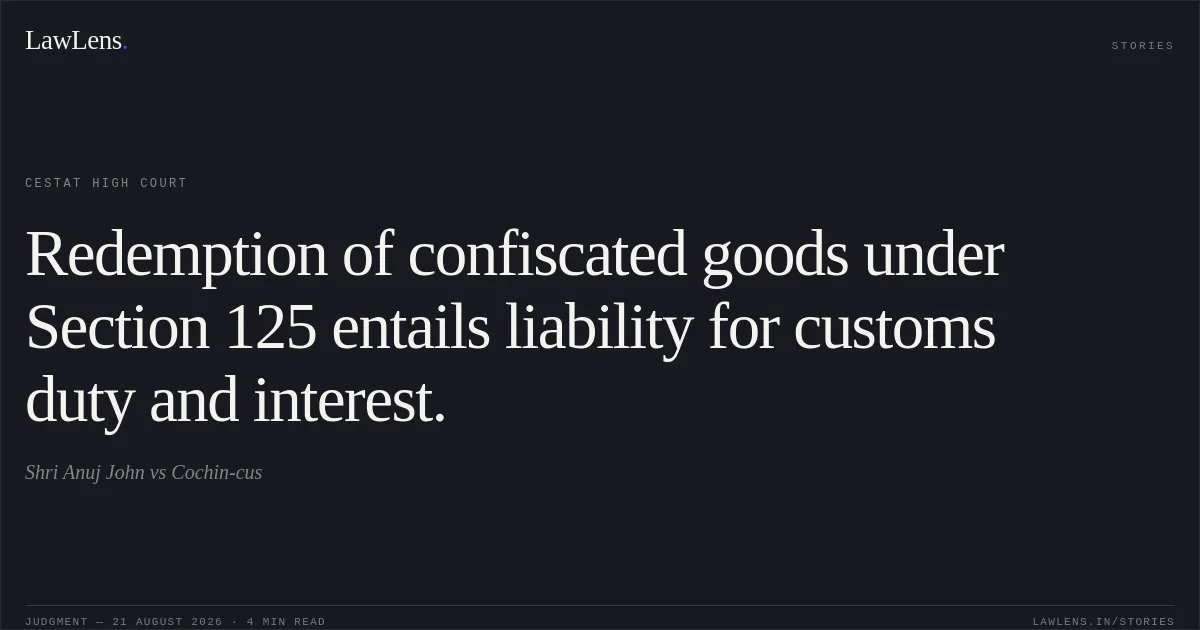
Source reference: pp.2–43. Whether, upon redemption of the confiscated motorcycle under Section 125 of the Customs Act, the owner or possessor was liable to pay customs duty and interest.
Source reference: pp.10–11, 18–214. Whether the redemption fine imposed by the lower authorities required reduction in view of the appellant’s good-faith purchase and the setting aside of the penalty.
Source reference: p.21Law Applied
The Tribunal applied Sections 111(d) and 111(m) of the Customs Act, 1962, concerning confiscation of improperly imported goods and goods covered by false or incorrect documents, along with Section 123 as referred to in the order.
Source reference: p.4Section 125(1) permits redemption of confiscated goods on payment of a fine in lieu of confiscation, while Section 125(2) makes the owner liable, in addition, to the duty and charges payable on the goods.
Source reference: pp.11–12The Tribunal held that the duty liability arising under Section 125(2) may be assessed and determined through Section 28, and that delayed payment attracts interest under Section 28AB.
Source reference: pp.18–21It relied on Commissioner of Customs (Preventive) v. AAFLOAT Textiles (I) Pvt. Ltd., 2009 (235) E.L.T. 587 (S.C.), for the principles that fraud vitiates transactions, forged documents have no legal existence, and caveat emptor requires a purchaser to verify title and authenticity.
Source reference: pp.3–10It further relied on Union of India v. Security and Finance (P.) Ltd., 1983 (13) E.L.T. 1562 (S.C.), Fortis Hospital Ltd. v. Commissioner of Customs (Import), 2015 (318) E.L.T. 551 (S.C.), Jagdish Cancer & Research Institute v. Union of India, and Navayuga Engineering Co. Ltd. v. Union of India, 2024 (30) E.L.T. 3 (S.C.), to distinguish the independent duty liability from confiscation and penalty proceedings and to affirm the liability to pay duty and interest where the goods are redeemed under Section 125.
Source reference: pp.13–21Reasoning
The Tribunal found that the motorcycle had been smuggled or otherwise illegally imported because the Bill of Entry was fabricated and no customs duty had been paid; it was therefore liable to confiscation under Sections 111(d) and 111(m).
Source reference: p.4Since Customs discovered the fraudulent import only on 17 April 2013 and issued the show-cause notice on 19 August 2013, the notice was held to be within time; the later discovery of fraud prevented the appellant from relying on the earlier date of import to establish limitation.
Source reference: pp.3–4, 10The appellant’s asserted bona fides did not cure the defective title or illegality of importation.
Source reference: pp.8–10Applying AAFLOAT Textiles and the principle of caveat emptor, the Tribunal held that a purchaser must undertake reasonable verification of the genuineness of the import documents and title.
Source reference: pp.8–10The Tribunal further held that duty under Section 125(2) becomes payable when the owner exercises the option to redeem the confiscated goods, and that the duty may be quantified under Section 28 with consequential interest under Section 28AB.
Source reference: pp.18–21Nevertheless, because the Commissioner (Appeals) had accepted the appellant’s good-faith purchase sufficiently to set aside the penalty, the Tribunal considered a lower redemption fine appropriate.
Source reference: p.21Holding
The Tribunal held that the confiscation proceedings were not time-barred, that the motorcycle was liable to confiscation because it had been imported on the basis of forged documents without payment of duty, and that redemption of the motorcycle attracted liability for customs duty and interest under Section 125(2), read with Sections 28 and 28AB.
The penalty remained set aside.
Source reference: p.21The redemption fine was reduced from ₹50,000 to ₹10,000, while the liability to pay duty and interest was upheld.
Source reference: p.21The appeal was consequently partly allowed.
Source reference: p.21Original Court PDF
Shri Anuj JohnvsCochin-cus
Click to open original judgment
Original judgment, available to read, download and summarize on LawLens.in