Facts
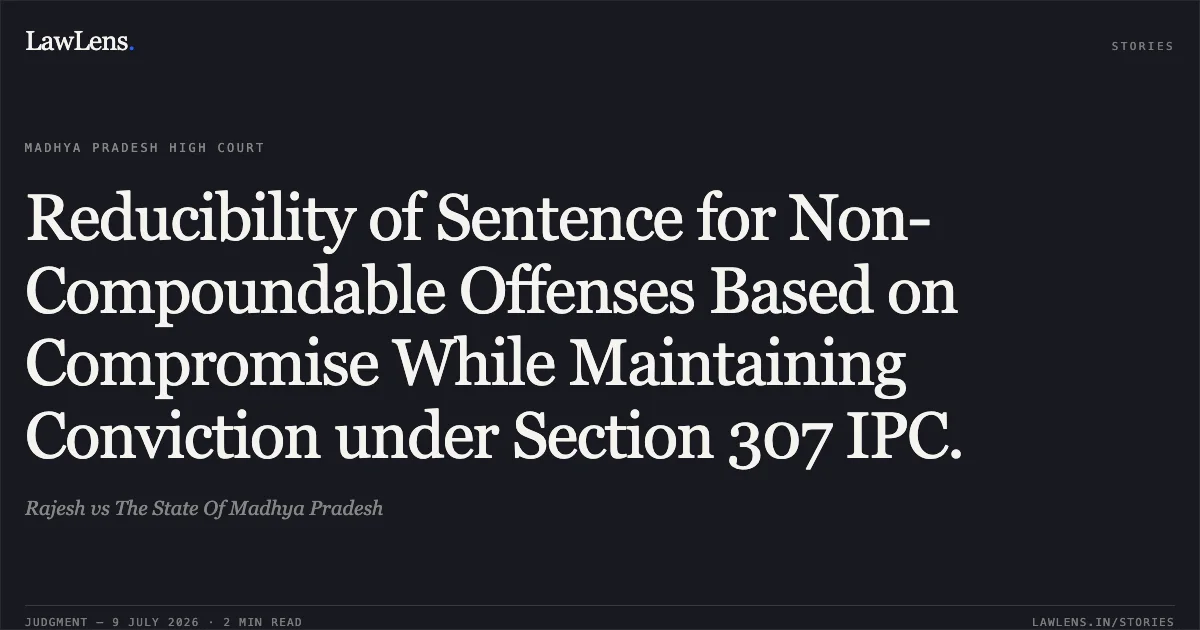
The appellants were convicted by the Additional Sessions Judge, Badnagar, for offences under Sections 148, 323/149, 307/149, and 506(2) of the IPC, receiving a maximum sentence of ten years’ rigorous imprisonment.
Source reference: para 1Following the conviction, the appellants and the complainant filed an application for compounding the offences based on a mutual compromise.
Source reference: para 2A verification report dated 22.06.2026 confirmed the compromise was voluntary, though noting that Sections 148, 307/149, and 506(2) are non-compoundable under the law.
Source reference: para 3The appellants sought a reduction of sentence to the period already undergone (approximately six months) based on this settlement.
Source reference: para 4, 15Issues
1. Whether a conviction for non-compoundable offences, specifically Section 307 of the IPC, can be set aside or the sentence modified based on a compromise between the parties at the appellate stage.
Source reference: para 9-112. Whether the trial court’s conviction of the appellants was legally sound based on the available medical and ocular evidence.
Source reference: para 7-8Law Applied
The court applied Section 320 of the Code of Criminal Procedure, 1973 (and Section 415 of BNSS, 2023) regarding the compounding of offences.
Source reference: para 1, 14The court relied on Gian Singh v. State of Punjab, establishing that inherent powers can be used to secure justice in personal disputes, and Narinder Singh v. State of Punjab, which permits treating Section 307 IPC as a personal matter rather than an offence against society under specific settlement conditions.
Source reference: para 9The court applied Ishwar Singh v. State of M.P. and Unnikrishnan alias Unnikuttan v. State of Kerala, which hold that while non-compoundable offences cannot be strictly "compounded," a compromise is a relevant factor for reducing a substantive sentence to the period already undergone.
Source reference: para 10-11Reasoning
The Court first reviewed the trial record, noting the testimonies of injured witnesses Anil Kevat (PW-2) and Dilip (PW-1) alongside medical evidence, confirming that the conviction was righteous and well-supported.
Source reference: para 7-8The Court observed that the parties—residing in the same society—had resolved their disputes to maintain peace.
Source reference: para 14Following the precedent in Bhagwan Narayan Gaikwad v. State of Maharashtra, the Court noted that sentencing must balance deterrence with rehabilitation and that a post-conviction compromise is a significant mitigating factor to "avoid bitterness" between families.
Source reference: para 13Since the appellants had already served approximately six months in jail and the incident occurred in 2022, the Court reasoned that further incarceration would serve no fruitful purpose given the restored harmony between the parties.
Source reference: para 15Holding
The Court maintained the conviction of the appellants for all charges but allowed the appeal in part regarding the sentence.
It held that while Section 307 IPC cannot be formally compounded, the sentence could be reduced in light of the settlement.
Source reference: para 14The jail sentences for all offences were reduced to the period already undergone, subject to the fine amounts imposed by the trial court; the appellants' bail bonds were discharged, and the appeal was disposed of accordingly.
Source reference: para 15, 16, 20Acts & Sections Cited
12 provisions across 3 statutes referred to in this judgment. Each provision opens on LawLens.
Bharatiya Nagarik Suraksha Sanhita, 20231
Code of Criminal Procedure, 19734
Indian Penal Code, 18607
Original Court PDF
RajeshvsThe State Of Madhya Pradesh
Click to open original judgment
Original judgment, available to read, download and summarize on LawLens.in