Facts
On January 25, 2023, the appellant, Arun Vishwakarma, and a juvenile allegedly assaulted Om Prakash Lovanshi with a knife and an iron rod near SS Convent, Bhopal.
Source reference: para. 2The victim sustained stab injuries to his leg and waist.
Source reference: para. 2Following a trial in ST No. 369/2023, the Sessions Judge, Bhopal, convicted the appellant on April 28, 2025, for offences under Sections 307 (Attempt to murder) and 294 (Obscene acts) of the IPC, and Section 25(1-b)(b) of the Arms Act.
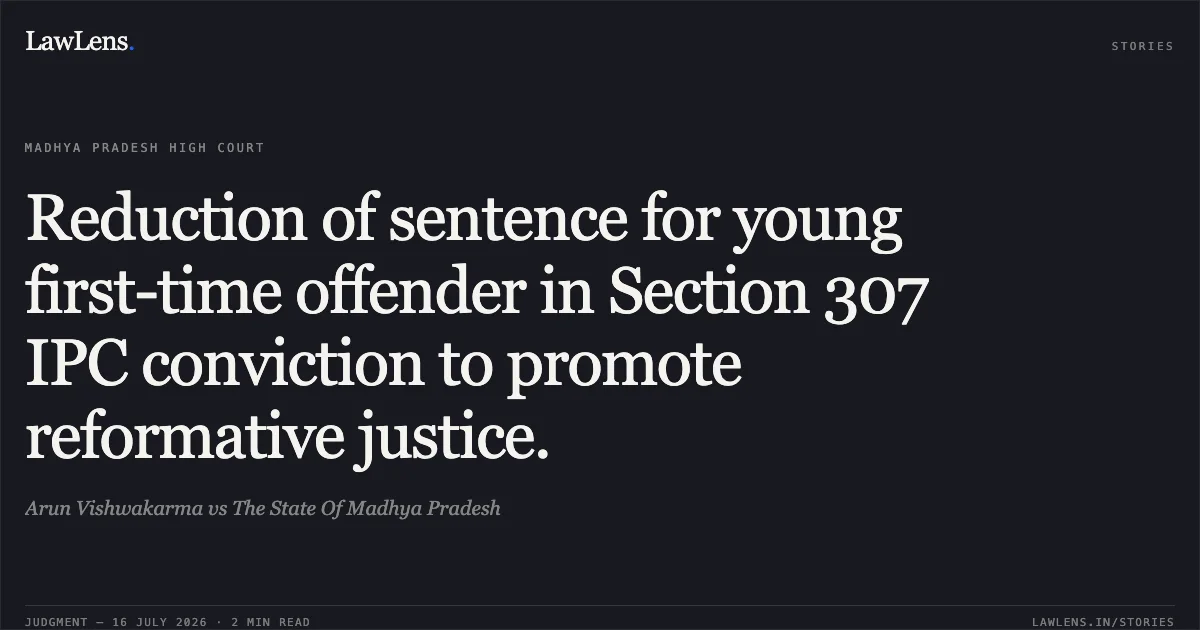
Source reference: para. 1The appellant was sentenced to seven years of rigorous imprisonment (RI) for the Section 307 conviction.
Source reference: para. 1The appellant challenged this judgment before the High Court, specifically limiting the plea to a reduction in the quantum of sentence.
Source reference: para. 4Issues
Whether the substantive sentence of seven years' rigorous imprisonment under Section 307 of the IPC is proportionate given the appellant’s age, lack of criminal antecedents, and period of incarceration already undergone.
Source reference: para. 4 & 6Law Applied
Section 374(2) of the Cr.P.C. read with Section 415 of the Bharatiya Nagarik Suraksha Sanhita (BNSS) regarding the right to appeal against a conviction.
Source reference: para. 1Sections 307 and 294 of the Indian Penal Code (IPC) and Section 25(1-b)(b) of the Arms Act.
Source reference: para. 1Sentencing principle of proportionality and the reformative theory of punishment, which dictates that the sentence must balance the gravity of the offence with the mitigating circumstances of the offender.
Source reference: para. 6Reasoning
The Court noted that the appellant did not challenge the merits of the conviction, and upon review, found the Trial Court’s appreciation of evidence to be sound.
Source reference: para. 4 & 6In addressing the quantum of sentence, the Court evaluated several mitigating factors: the appellant was a young person, he had no prior criminal record or history as a habitual offender, and he had already served approximately two years and eleven months of his sentence.
Source reference: para. 4 & 6The Court reasoned that while the conviction was justified, the ends of justice would be better served by a more reformative approach. Consequently, it determined that reducing the seven-year term to five years would satisfy the requirement for a proportionate sentence while acknowledging the appellant’s potential for rehabilitation.
Source reference: para. 6Holding
The High Court maintained the conviction of the appellant under Sections 307 and 294 of the IPC and Section 25(1-b)(b) of the Arms Act, but partly allowed the appeal regarding the sentence.
The Court ordered the substantive jail sentence under Section 307 IPC be reduced from seven years to five years of rigorous imprisonment. It further directed that all other fines and default sentences imposed by the Trial Court remain unchanged and that the appellant be released upon completion of the five-year term if not required in any other case.
Source reference: para. 7Acts & Sections Cited
8 provisions across 4 statutes referred to in this judgment. Each provision opens on LawLens.
Code of Criminal Procedure, 19731
Bharatiya Nagarik Suraksha Sanhita, 20231
Indian Penal Code, 18605
Arms Act, 19591
Original Court PDF
Arun VishwakarmavsThe State Of Madhya Pradesh
Click to open original judgment
Original judgment, available to read, download and summarize on LawLens.in