01Facts
The complainant was traveling on the Punjab Mail on May 15, 2022, when three individuals forcibly snatched his trolley bag containing cash, electronics, and personal documents near the Burhanpur railway station.
¶ 2The Government Railway Police (GRP) registered an FIR under the IPC, leading to the arrest and subsequent trial of the appellants.
¶ 2On December 23, 2024, the Sessions Judge, Burhanpur, convicted the appellants of robbery and sentenced them to five years of rigorous imprisonment.
¶ 1, 3The appellants approached the High Court, not to contest the conviction itself, but to seek a reduction in the duration of the sentence based on time already served.
¶ 402Issues
i.1. Whether the conviction of the appellants under the relevant sections of the Indian Penal Code was legally sustainable based on the evidence on record.
¶ 6ii.2. Whether the term of imprisonment should be modified to the period of incarceration already undergone by the appellants, totaling approximately four years and three months.
¶ 4, 703Law Applied
The court applied Section 392 of the Indian Penal Code, which defines and prescribes the punishment for robbery, read in conjunction with Section 34 regarding acts done by several persons in furtherance of a common intention.
¶ 1, 3The court also exercised its appellate jurisdiction to modify sentencing in the interest of justice, weighing the nature of the offense against the duration of the actual time served by the convicts.
¶ 7, 8Provisions in the judgment · 2 · Linked ones open on LawLens
Indian Penal Code, 1860 Section 392Section 34
04Reasoning
The High Court independently reviewed the trial record, including the testimonies of prosecution and defense witnesses, and determined that the lower court’s findings were based on a proper appreciation of both oral and documentary evidence.
¶ 6Since the appellants did not challenge the merits of the conviction, the court focused its analysis on the sentencing. It noted that the appellants had already served four years and three months of their five-year sentence.
¶ 4, 7The court reasoned that the ends of justice would be sufficiently met by treating the time already served as the final sentence, provided the financial penalty (fine) was increased to serve as an adequate deterrent.
¶ 7, 805Holding
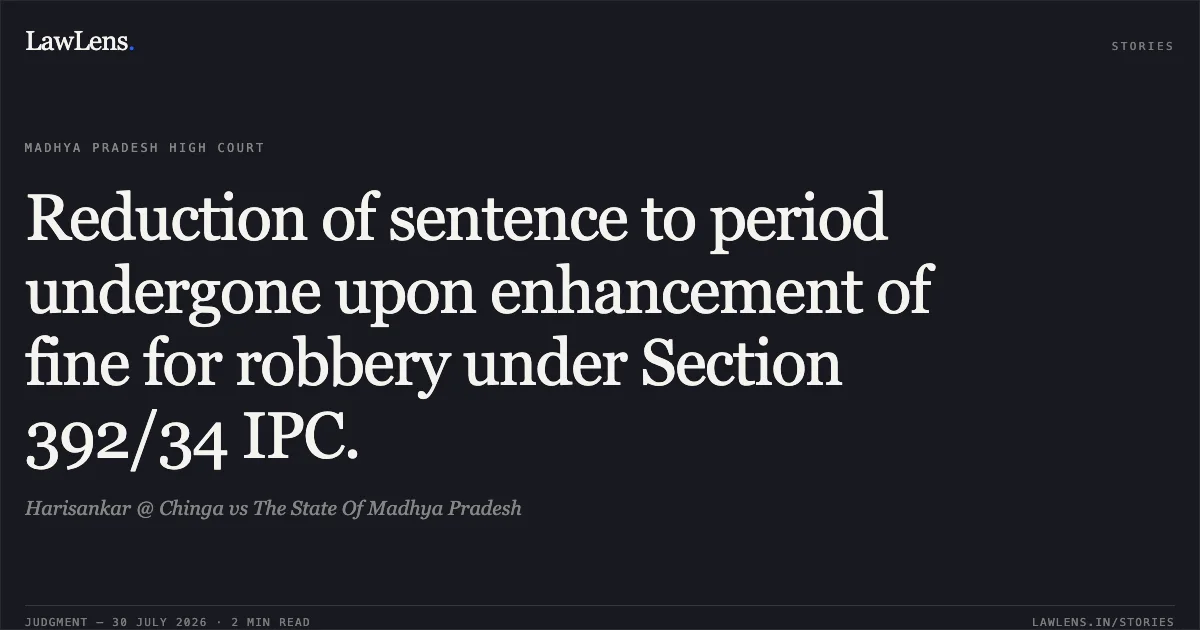
The High Court upheld the conviction under Section 392/34 IPC but partly allowed the appeal by modifying the sentence.
¶ 8, 9The court ordered the jail term to be reduced to the period already undergone by the appellants. Concurrently, the court enhanced the fine from Rs. 5,000 to Rs. 10,000 per appellant, with a two-month deadline for payment. The appellants were ordered to be released forthwith, provided they were not required for any other legal matters.
¶ 8Original Court PDF
Harisankar @ ChingavsThe State Of Madhya Pradesh
Click to open original judgment
Original judgment, available to read, download and summarize on LawLens.in