Facts
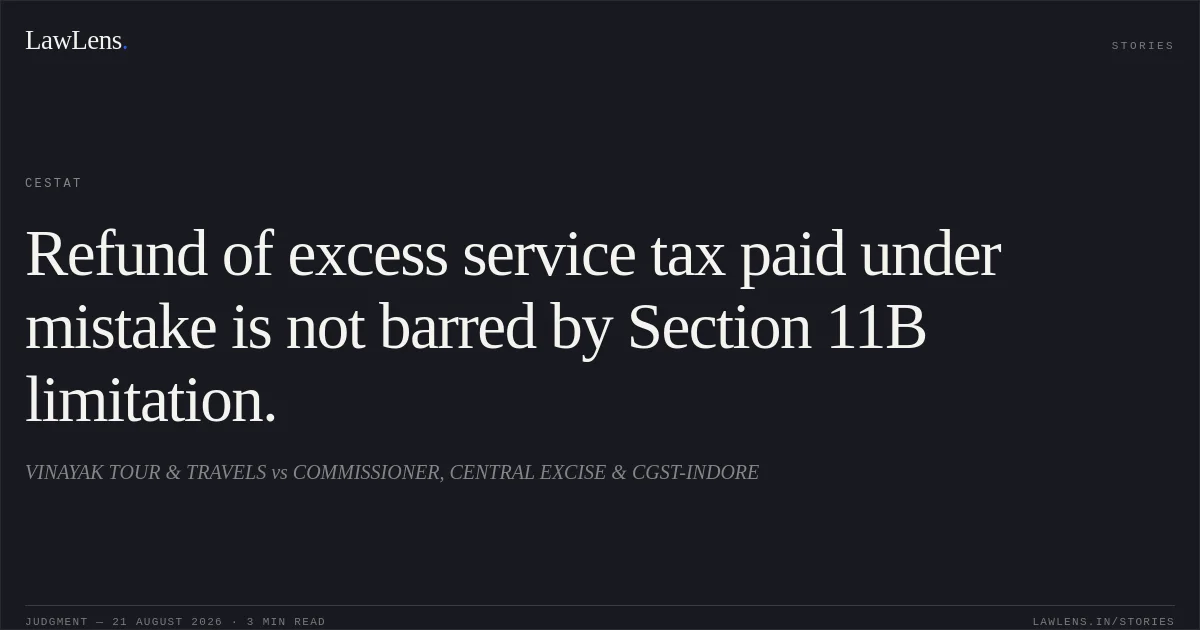
The appellant, a provider of tour operator services, challenged the order affirming rejection of its refund claim under Section 11B of the Central Excise Act, 1944, as applicable to service tax through Section 83 of the Finance Act, 1994.
Source reference: para. 1The appellant contended that, due to ignorance of the applicable abatement provisions, it paid service tax on amounts exceeding its actual liability for financial years 2016–17 and 2017–18. It claimed a refund on 23 November 2020.
Source reference: para. 2The refund claim was rejected on the grounds that it was filed beyond one year from the relevant date and that the appellant had failed to establish that the tax burden had not been passed on to its customers.
Source reference: para. 2The appellant argued that the excess payment was not “service tax” but a deposit made under mistake of law, which the Government had no authority to retain under Article 265 of the Constitution.
Source reference: para. 3Issues
1. Whether the refund claim relating to excess service tax paid under a mistaken understanding of the law was barred by the one-year limitation prescribed under Section 11B of the Central Excise Act, 1944?
Source reference: paras. 5–72. Whether the refund was liable to be rejected on the ground of unjust enrichment on the basis that the incidence of service tax may have been passed on to customers?
Source reference: paras. 5, 9Law Applied
Section 11B of the Central Excise Act, 1944 prescribes a one-year limitation for claims seeking refund of duty and interest paid thereon; through Section 83 of the Finance Act, 1994, the provision applies to service tax.
Source reference: paras. 1, 6However, an amount paid under a mistaken notion, in excess of the legally leviable tax, is in the nature of a deposit and not duty or tax, and its refund is not governed by the limitation under Section 11B. This principle was supported by McCann Erickson (India) Pvt. Ltd. v. Commissioner of CGST & CX, Swastik Sanitary Wares Ltd. v. Union of India, Commissioner of Central Excise (Appeals), Bangalore v. KVR Construction, and Credible Engineering Construction v. CCE, Hyderabad.
Source reference: para. 7Article 265 of the Constitution prohibits levy or collection of tax except by authority of law; amounts collected without such authority cannot be retained by the State.
Source reference: paras. 3, 7Refund may nevertheless be denied on the ground of unjust enrichment where the claimant has passed the tax burden to another person; the claimant must establish that the incidence was borne by it and not recovered from customers.
Source reference: para. 9The decisions in Union of India v. ITC Ltd. and BT (India) Ltd.—concerning refund proceedings requiring prior modification of an assessment or self-assessment—were held inapplicable where the claim concerns refund of a deposit rather than service tax.
Source reference: para. 8Reasoning
The Tribunal held that the excess amount paid by the appellant had no legal basis as service tax because it exceeded the tax actually leviable after applying the applicable abatement. It therefore characterised the payment as a deposit made under mistake of law, rather than as “duty” or “service tax” within the scope of Section 11B.
Source reference: paras. 7–8Since the Government could not retain an amount collected without authority of law, the one-year limitation under Section 11B did not apply.
Source reference: paras. 7–8The Tribunal further found that the appellant had produced sample invoices and a certificate dated 11 June 2018 from the Superintendent, District Ujjain, demonstrating that the service tax amount had not been recovered from service recipients.
Source reference: para. 9Accordingly, the appellant discharged the burden of proving that refund would not result in unjust enrichment.
Source reference: para. 9The Revenue’s reliance on ITC Ltd. and BT (India) Ltd. was rejected because those decisions dealt with refund of assessed tax, whereas the present case involved return of an excess deposit.
Source reference: para. 8Holding
The Tribunal answered both issues in favour of the appellant. It held that the excess service tax paid under a mistaken understanding of the law was in the nature of a deposit, to which the limitation under Section 11B did not apply, and that the refund was not barred by unjust enrichment because the tax burden had not been passed on to customers.
The impugned order was set aside, the appeal was allowed, and consequential relief was granted, if any.
Source reference: para. 10Acts & Sections Cited
2 provisions across 2 statutes referred to in this judgment. Each provision opens on LawLens.
Central Excise Act, 19441
Indian Contract Act, 18721
Original Court PDF
VINAYAK TOUR & TRAVELSvsCOMMISSIONER, CENTRAL EXCISE & CGST-INDORE
Click to open original judgment
Original judgment, available to read, download and summarize on LawLens.in