Facts
The appellants manufactured excisable textile goods and discharged central-excise duty under the compounded levy scheme under Section 3A of the Central Excise Act, 1944.
Source reference: no citationThey sought refund of duty paid between 16 December 1998 and 28 February 2000 on the gallery portions of hot-air stenter machines, contending that galleries were wrongly included while determining their Annual Production Capacity (“APC”) under the Hot Air Stenter Independent Textile Processors Annual Capacity Determination Rules, 1998.
Source reference: p.2The refund claims were rejected by the Deputy Commissioner on the grounds of limitation, failure to establish payment under protest, non-challenge to the APC determination, and unjust enrichment under Sections 11B and 12B of the Act.
Source reference: pp.3–4The Commissioner (Appeals) allowed the claims, holding that the levy on the gallery portions was unconstitutional and that the refund was not subject to limitation or unjust-enrichment requirements.
Source reference: p.5The Tribunal allowed the Revenue’s appeals, holding that the APC determination had not been challenged, the Rule 233B procedure had not been followed, and the appellants had not disproved passing on the duty burden.
Source reference: pp.5–7The appellants thereafter approached the High Court under Section 35G of the Act.
Source reference: p.2Issues
1. Whether the Tribunal was correct in holding that the appellants’ applications for rectification of mistake were barred by limitation and in refusing to decide them on merits?
Source reference: para. 3(a)2. Whether the Tribunal’s refusal to correct the alleged mistakes in its orders allowing the Revenue’s appeals was legally sustainable?
Source reference: para. 3(b)3. Whether the Tribunal was correct in refusing to direct redetermination of the appellants’ APC after excluding the gallery portions of the stenter machines?
Source reference: para. 3(c)4. Whether the appellants could claim refund of duty collected on the gallery portions without separately challenging the APC determination and without satisfying the statutory requirements concerning limitation, payment under protest and unjust enrichment?
Source reference: pp.9–16; paras. 11–14Law Applied
The Court considered Section 3A of the Central Excise Act, 1944 and the 1998 and 2000 APC Rules governing determination of annual production capacity for independent textile processors.
Source reference: no citationIt relied on Sangam Processors Bhilwara Ltd. v. Commissioner of Central Excise, affirmed by the Supreme Court, for the principle that the exclusion of galleries under the 2000 Rules clarified an ambiguity in the 1998 Rules and operated retrospectively.
Source reference: pp.10–12, 17Following Premraj Dyeing & Printing Mills Pvt. Ltd. v. Union of India, the Court held that APC determination under the Rules was an administrative determination, not an appealable quasi-judicial order; consequently, failure to challenge it did not bar a subsequent refund claim.
Source reference: pp.9–16The Court distinguished Mafatlal Industries Ltd. v. Union of India and Collector v. Flock (India) Pvt. Ltd., observing that those decisions precluded refund claims where an appealable adjudicatory order had not been challenged, whereas APC determination was not appealable.
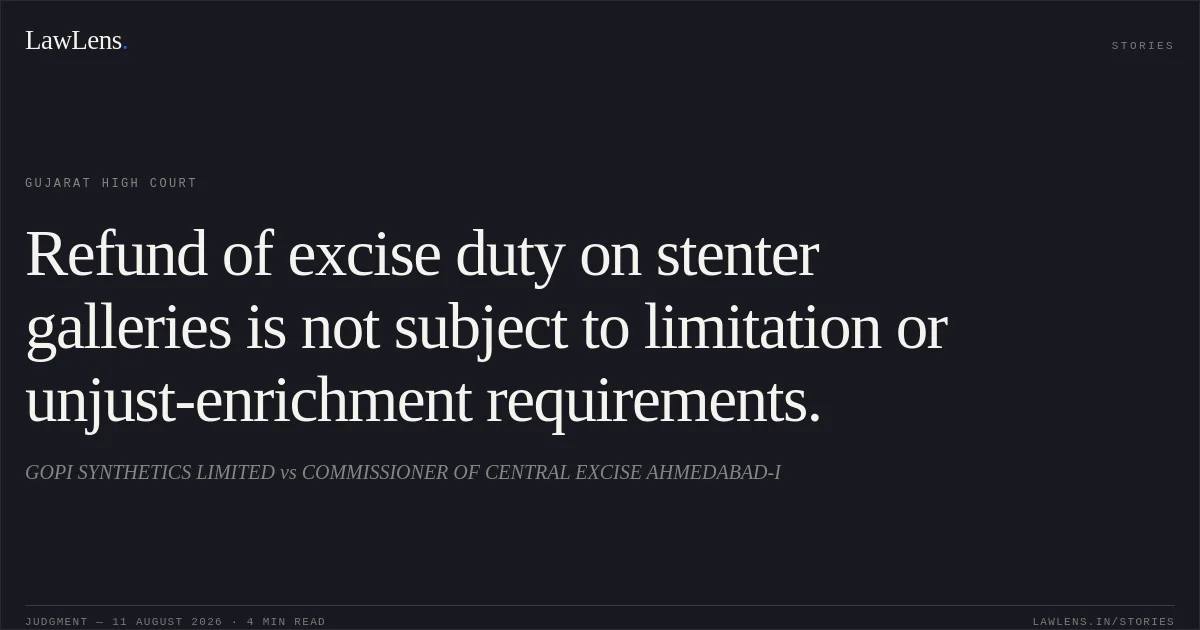
Source reference: pp.14–16The Court also held that where duty was collected without authority of law on account of the erroneous inclusion of galleries, the statutory limitation and unjust-enrichment requirements under Sections 11B and 12B would not defeat restitution.
Source reference: pp.17–20The Tribunal’s reliance on Rule 233B and the principle of unjust enrichment was therefore held inapplicable in the circumstances recorded by the Commissioner (Appeals).
Source reference: pp.5–7, 16–20Reasoning
The Court found that the legal position regarding exclusion of gallery portions from APC had been settled by Sangam Processors, and that the Commissioner (Appeals) had recorded a factual finding that duty had been collected on the galleries pursuant to an incorrect interpretation of the 1998 Rules.
Source reference: pp.10–12, 16–17Applying Premraj Dyeing, the Court held that the APC communication was not an appealable order because the Rules prescribed an administrative determination without a hearing or statutory appeal.
Source reference: pp.12–16Therefore, the appellants’ failure to challenge the APC determination did not attract the rule in Flock (India).
Source reference: no citationThe Court further held that the Tribunal erred in applying unjust enrichment under Mafatlal Industries, since the levy on the gallery portions had been treated as without authority of law and the Commissioner (Appeals)’s finding on that issue had not been displaced by the Tribunal.
Source reference: pp.17–20The Court consequently considered it appropriate to require a fresh determination of APC excluding the galleries, followed by computation of the correct duty and processing of the refund claims.
Source reference: pp.20–21Holding
The Court held that non-challenge to the APC determination could not by itself justify rejection of the refund claims, since the determination was not appealable.
It declined to answer Issues 1 and 2 concerning the Tribunal’s jurisdiction and limitation in relation to the rectification applications.
Source reference: para. 15The impugned Tribunal orders were quashed and the order of the Commissioner (Appeals) was restored.
Source reference: no citationThe Commissioner was directed to redetermine the appellants’ APC after excluding the gallery portions of the stenter machines, determine the correct duty liability, and process the refund claims accordingly.
Source reference: paras. 16–17Pursuant to the appellants’ statement, no interest would be payable up to the date of determination and processing of the refund claim.
Source reference: paras. 16–17The Tax Appeals were formally dismissed.
Source reference: para. 18Acts & Sections Cited
5 provisions across 2 statutes referred to in this judgment. Each provision opens on LawLens.
Central Excise Act, 19443
Indian Contract Act, 18722
Original Court PDF
GOPI SYNTHETICS LIMITEDvsCOMMISSIONER OF CENTRAL EXCISE AHMEDABAD-I
Click to open original judgment
Original judgment, available to read, download and summarize on LawLens.in