Facts
An FIR dated 12 June 2007 was registered under five case-crime numbers alleging that the applicant had obtained three arms licences, although the applicable policy allegedly permitted an individual to possess only two firearms, and that he possessed ammunition in excess of the permissible limit.
Source reference: para. 3The applicant was being tried for offences under Sections 25, 27 and 30 of the Arms Act.
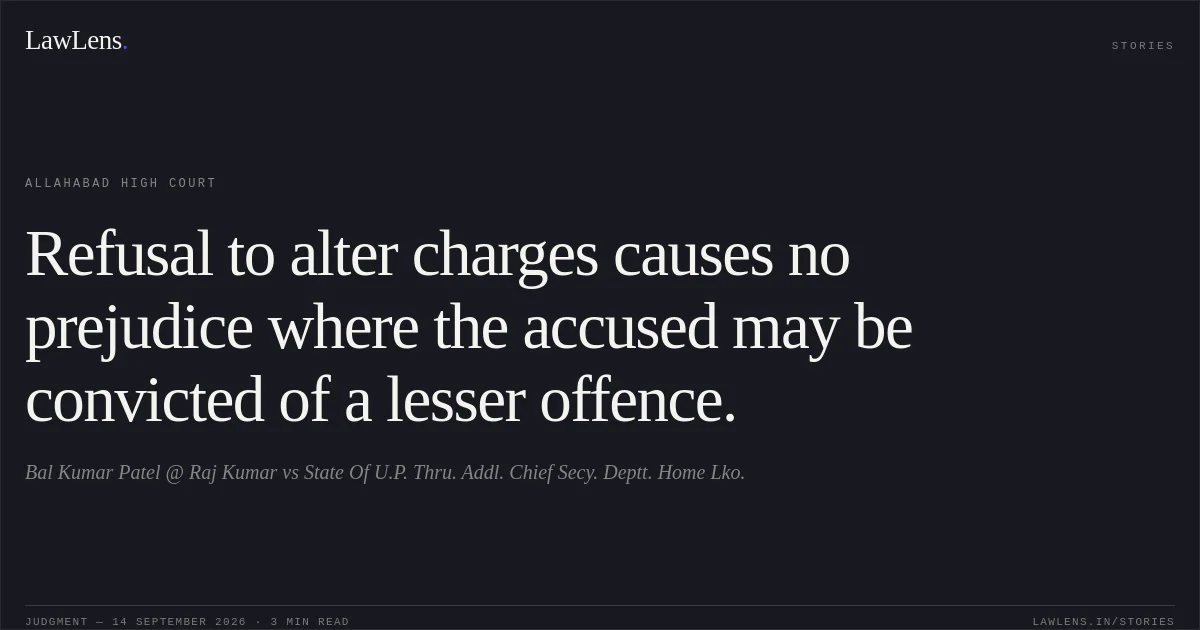
Source reference: para. 12At the stage of final submissions, he moved an application under Section 216 Cr.P.C., seeking deletion of those charges and alteration of the charge to an offence under Section 19 of the Arms Act, contending that the prosecution evidence did not establish the graver offences.
Source reference: para. 4The trial court rejected the application, observing that obtaining three licences was illegal, that subsequent surrender of one firearm did not cure the illegality, and that the alleged recovery of excessive ammunition constituted a serious matter.
Source reference: para. 5The applicant challenged that order under Section 482 Cr.P.C./Section 528 BNSS, asserting that the three licences had been obtained before the policy was amended in 2019 and that he had thereafter surrendered one firearm.
Source reference: para. 6Issues
Whether the trial court erred in rejecting the applicant’s application under Section 216 Cr.P.C. for alteration of charges from Sections 25, 27 and 30 of the Arms Act to Section 19 read with Section 25 of the Arms Act.
Source reference: paras. 2, 4, 12Whether the rejection of the alteration application occasioned prejudice or failure of justice warranting exercise of the High Court’s inherent jurisdiction under Section 482 Cr.P.C./Section 528 BNSS.
Source reference: para. 12Whether the trial court could ultimately convict the applicant for a lesser or different offence disclosed by the evidence, even if that offence had not been specifically charged.
Source reference: paras. 7–12Law Applied
The Court applied Sections 221(1) and 221(2) Cr.P.C., which permit alternative or multiple charges where the precise offence disclosed by the facts is doubtful and permit conviction for another offence proved by the evidence in such circumstances.
Source reference: para. 9It also applied Section 464 Cr.P.C., under which omission, error or irregularity in framing a charge does not invalidate a finding or sentence unless it has occasioned a failure of justice.
Source reference: para. 9Relying on Dinesh Seth v. State (NCT of Delhi), (2008) 14 SCC 94, and Paranagouda v. State of Karnataka, (2024) 18 SCC 793, the Court reiterated that an accused may be convicted for a lesser offence established by the evidence despite the absence of a separate charge, provided no prejudice or failure of justice is caused.
Source reference: paras. 10–11The Court further recognised that an offence under Section 19 read with Section 25 of the Arms Act carries a substantially lesser maximum punishment than the offences under Sections 25, 27 and 30 of the Arms Act.
Source reference: para. 12Reasoning
The Court held that even if the applicant’s contention were accepted—that the evidence established only an offence under Section 19 read with Section 25 of the Arms Act—the trial court could convict him for that lesser offence without formally altering the charge, because the same evidence would be relevant and no additional evidence would be required.
Source reference: para. 12Consequently, refusal to alter the charge did not prejudice the applicant or occasion a failure of justice within the meaning of Section 464 Cr.P.C.
Source reference: para. 12The Court also clarified that the trial court’s observations concerning the alleged illegality of holding three arms licences and the effect of surrendering one firearm were made only while deciding the Section 216 application and could not prejudge the merits of the trial.
Source reference: paras. 5–6, 13Holding
The High Court declined to interfere with the order rejecting the application under Section 216 Cr.P.C. and disposed of the petition.
It directed the trial court to decide the case on its merits, including the applicant’s contention that the evidence did not establish offences under Sections 25, 27 and 30 of the Arms Act but only an offence under Section 19, without being influenced by the observations in the impugned order, which were confined to the determination of the charge-alteration application.
Source reference: para. 13Acts & Sections Cited
10 provisions across 3 statutes referred to in this judgment. Each provision opens on LawLens.
Bharatiya Nagarik Suraksha Sanhita, 20231
Code of Criminal Procedure, 19735
Arms Act, 19594
Original Court PDF
Bal Kumar Patel @ Raj KumarvsState Of U.P. Thru. Addl. Chief Secy. Deptt. Home Lko.
Click to open original judgment
Original judgment, available to read, download and summarize on LawLens.in