Facts
Rajo Devi owned the suit land. Bullu Ram, claiming to be her sole legal heir under a registered Will dated 21 June 1990, filed a suit seeking declaration that a General Power of Attorney executed by Rajo Devi in favour of defendant No. 1, the sale deed executed by defendant No. 1 in favour of defendant No. 2 on 3 October 1990, and the subsequent sale deed in favour of defendants No. 4 to 7 dated 20 March 1992 were fraudulent, void and ineffective against him. He also sought injunction and consequential reliefs.
Source reference: para. 2–3The defendants maintained that Rajo Devi had validly executed the General Power of Attorney, that defendant No. 1 had sold the land to defendant No. 2 for ₹20,000, and that defendants No. 4 to 7 had subsequently purchased it for ₹34,500. The Trial Court held that Bullu Ram had proved his Will but that Rajo Devi had subsequently executed a Will dated 26 September 1990 in favour of defendant No. 1. It upheld the General Power of Attorney and the subsequent sale transactions and dismissed the suit.
Source reference: para. 4–11The First Appellate Court reversed the Trial Court, holding that the General Power of Attorney had been procured by fraud, that it authorised only management and not sale, and that the Will in favour of defendant No. 1 was surrounded by suspicious circumstances. The purchasers thereafter filed the present regular second appeal, which was admitted on three substantial questions of law.
Source reference: para. 12–13Issues
Whether the plaintiff, as the legal representative of Rajo Devi, was entitled to challenge the validity of the registered General Power of Attorney on the ground of fraud or misrepresentation?
Source reference: para. 13, Substantial Question No. 1Whether the First Appellate Court erred in holding that the General Power of Attorney authorised only prudent management of the property and did not authorise its sale, despite the registered document and its contents?
Source reference: para. 13, Substantial Question No. 2Whether the First Appellate Court erred in rejecting the Will dated 26 September 1990 in favour of defendant No. 1 on the basis of allegedly suspicious circumstances?
Source reference: para. 13, Substantial Question No. 3Whether the absence of proof that the sale consideration was directly paid to Rajo Devi invalidated the sale deed executed by her attorney?
Source reference: para. 59–60Law Applied
The Court applied the principles under Sections 19 and 19A of the Indian Contract Act, 1872, holding that a contract procured by fraud, misrepresentation or undue influence may be avoided by the legal representatives of the affected party, unless the right was lost by acquiescence. Section 27 of the Specific Relief Act, 1963 permits any person interested, including an heir or legal representative, to seek rescission or setting aside of an instrument.
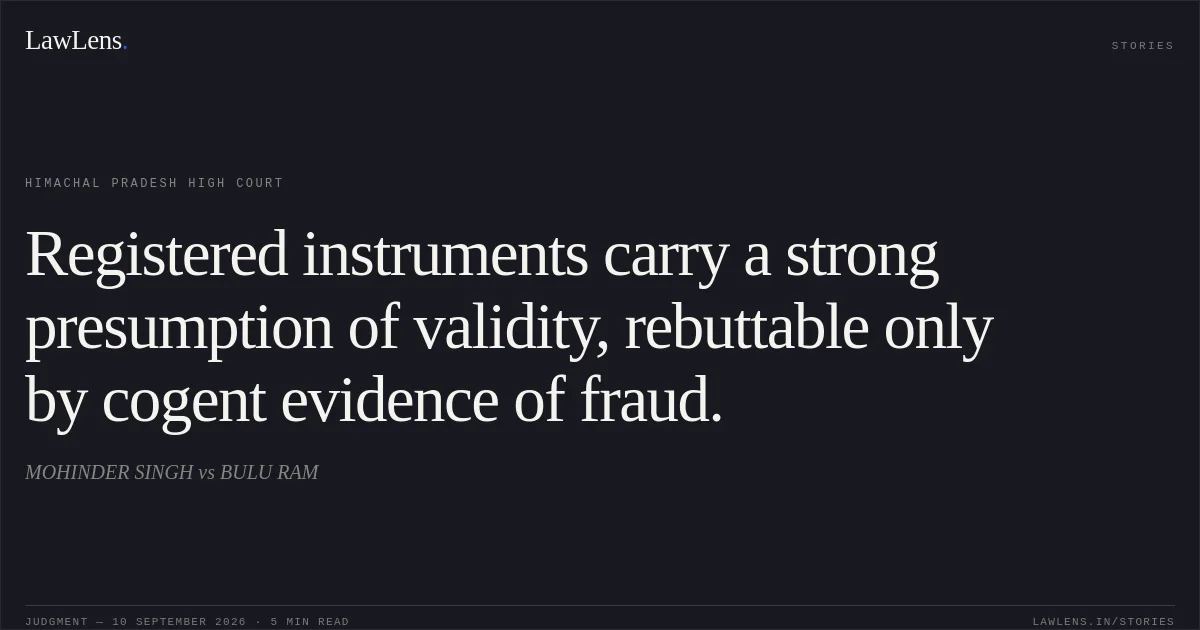
Source reference: para. 20–24However, a registered document carries a presumption of valid execution and genuineness under Section 60(2) of the Registration Act, 1908; the person alleging fraud bears the burden of rebutting that presumption with cogent evidence. Fraud cannot be established by suspicion or conjecture and must be proved by substantial and convincing evidence.
Source reference: para. 28–39A Will must satisfy Section 63 of the Indian Succession Act, 1925 and Section 68 of the Evidence Act, 1872; where suspicious circumstances are specifically established, the propounder must dispel them and satisfy the judicial conscience.
Source reference: para. 40–42Suspicious circumstances cannot ordinarily be introduced for the first time at the appellate stage without appropriate pleading and proof.
Source reference: para. 44Under Section 96 and Order XLI Rule 31 CPC, a first appellate court must independently consider the facts and law, frame points for determination, and give reasons while reversing the Trial Court.
Source reference: para. 53–57Non-payment of consideration at the precise time of execution does not, by itself, invalidate a sale deed, particularly where payment is acknowledged in the instrument.
Source reference: para. 59Reasoning
The Court held that Bullu Ram, as Rajo Devi’s legal representative and a person interested in the transaction, was legally competent to challenge the General Power of Attorney. However, he failed to discharge the heavy burden of proving fraud or misrepresentation.
Source reference: para. 25–27His own admission that he was unaware of the execution of the General Power of Attorney contradicted his pleaded assertion that its contents had not been explained to Rajo Devi; he was not present when it was executed and therefore could not give direct evidence about the alleged fraud.
Source reference: para. 25–27The registered nature of the document attracted the statutory presumption of due execution and explanation of its contents, and the evidence led by the plaintiff was insufficient to rebut that presumption.
Source reference: para. 28–39The Court further found no evidentiary basis for the First Appellate Court’s conclusion that the Power of Attorney was restricted to management and did not authorise sale.
Source reference: para. 39With respect to the Will in favour of defendant No. 1, the Court held that its execution had been duly proved through the attesting witness.
Source reference: para. 43–52The alleged suspicious circumstances—such as the witness’s connection with the subsequent purchasers, his alleged hostility towards Bullu Ram, and the unequal dispositions—were either not properly pleaded, not established in cross-examination, or adequately explained by the fact that Rajo Devi had already gifted 28 kanals to Bullu Ram and intended the Will to equalise the benefits received by her two sons.
Source reference: para. 43–52The First Appellate Court therefore erred in reversing the Trial Court without properly engaging with its reasoning and the evidence on record.
Source reference: para. 53–58The absence of proof that consideration was personally paid to Rajo Devi did not invalidate the sale, particularly because defendant No. 1, acting under the General Power of Attorney, acknowledged receipt of the consideration.
Source reference: para. 59Holding
The High Court allowed the regular second appeal. It held that the plaintiff was competent to challenge the General Power of Attorney but failed to prove fraud, misrepresentation, want of authority, or any other legal infirmity in the document.
The Will dated 26 September 1990 in favour of defendant No. 1 was duly proved and was not shown to be surrounded by legally established suspicious circumstances. The sale transactions executed pursuant to the General Power of Attorney were therefore valid, and non-payment of consideration directly to Rajo Devi did not invalidate them.
Source reference: para. 39, 52, 58–60The judgment and decree of the First Appellate Court dated 25 September 2008 were set aside, and the Trial Court’s judgment and decree dismissing the suit dated 19 February 2001 were restored.
Source reference: para. 60Acts & Sections Cited
12 provisions across 5 statutes referred to in this judgment. Each provision opens on LawLens.
Indian Contract Act, 18725
Specific Relief Act, 19631
Registration Act, 19083
Indian Succession Act, 19251
Code of Civil Procedure, 19082
Original Court PDF
MOHINDER SINGHvsBULU RAM
Click to open original judgment
Original judgment, available to read, download and summarize on LawLens.in