Facts
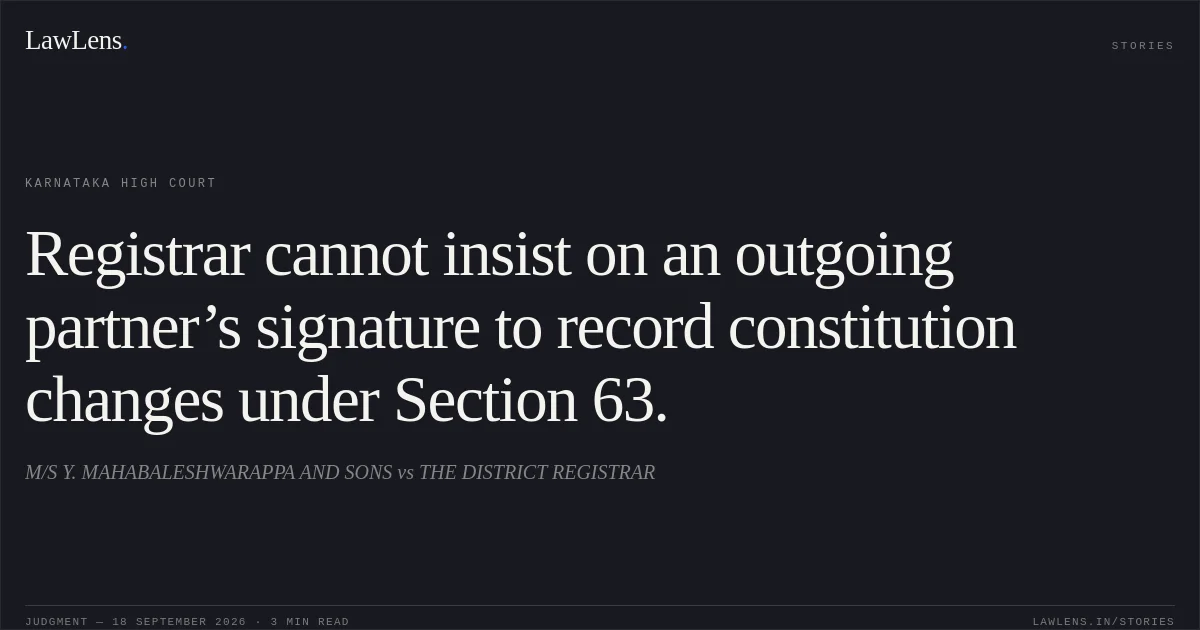
The petitioner, a registered partnership firm engaged in mining, was reconstituted under a deed dated 26 November 2025. Mr. Y. Harish, Ms. Jyothi and Ms. Ria continued as partners, while Mr. Y. Satish ceased to be a partner following disputes and settlement proceedings between the parties.
Source reference: paras. 2–4The petitioner submitted the requisite documents and Form-V to the District Registrar for recording the change in the constitution of the firm under Section 63 of the Indian Partnership Act, 1932.
Source reference: paras. 5–7The Registrar had earlier declined to act because the outgoing partner had not signed the reconstitution deed; the petitioner successfully challenged that decision in W.P. No. 101299 of 2026, pursuant to which the Registrar was directed to consider the application in accordance with law.
Source reference: para. 6After a subsequent change arising from the death of an erstwhile partner, the petitioner again submitted Form-V dated 12 June 2026. By letter dated 15 June 2026, the Registrar again refused to proceed unless Mr. Y. Satish’s signature was obtained on the reconstituted deed.
Source reference: paras. 7–10Issues
Whether the Registrar was justified in refusing to record the change in the constitution of the registered firm solely because the outgoing partner had not signed the reconstituted partnership deed?
Source reference: para. 17Whether Section 63 of the Indian Partnership Act, 1932 permits the Registrar to insist upon the consent or signature of the outgoing partner as a condition for recording the notified change?
Source reference: paras. 18–24, 29–32Law Applied
The Court applied Section 63(1) of the Indian Partnership Act, 1932, which provides that, when a change occurs in the constitution of a registered firm, “any incoming, continuing or outgoing partner” may give notice of the change to the Registrar, who “shall make a record of the notice” in the Register of Firms.
Source reference: para. 18The provision does not require notice to be given by all partners or mandate the signature or consent of the outgoing partner.
Source reference: paras. 19–24The Karnataka Partnership Rules, 1954 govern the prescribed procedural requirements, but do not authorise the Registrar to impose an additional condition not found in the Act or Rules.
Source reference: paras. 29, 33The Registrar’s statutory role is ministerial and limited to recording the notified change; it does not include adjudicating the validity, enforceability or binding nature of the reconstitution deed or disputed inter se rights of the partners.
Source reference: paras. 25–28, 34–36Reasoning
The Court held that the statutory language of Section 63 deliberately permits any incoming, continuing or outgoing partner to notify a change, and does not require concurrence or signatures from all partners.
Source reference: paras. 19–22Requiring the outgoing partner’s signature would effectively confer a veto upon that partner and would add a condition absent from the statutory scheme.
Source reference: paras. 22, 30–32The Registrar had wrongly conflated recording a notice of change with adjudicating whether the reconstitution was legally valid or binding upon the outgoing partner.
Source reference: paras. 25–28Any challenge by Mr. Y. Satish regarding lack of consent, authority or enforceability of the reconstitution deed could be pursued before the competent forum, but the possibility of such a dispute could not justify refusal to perform the statutory recording function.
Source reference: paras. 35–39Since the impugned communication relied solely on the absence of the outgoing partner’s signature and identified no other statutory deficiency, it was legally unsustainable.
Source reference: paras. 34, 39Holding
The writ petition was allowed. The Registrar’s letter dated 15 June 2026 was quashed and set aside.
The Registrar was directed to reconsider Form-V dated 12 June 2026 and not to insist upon the signature or consent of the outgoing partner as a condition precedent to recording the change.
Source reference: order clauses (iii)–(iv)If the petitioner had otherwise complied with the Indian Partnership Act, 1932 and the Karnataka Partnership Rules, 1954, the Registrar was directed to record the change in the Register of Firms within four weeks of receiving the certified order.
Source reference: order clauses (v)–(vi)The Court clarified that such recording would not amount to adjudication of the validity or enforceability of the reconstitution deed and would not prevent any party from pursuing appropriate proceedings before the competent forum.
Source reference: order clauses (vii)–(viii)Acts & Sections Cited
2 provisions across 1 statute referred to in this judgment. Each provision opens on LawLens.
Indian Partnership Act, 19322
Original Court PDF
M/S Y. MAHABALESHWARAPPA AND SONSvsTHE DISTRICT REGISTRAR
Click to open original judgment
Original judgment, available to read, download and summarize on LawLens.in