Facts
The petitioner claimed title to lands in Survey Nos. 95/2A and 33/1 through a registered Will executed in 1965 by Rathinammal, who had purchased the lands under sale deeds registered in 1944 and 1948.
Source reference: pp. 3–6He presented a settlement deed in favour of his son, but the Sub-Registrar returned it by a refusal check slip, citing discrepancies in the property records and the absence of a patta in the petitioner’s name.
Source reference: pp. 3–6The Tahsildar had previously rejected the petitioner’s patta application, and that decision was under appeal.
Source reference: p. 7Respondents 3–7 claimed interests in the lands through separate transactions and relied on patta entries in their favour.
Source reference: pp. 8–11The petitioner challenged the refusal check slip under Article 226.
Source reference: pp. 1–2Issues
Whether the Sub-Registrar could refuse registration on the basis that the petitioner lacked a patta in his name.
Source reference: pp. 11–12, 15Whether the petitioner’s claimed title and the competing claims could be determined in the writ proceedings so as to direct registration of the settlement deed.
Source reference: pp. 13–17Law Applied
Under the Tamil Nadu Patta Pass Book Act, 1983, a patta is not a mandatory prerequisite to registration.
Source reference: p. 15Relying on the Division Bench decision in N. Ramayee v. The Sub Registrar, Salem and Another, W.P. No. 674 of 2020, the Court stated that a registering officer generally cannot determine title and has no power to refuse registration except as authorised by the applicable statutory provisions, including Section 22-A of the Registration Act; the registration process serves to give public notice of transactions.
Source reference: p. 15The Court also relied on Anitha v. Axelin Thiraviyam and Others, W.A.(MD) No. 3205 of 2025, in identifying civil proceedings as the appropriate forum to seek declarations concerning the validity of competing documents.
Source reference: p. 17Reasoning
The refusal was based on the petitioner’s lack of patta, although the Court noted that patta is not, by itself, a mandatory condition for registration.
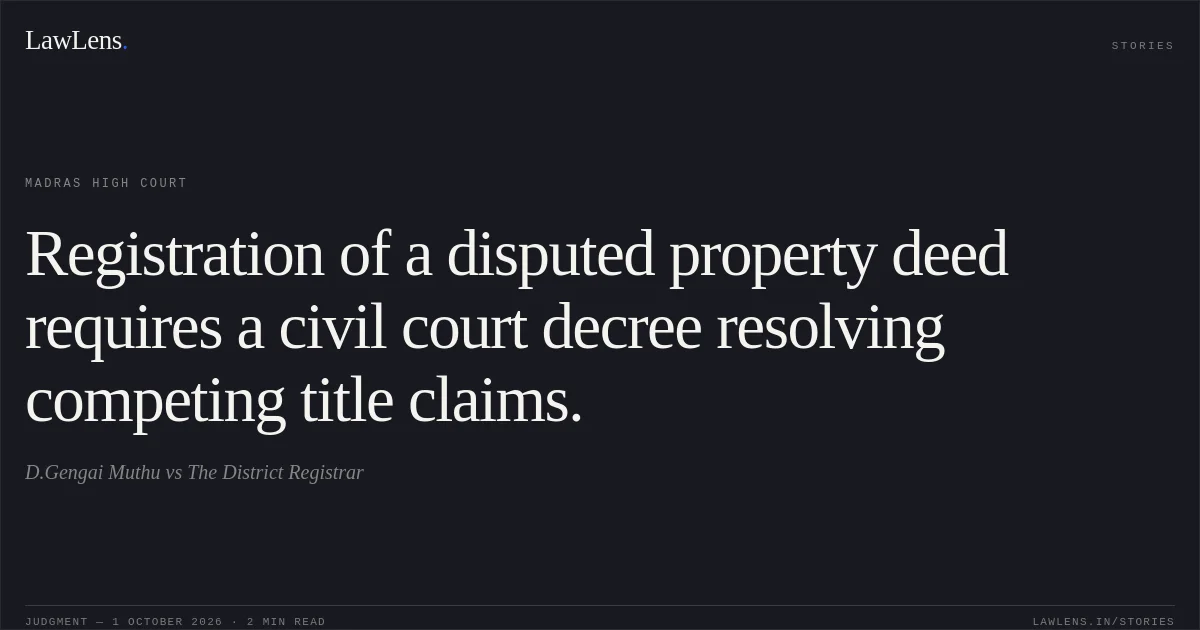
Source reference: pp. 14–15The parties traced their claims to competing transactions, and the records disclosed conflicting pattas, registrations, and assertions of possession. The Court considered that conflict a title dispute which could not be conclusively resolved in writ proceedings; the parties’ respective title and possession claims required determination by a competent civil court.
Source reference: pp. 14–17Accordingly, it left those disputes open and made registration conditional on obtaining an appropriate civil-court decree.
Source reference: p. 17Holding
The writ petition was disposed of.
The Court directed the Sub-Registrar to register the settlement deed only after the petitioner or the private respondents, as the case may be, obtained an appropriate decree from the competent civil court.
Source reference: p. 17The parties were left to pursue their remedies there, including seeking declarations concerning the identified documents; no costs were awarded.
Source reference: p. 17Acts & Sections Cited
3 provisions across 1 statute referred to in this judgment. Each provision opens on LawLens.
Tamil Nadu Patta Pass Book Act, 1983.3
Original Court PDF
D.Gengai MuthuvsThe District Registrar
Click to open original judgment
Original judgment, available to read, download and summarize on LawLens.in