Facts
The petitioner sought Letters of Administration with the Will annexed under Sections 232 and 276 of the Indian Succession Act, 1925, in respect of a registered Will dated 13.01.2011 executed by her maternal aunt, S. Saguntha Roja.
Source reference: para. 1The deceased was stated to have died a spinster and issueless on 21.06.2011, with the petitioner claiming to be her only surviving legal heir and beneficiary under the Will.
Source reference: para. 2Notice was issued to the Collector and citations were published, but no objection or caveat was received.
Source reference: para. 4The petitioner examined herself and Balaji as P.W.2 and produced the original Will and other documents.
Source reference: para. 5The Court subsequently directed clarification regarding the deceased’s other siblings, production of a legal-heirship certificate, and clarification of P.W.2’s relationship and status as an attesting witness; the petitioner did not furnish the required particulars or documents.
Source reference: para. 6Issues
Whether the petitioner established the due execution and attestation of the registered Will dated 13.01.2011 so as to obtain Letters of Administration with the Will annexed?
Source reference: paras. 7–12Whether the evidence of P.W.2 satisfactorily established that he was an attesting witness to the Will?
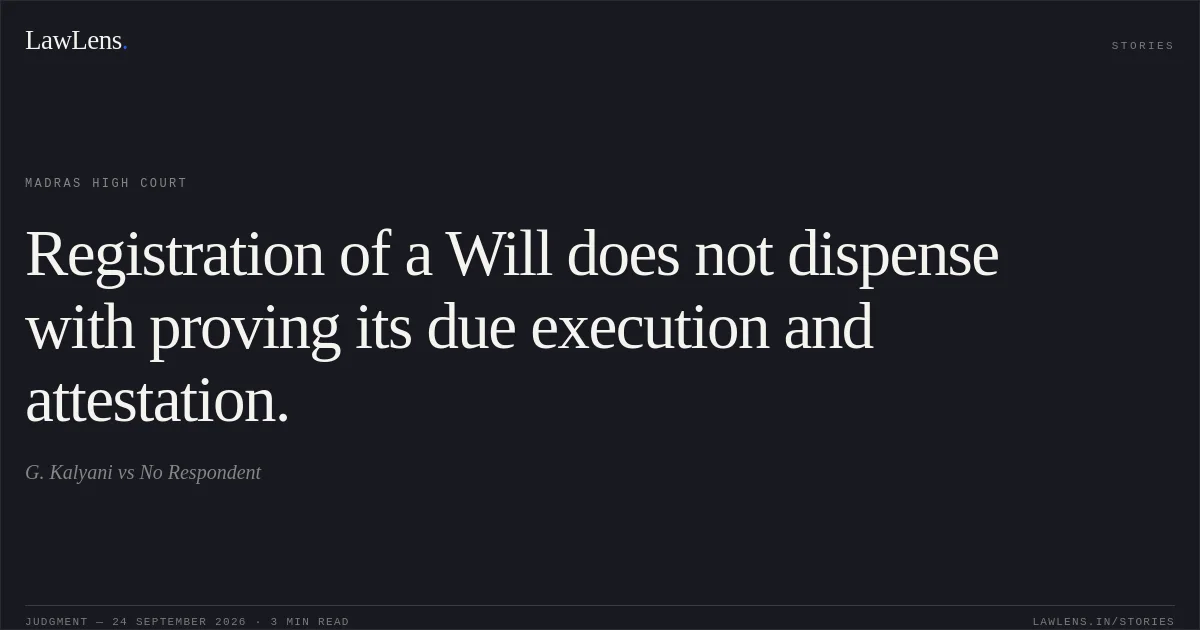
Source reference: paras. 7–11Whether registration of the Will, by itself, dispensed with the requirement of proving its due execution and attestation?
Source reference: para. 12Law Applied
The petition was filed under Sections 232 and 276 of the Indian Succession Act, 1925, which govern the grant of Letters of Administration with the Will annexed where no executor is appointed.
Source reference: para. 1A Will must be proved through evidence establishing its due execution and attestation in accordance with law; the requirement of proving attestation is not eliminated merely because the Will is registered.
Source reference: para. 12The applicable statutory framework includes Section 63(c) of the Indian Succession Act, 1925, concerning attestation of an unprivileged Will, and Section 68 of the Indian Evidence Act, 1872, requiring examination of an attesting witness where such witness is available.
Source reference: no citationThe identity and testimony of the attesting witness must correspond with the particulars appearing in the original Will.
Source reference: no citationReasoning
The Court found material inconsistencies between Ex.P1 and the testimony of P.W.2. Although the Will recorded that the testatrix affixed her left thumb impression due to her health condition, P.W.2 stated that she signed the Will in his presence.
Source reference: para. 7P.W.2 claimed to be the fourth attesting witness, whereas the fourth witness named in the Will was C. Mani; he also referred to “Rajasekar” as another attesting witness, although no such person appeared in Ex.P1.
Source reference: para. 8Further, the English translation identified the fifth attesting witness as “S. Shiva, son of Sadhanantham,” while P.W.2 was Balaji, son of Sadhanantham.
Source reference: para. 9The affidavit described as that of an attesting witness had been sworn by S. Rajeswari Sadhanandam, who was shown in the Will only as an identifying witness before the Sub-Registrar and was not examined in Court.
Source reference: para. 10In view of these discrepancies, the Court held that P.W.2’s status as an attesting witness was doubtful and that the Will had not been proved in accordance with law.
Source reference: para. 11Its registration could not cure the failure to establish due execution and attestation.
Source reference: paras. 11–12Holding
The Court answered the principal issues against the petitioner. It held that the due execution and attestation of the Will dated 13.01.2011 had not been satisfactorily proved and that registration of the Will did not dispense with that requirement.
Consequently, the petition for Letters of Administration with the Will annexed was dismissed, with no order as to costs.
Source reference: para. 13Acts & Sections Cited
2 provisions across 1 statute referred to in this judgment. Each provision opens on LawLens.
Indian Succession Act, 19252
Original Court PDF
G. KalyanivsNo Respondent
Click to open original judgment
Original judgment, available to read, download and summarize on LawLens.in